
Spain reached from the Atlantic side, where the ships call. The focus so far is Galicia and the Rías Baixas: Vilagarcía de Arousa, a working commercial port on the Ría de Arousa that most ships use as the back door to Santiago de Compostela — and a town that turns out to be worth the day on its own, with a fortified pazo, a convent whose nuns still sell almond cakes through a revolving hatch, and a 900-metre beach inside the town. Santiago de Compostela and A Coruña are covered separately. The articles here are written from days ashore rather than from a holiday: where the ship ties up, what is reachable on foot or by train, what the same route costs against the ship’s excursion, and how much buffer to keep before all-aboard. Prices and timetables carry the season in which they were checked, and the photographs were taken on the day described.
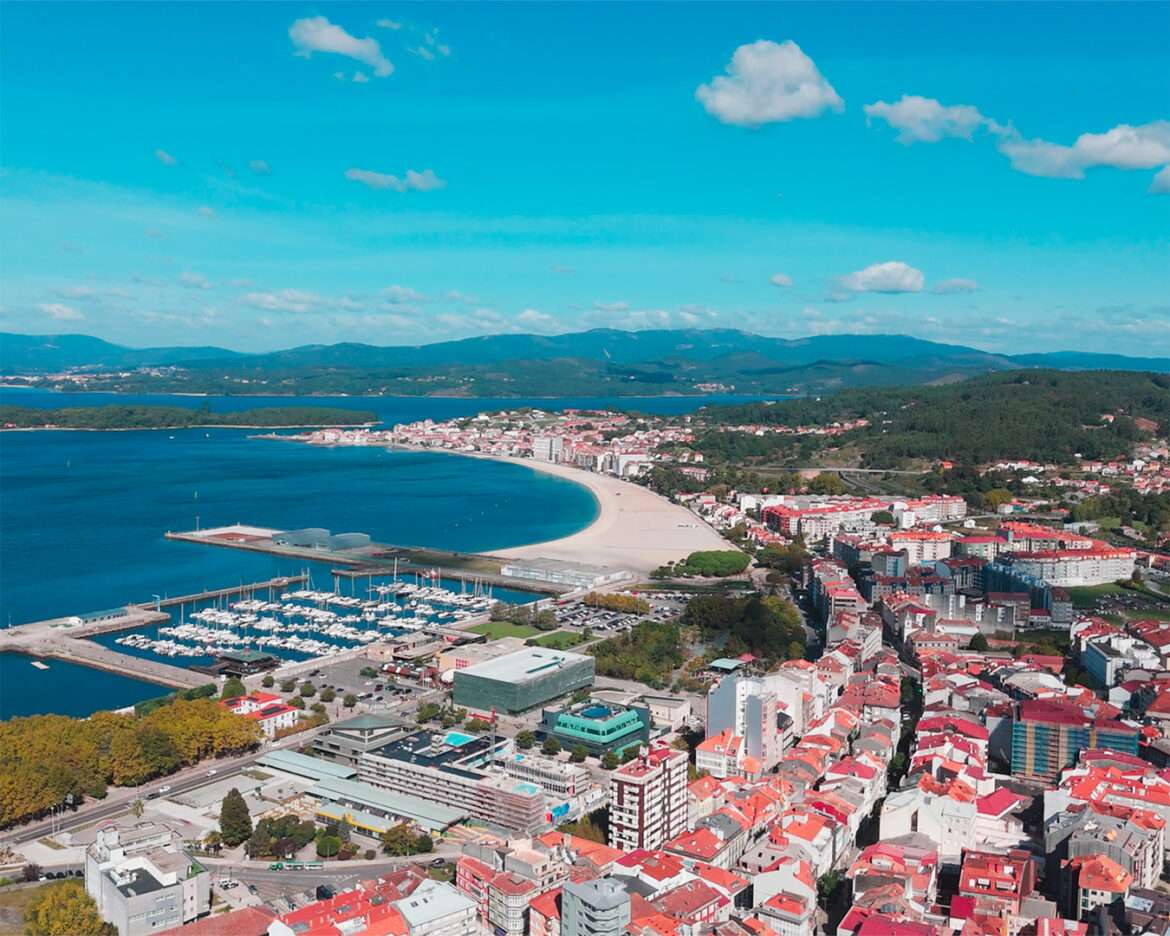
Visited: 8 October 2026, a Thursday, on a call of MS Amadea. A full day ashore; the photographs were taken that day.
Yes — Vilagarcía de Arousa is an easy port to do on your own, and the walk is shorter than the ship makes it sound. A free road train runs from the berth into town — irregularly, whatever the half-hourly timetable says — and the same 2 km can be walked in about twenty-five minutes on the flat. The old town, the fortified Vista Alegre complex and the town beach all sit within that radius. Santiago de Compostela is reachable too — 36 km by rail, from €4, with around eighteen direct trains a day — and the ship’s coach was €49. What it really costs is the day: boarding began at 07:00.
Where does the ship dock in Vilagarcía de Arousa?
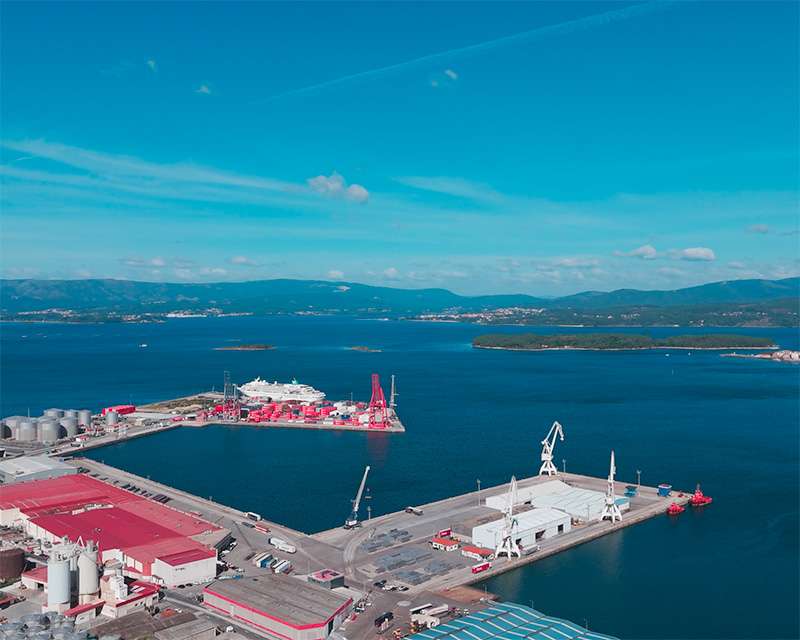
Vilagarcía has no dedicated cruise terminal. The Port Authority assigns one of several quays depending on the ship. O Ramal is the berth closest to the centre and is used by smaller ships; it sits practically inside the town’s street grid. Larger or deeper vessels go to the southern quays — Ferrazo, Comercial Norte, Comercial Oeste or Comboa — which carry a depth of up to 13 metres and are the ones that put you the full 2 km from the old town.
There is no tendering here. Ships lie alongside, you walk down the gangway onto concrete, and a visitor point staffed by Port Authority personnel stands at the foot of the quay with town maps. It is a cargo port with containers, cranes and timber stacks, so the first two hundred metres are industrial and the walk out follows a marked route rather than a promenade.
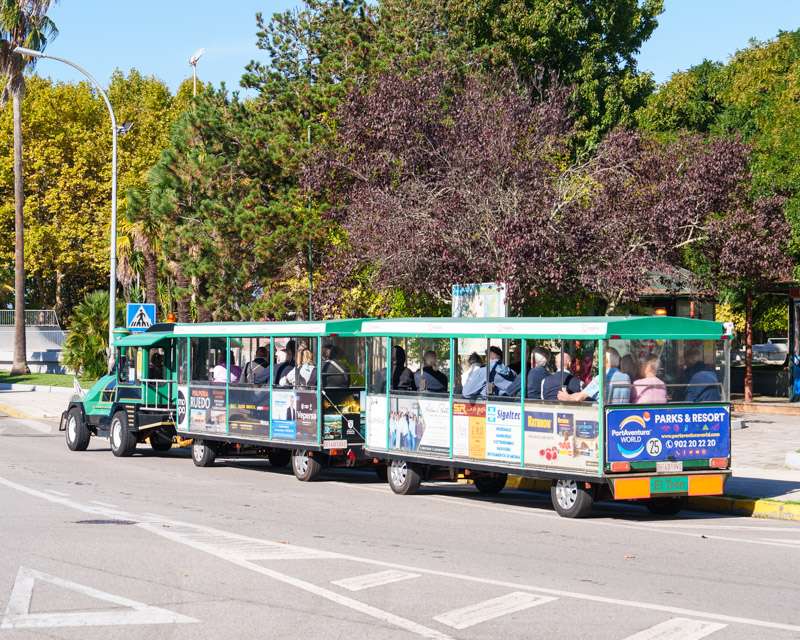
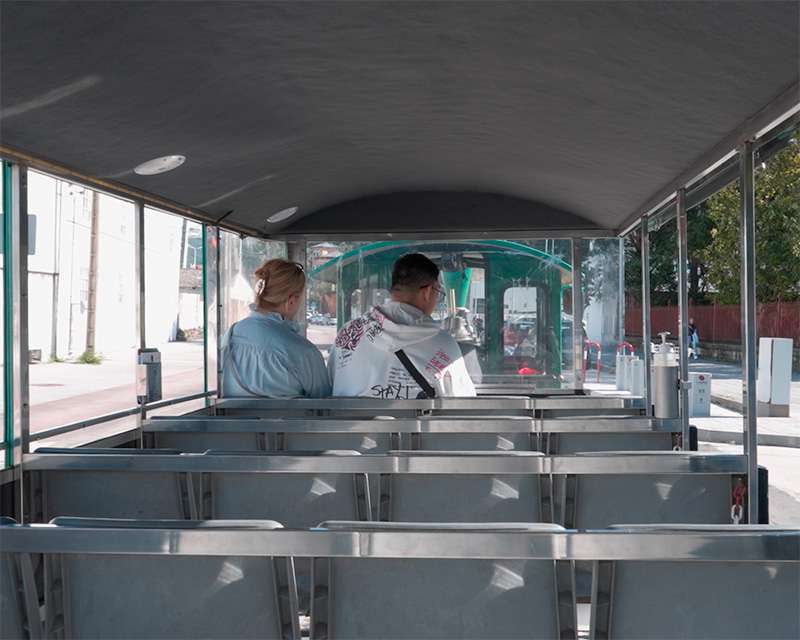
The road train between the quay and the centre, laid on free of charge by the town. It is advertised as running every thirty minutes. It did not: the intervals were irregular, and there was a midday break in the middle of them.
Can you walk from the cruise berth into Vilagarcía?
You can, and most people should. It is roughly 2 km from the southern quays to the pedestrian streets, flat the whole way, on pavement. Twenty-five minutes at an unhurried pace. The road train is useful if you have knees that object to concrete or if you want to save the legs for the climb to Vista Alegre. But treat it as a bonus rather than a timetable: it is advertised at every thirty minutes and ran nothing like it on our call, with a midday break in the middle. Ride it in if it is standing there, and plan to walk back. That is the honest version, and it costs you nothing here — nobody is stranded in Vilagarcía, which separates it from the ports where a missed shuttle costs you the morning.
Is Vilagarcía worth a day, or should you go to Santiago de Compostela?
This is the only question that matters in this port, and the honest answer depends on something the brochure will not tell you: what time the coaches leave.
On our call, the organised excursions to Santiago de Compostela began boarding at 07:00. That is a long day on a coach for a cathedral city you will share with every other ship in Galicia that week. Santiago is extraordinary and I am not talking anyone out of it — but go in knowing that the ship’s version costs you breakfast, the light, and any chance of seeing the town you actually docked in.
What the ship offered, and what it cost
Three excursions were on the programme for this call, all at the same price:
| Excursion | Length | Price 2026 |
|---|---|---|
| Combarro and Pontevedra | about 4 hours, over 2 hours of it on foot | €49 |
| Santiago de Compostela | about 6 hours, with a lunchbox | €49 |
| Walking a stretch of the pilgrim path into Santiago | about 6 hours; 4 km on a steep path, then the cathedral | €49 |
Read that list again and notice what is missing. Not one of the three stays in Vilagarcía. The ship sold three ways out of the town and no way into it — which is a fair description of how this port is treated generally, and the reason this page exists.
The Santiago coach is the one worth doing the arithmetic on. The programme allows about an hour each way, plus a 15-minute walk from the coach park to the Praza do Obradoiro, and it states plainly that all explanation of the cathedral and the surrounding houses is given outside — you go in on your own, in your free time. So €49 buys the transfer, the timing and the certainty of getting back. It does not buy a guided cathedral.
Against that, the train from the town station is from €4 one way, so roughly €8 return for the same city. The gap is real, and so is what the gap pays for: the ship waits for its own coaches and not for you.
The Combarro and Pontevedra tour is the harder one to replicate. Pontevedra is easy enough on your own — 21 km by rail, 14 to 16 minutes, from €4, on the same eighteen-trains-a-day line. Combarro is not: it is a village across the next ría with no station, which leaves a taxi and a negotiated wait. If Combarro is what you want, €49 is a reasonable price for the problem it solves.
The independent alternative is the train. Vilagarcía station sits in the town, not out on a bypass, and the line to Santiago has been running since 15 September 1873. It is 36 km by rail, around eighteen direct services a day, fares from €4, and a journey of roughly 21 to 48 minutes depending on whether you catch a Media Distancia stopper or a fast Alvia. By road it is 45 km, about forty minutes.
Two cautions before you treat that as a solved problem. Santiago’s station is below the old town and the walk up to the cathedral is longer and steeper than the map suggests. And a return train that is twenty minutes late is a different kind of twenty minutes when the gangway closes at a fixed hour. If your call is short, or if the all-aboard is early, the ship’s coach is the safer purchase — it is one of the few ports where I would say that plainly.
My own choice was to stay. I had the full day, and a town of 37,000 people that no guidebook covers properly is a better use of a camera than a cathedral that has been photographed ten million times. I do not regret it.
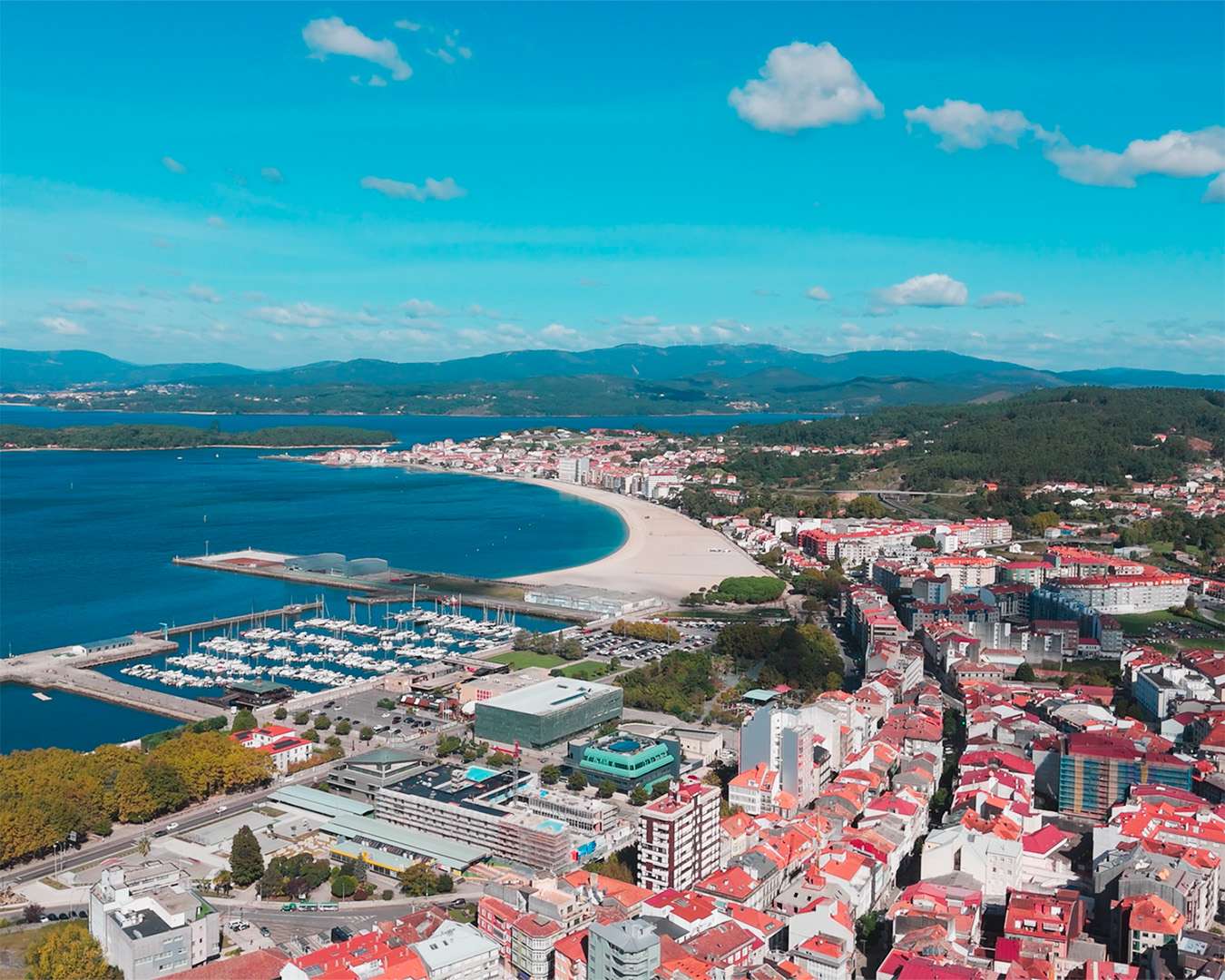
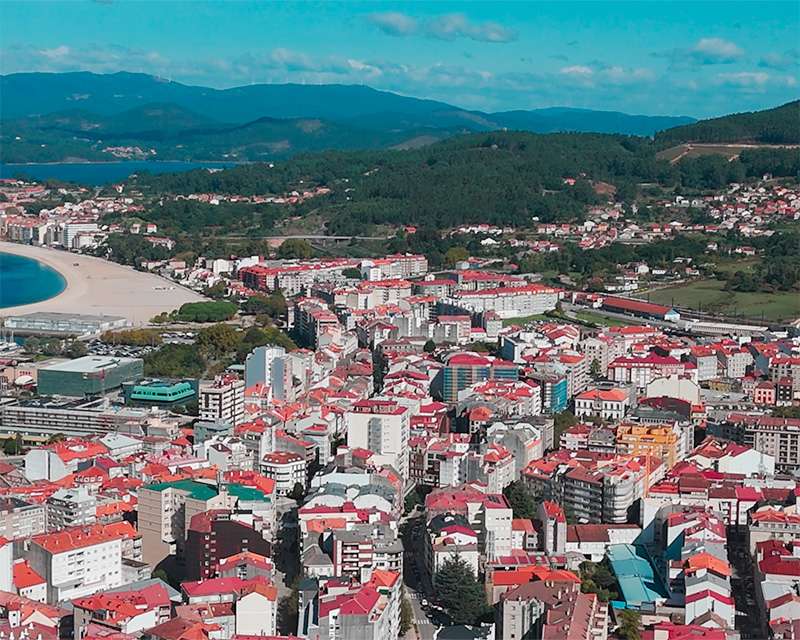
The whole decision in one frame: town, marina, the 900-metre town beach, and the Barbanza hills across the ría. None of it is more than half an hour on foot from the next thing.
What to see in Vilagarcía de Arousa in half a day
Walked in this order, the town takes between three and four hours including coffee. Everything below is within 1.5 km of everything else.
1. The seafront and the marina (20 minutes)
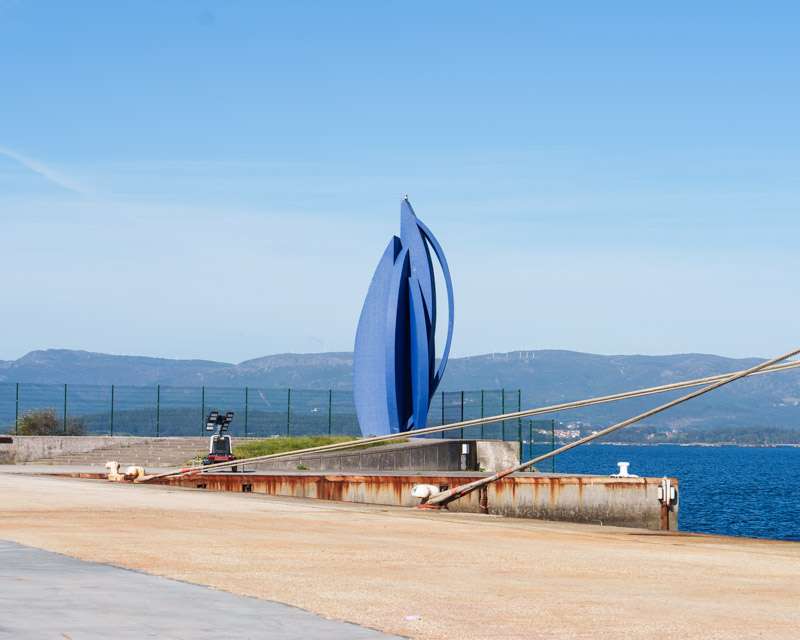
Come out of the port area and turn right along the water. The promenade runs north past the marina — close to five hundred berths — with a blue steel sculpture standing against the ría and the Barbanza hills behind it. The seaside walk continues 2 km to the old fishing village of Carril, which is where the clams come from and where the town eats on Sundays. If you have the whole day, that walk is the better use of an afternoon than anything indoors.
2. The old town and the clock column (45 minutes)
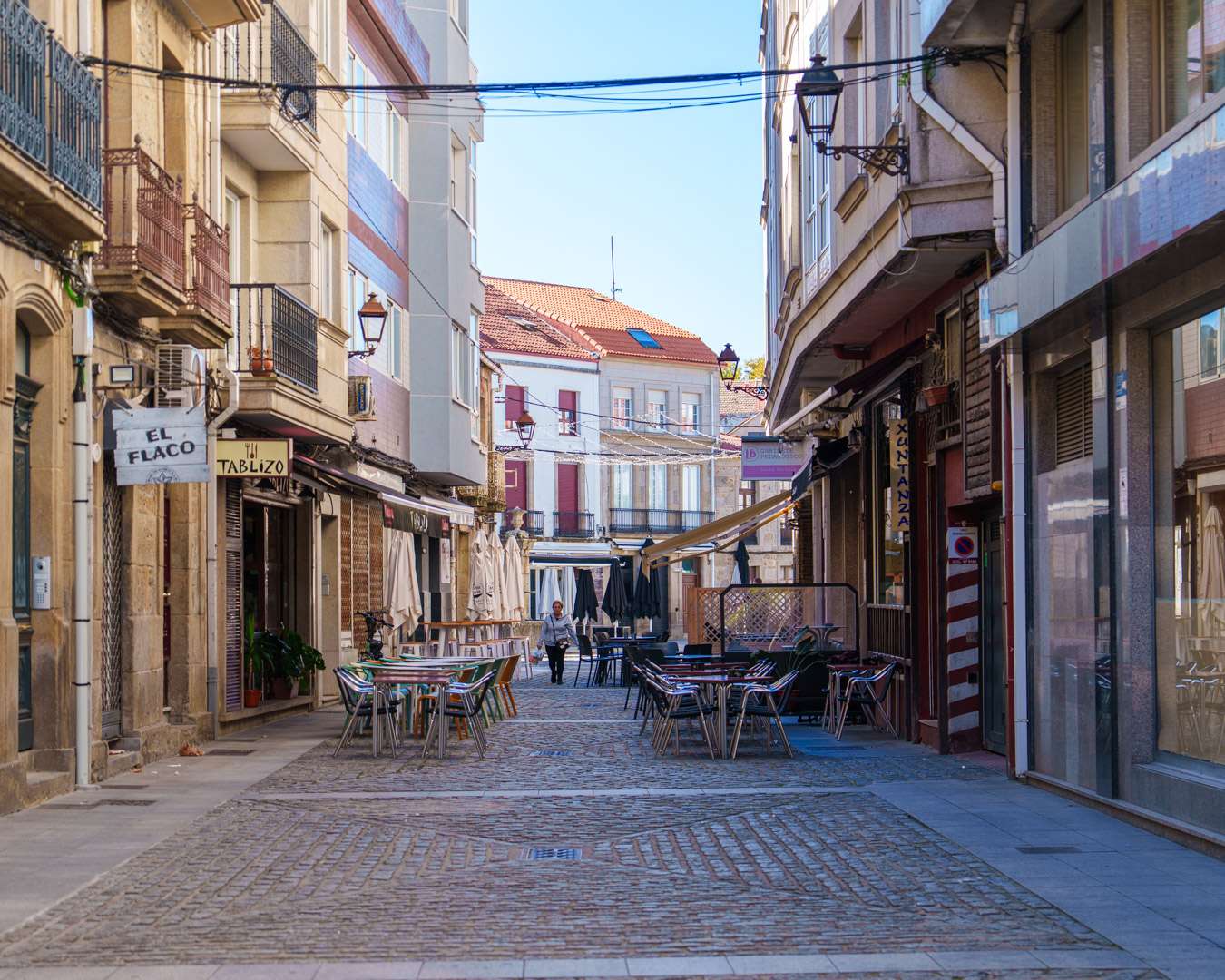
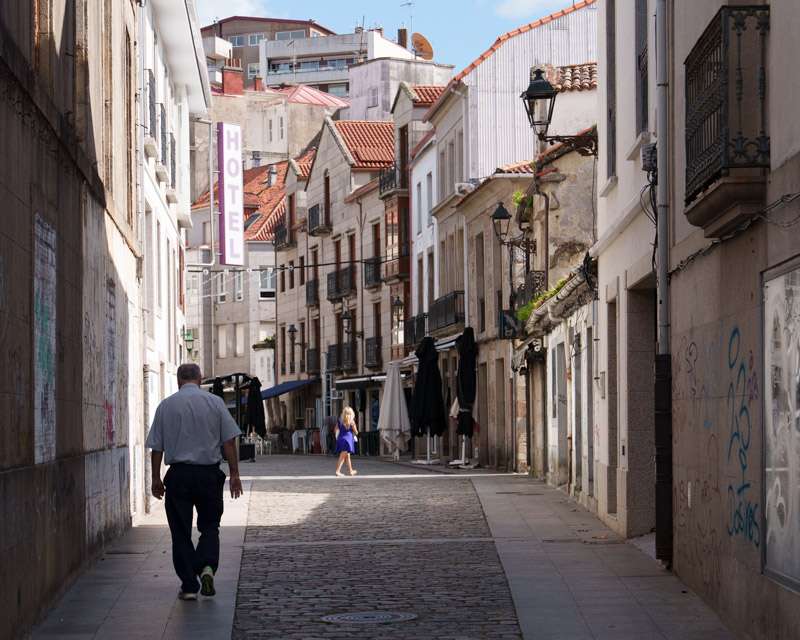
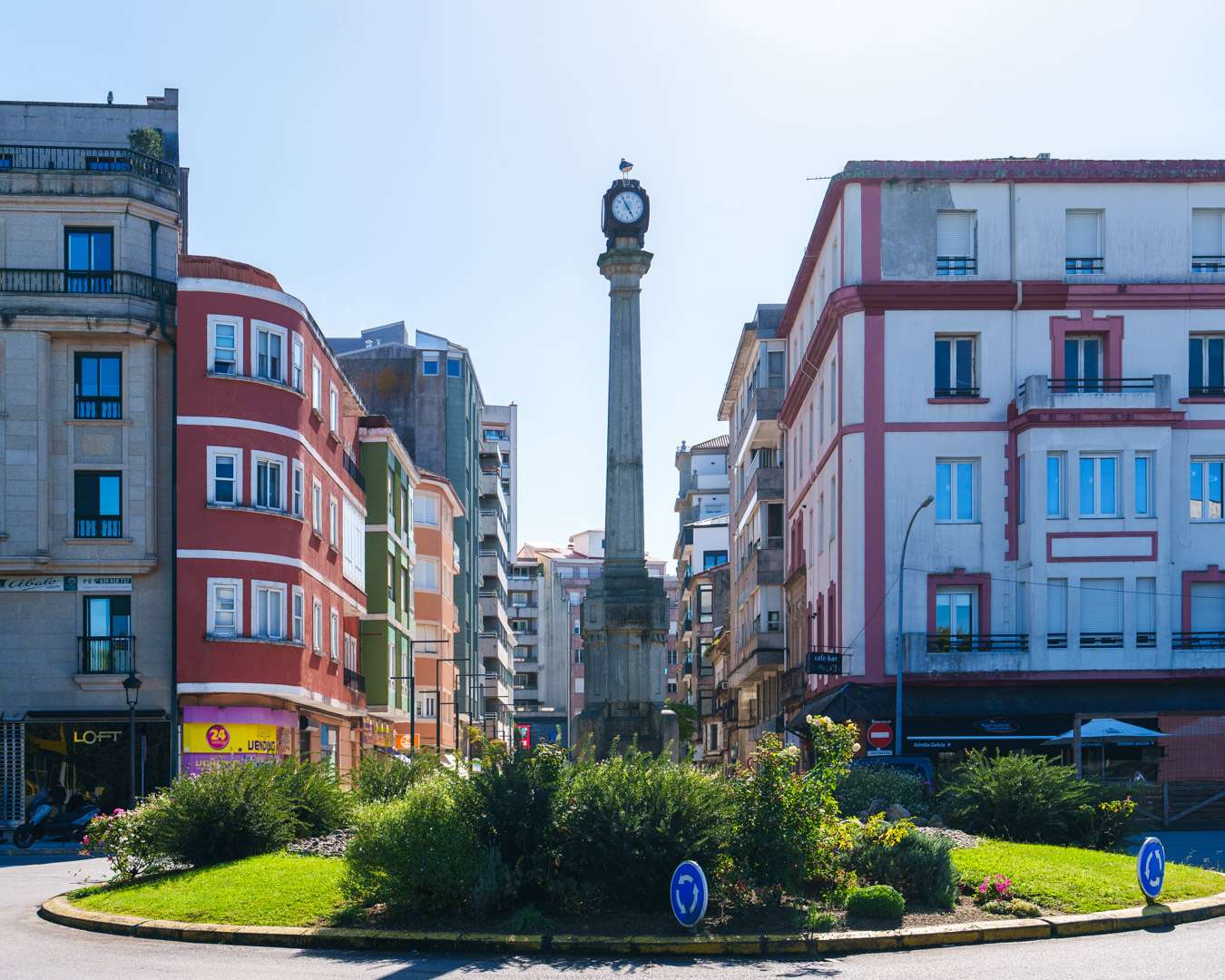
The centre is small, flat and pedestrianised in its core. Café terraces fill the cobbled lanes from mid-morning; the shops keep Galician hours, roughly 09:30 to 13:30 and again 16:30 to 20:00, which means a ship in port over lunchtime finds half the town shut. The street market runs on Tuesdays and Saturdays.
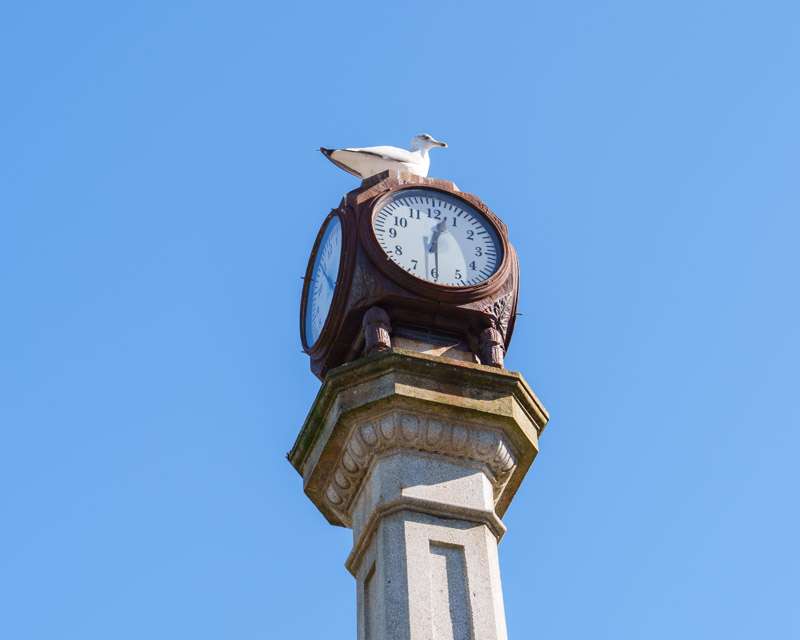
The landmark you will navigate by is a stone column carrying a clock, standing in a planted roundabout among painted four-storey buildings. It is not an important monument. It is simply the thing everyone meets at, and on the morning I was there a gull had claimed the top of it.
3. The Río Con and the fortified gate (15 minutes)
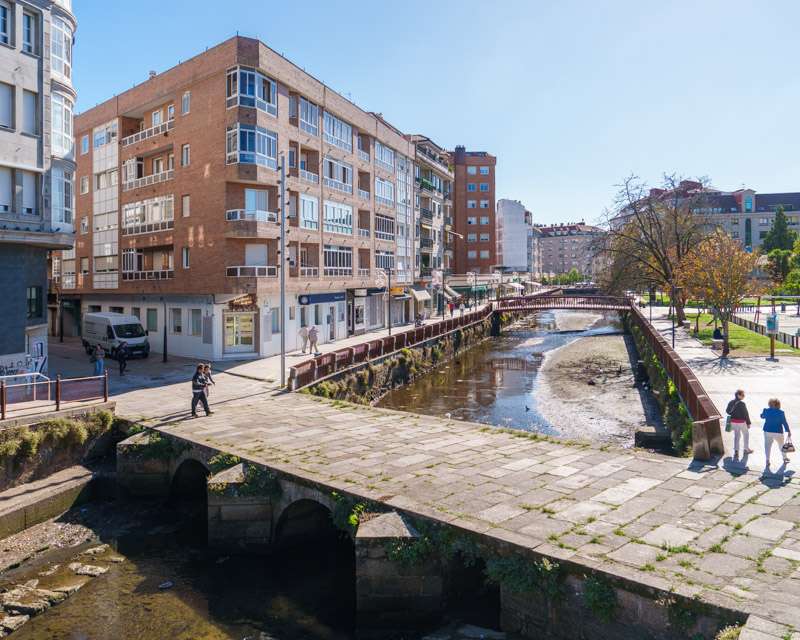
A small river runs through the town between concrete-walled banks and modern apartment blocks, crossed by low stone bridges. Follow it inland and the scenery changes abruptly: a crenellated gateway with a round arch stands over the water, flanked by battlemented walls. This is the edge of the Vista Alegre enclosure, and the remains of the medieval fortress wall run alongside the river here.
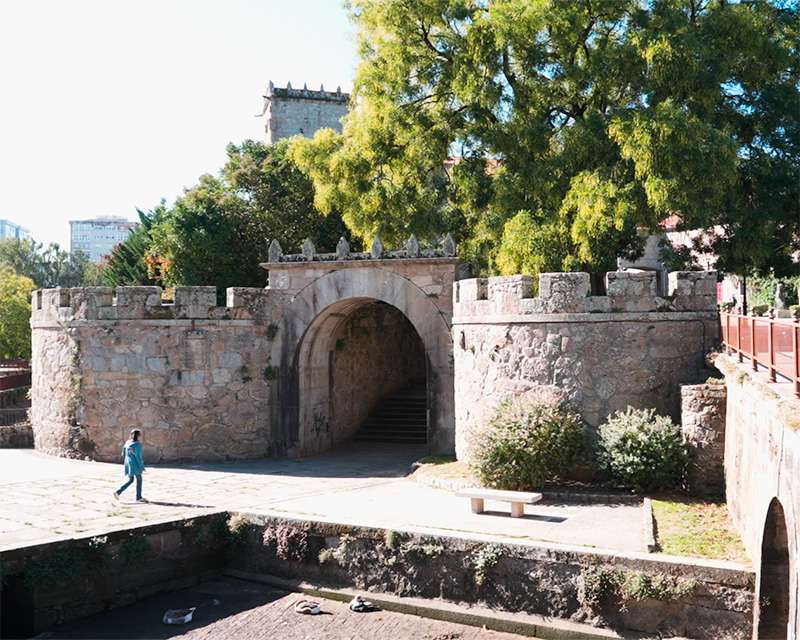
The Pazo and convent of Vista Alegre — and the almond cakes
This is why the day is worth having, and it is the one thing in Vilagarcía that no database port guide mentions.
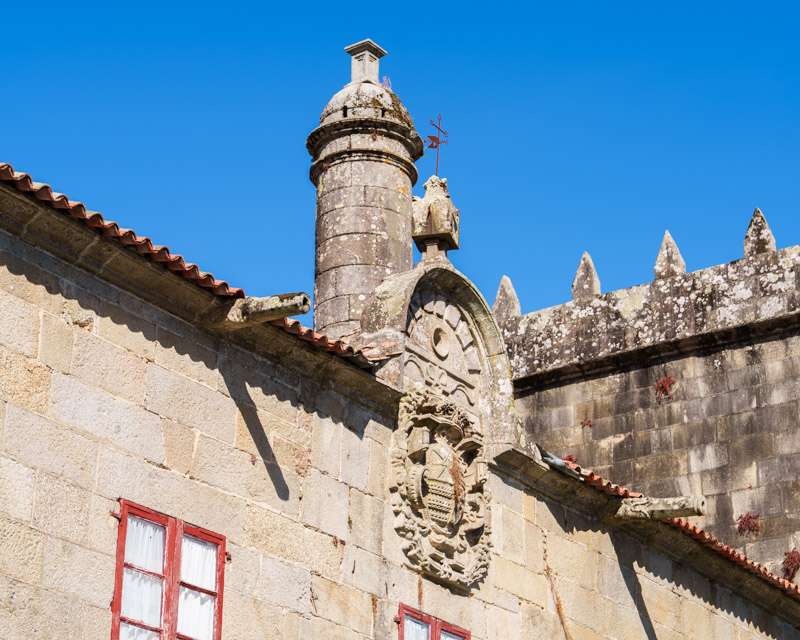
The site goes back to 1461, when a charter founded a fishing settlement beside the hill fort of San Cristóbal. Álvaro de Mendoza y Soutomaior built the first palace in the sixteenth century and his brother Rodrigo enlarged it in 1566. The result is Renaissance granite ashlar with very little decoration — medallions, coats of arms, two chimneys on the roof, one round and one rectangular. It once had two crenellated towers flanking the main block; one was moved across to the convent building in the seventeenth century, which is why the roofline looks slightly wrong in a way you notice before you can explain it.
Fernando de Andrade Soutomaior y Caamaño, born in the palace, founded the church and the convent of Augustinian Recollect nuns next door in the second half of the seventeenth century. The church of San Cristóbal is attributed to Bartolomé Fernández Lechuga: one nave, three bays of side chapels, a transept, a crypt. His ecclesiastical arms are on the façades. The complex is a listed monument; the palace itself now houses a school, and the published visiting hours are Thursday to Sunday, 10:30 to 20:00. That detail matters more on a cruise call than it looks: a ship arriving Monday to Wednesday finds those hours closed. Ours was a Thursday, which was luck rather than planning.
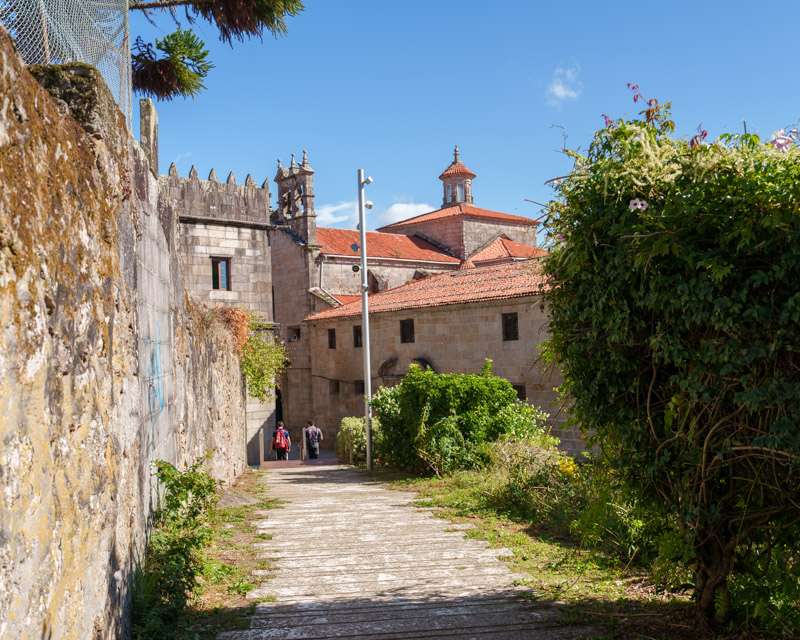
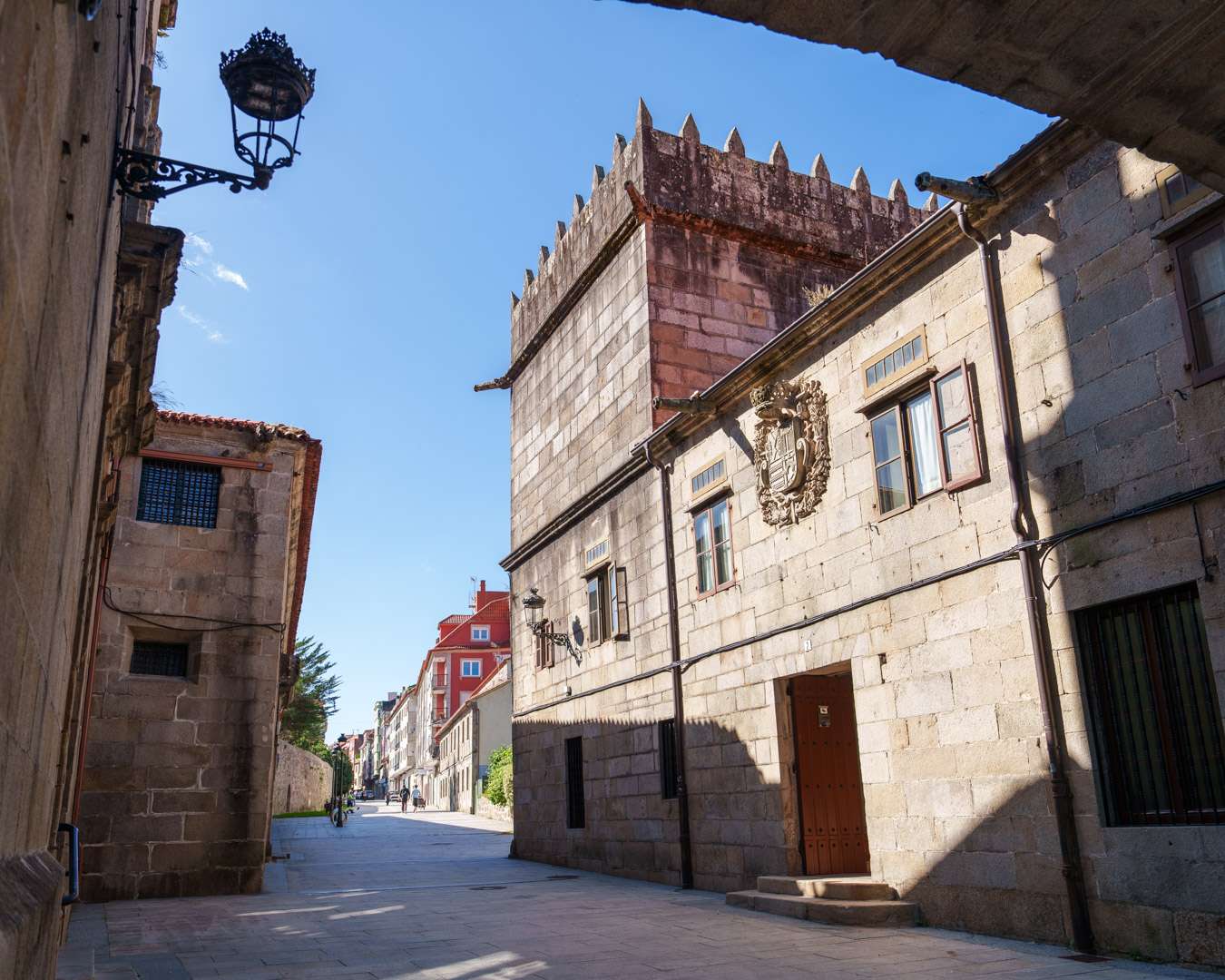
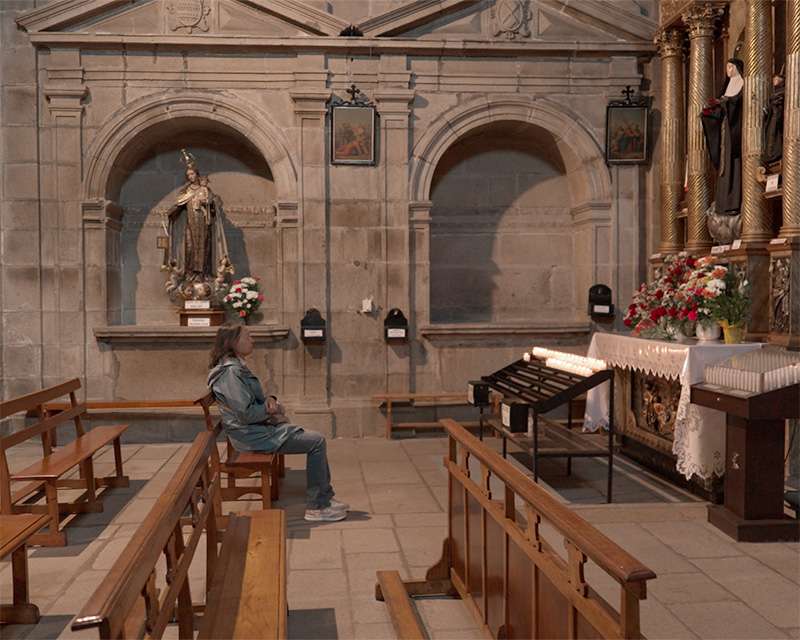
The church is open and you can walk in. It is cool, plain and almost empty — bare granite, side altars with painted saints, wooden pews, one person sitting near the front. After a morning of cranes and shop awnings the silence is startling.
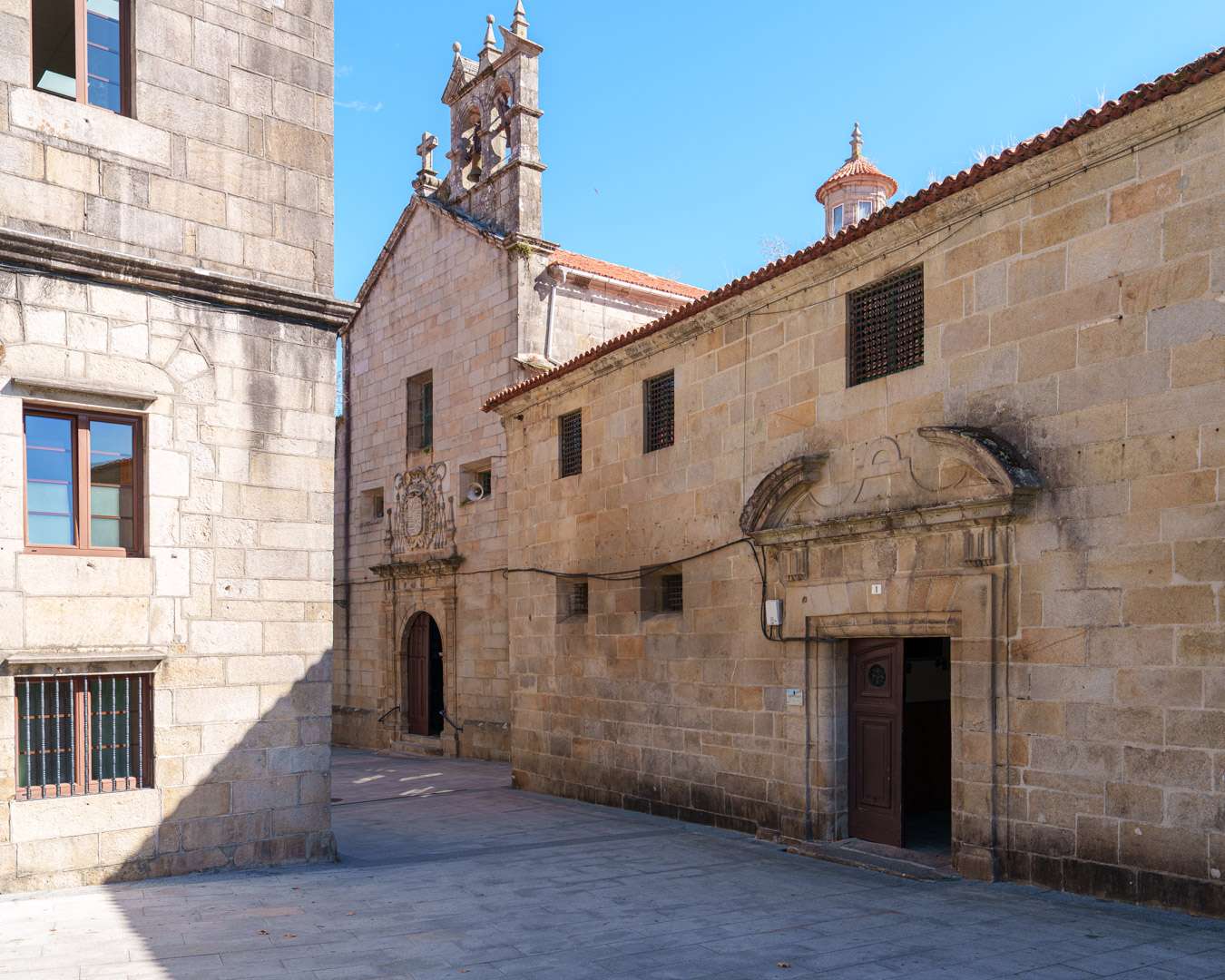
On the convent door there is a notice, and it is the best thing I found all day. The rosary is said daily at 10:25 and mass at 11:00, Monday to Sunday. Below that, a second sheet advertises the sale of biscuits, almond tarts and sponge cakes, with one line of instruction: información: preguntar en el torno — ask at the revolving hatch. The nuns are enclosed; the torno is a turntable set into the wall, you speak through it, money goes one way and cake comes back the other. The larger almond cakes want at least a day’s notice, which no cruise passenger has, but the biscuits are there for the asking.
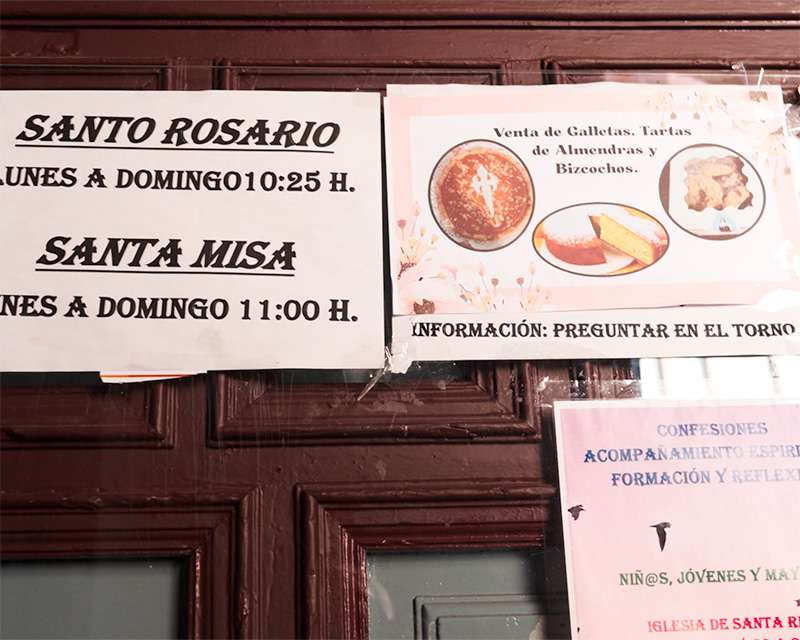
If you take nothing else from this page: a ship in port over the morning puts you in range of an eleven o’clock mass in a seventeenth-century convent church and a bag of almond biscuits handed to you through a hole in a wall by somebody you will never see. That is not an excursion anyone sells.
How much does a day in Vilagarcía cost?
| Item | Price 2026 | Note |
|---|---|---|
| Walk from the berth to the old town | free | About 2 km, flat, roughly 25 minutes |
| Road train, quay to centre | free, provided by the town | Advertised every 30 min; ran irregularly, with a midday break. Do not plan the return around it |
| Train to Santiago de Compostela, one way | from €4 | 36 km, 21–48 min, about 18 direct services a day |
| Convent church of San Cristóbal | free | Mass daily 11:00, rosary 10:25 |
| Biscuits from the convent torno | a few euro | Almond tarts need a day’s notice; bring coins |
| Praia de Compostela | free | 900 m of white sand inside the town |
| Train to Pontevedra, one way | from €4 | 21 km, 14–16 min, same line |
| Ship’s excursion to Santiago | €49 | About 6 hours with a lunchbox; ours boarded from 07:00. Cathedral explained from outside only |
| Ship’s excursion to Combarro and Pontevedra | €49 | About 4 hours, over 2 of them walking. The one that is genuinely hard to do alone |
| Ship’s pilgrim-path walk into Santiago | €49 | About 6 hours; 4 km on a steep path |
Euro, cards taken widely, but the convent is cash. Spain’s emergency number is 112.
If this call is part of an Iberian run, the two that usually follow are Lisbon, where the ship ties up 500 metres below the Alfama, and Leixões for Porto — the opposite case, 9 to 10 km from the old town.
Photo spots and the best light
The town faces roughly west across the ría, which decides everything. Mornings give you flat, clean light on the granite of Vista Alegre — the coat of arms on the convent wall, the corner turret, the crenellations against a hard blue sky all read best before noon, and the lane climbing up to the complex is in sun. Leave the waterfront for late afternoon, when the light comes down the ría towards you and the marina and the Barbanza hills separate into layers.
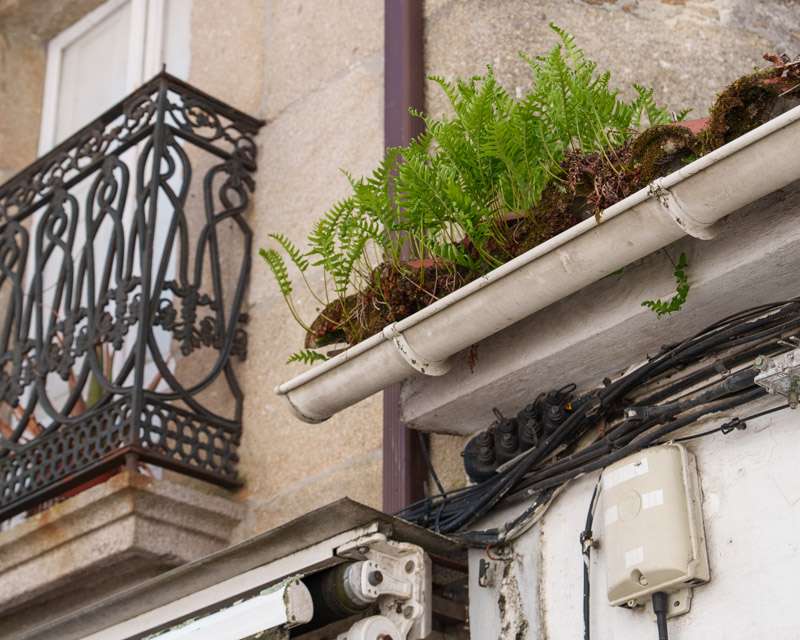
The two frames I would travel back for are both details rather than monuments: the carved shield and the little round sentry turret on the convent wall, shot tight so the scale is ambiguous, and a rain gutter on an ordinary street where a colony of ferns has rooted above a wrought-iron balcony. Galicia is wet, and the town shows it everywhere once you start looking.
The part the brochures leave out
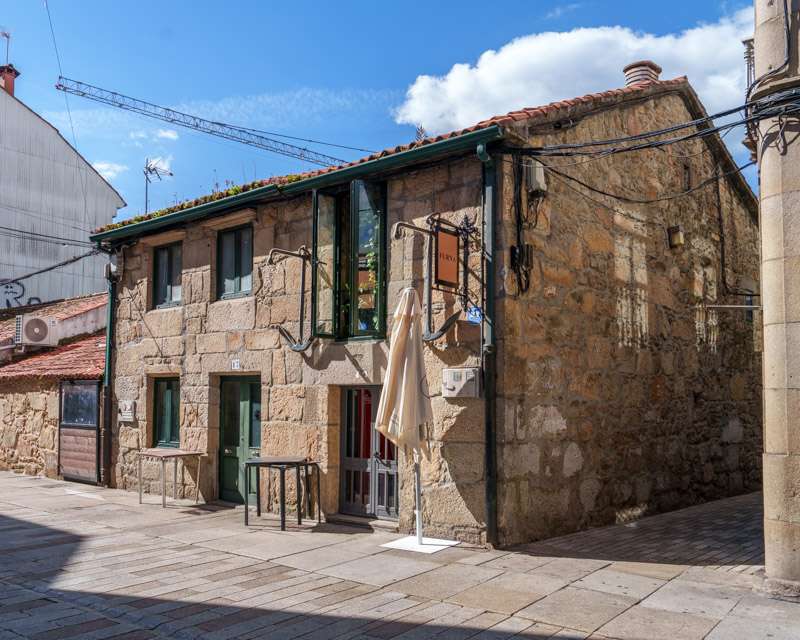
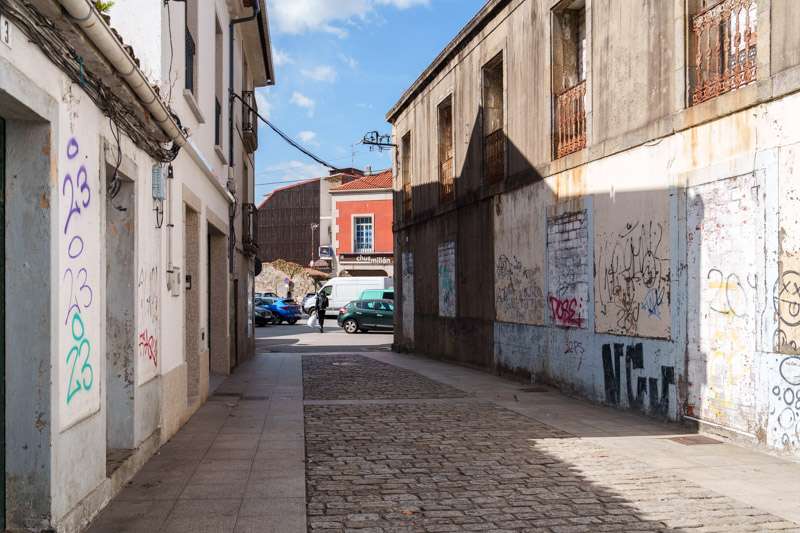
Vilagarcía is a working town of 37,000 people, not a preserved one, and a few streets behind the pedestrian core the paint runs out. There are blocks of empty granite houses with the windows gone and graffiti across the render, and there are old fishermen’s cottages standing in the shadow of a tower crane, waiting to find out which way the redevelopment goes. On the day I was there a bank branch in the centre had its sign and frontage covered in red paint, a protest banner still half readable underneath.
I mention it because the port guides that rank for this town describe somewhere that does not exist — one of them lists flamenco, bullfighting and three beaches that are in different towns entirely. Vilagarcía is better than that and also rougher than that. If you want a polished Galician set piece, Cambados and Combarro are both about half an hour away by car — Combarro, a listed village since 1972 with some sixty granite hórreos standing along the shore, is the one the ship sells. If you want a Galician town getting on with its Thursday, this is one.
Tips for the day ashore
Check your berth before you plan. O Ramal drops you at the edge of the centre; the southern commercial quays put the full 2 km in front of you. It changes the shape of the morning but not whether the day works.
Go out early and eat late. The shops close from about 13:30 to 16:30. A ship alongside from eight to six should do the old town and Vista Alegre in the morning and keep the seafront walk towards Carril for the afternoon.
Carry coins. For the convent, and for the small bakeries, which are not set up for a card.
Keep the return buffer. Be back at the quay 45 to 60 minutes before all-aboard. From the old town that is a comfortable margin on foot — and on foot is how to count it, because the road train keeps its own hours. If you have gone to Santiago by train, make it the service before the one you think you need.
If you want the Rías Baixas rather than the town, Pontevedra is the easy one: 21 km by rail, 14 to 16 minutes, from €4, and the old town begins a short walk from the station — the ruined 14th-century apses of San Domingos and the scallop-shaped Peregrina church are both inside it. A Illa de Arousa is about fifteen minutes away by road, and Cambados, Combarro and O Grove all sit within about half an hour by car. Those three mean a taxi and a negotiated return; for Combarro in particular, the ship’s €49 coach is the sensible answer.
What I would do differently next time
I would walk the 2 km to Carril along the water instead of spending the time in the centre. The clams and cockles of Carril are what Galicia actually knows this stretch of coast for, the walk is flat and on the sea the whole way, and it would have put me on the seafront in the afternoon light rather than in a pedestrian street at midday.
And I would have gone to the convent first thing and ordered the almond cake on arrival, on the chance that an enclosed order makes an exception for a ship that leaves at six.
Sources: berths, depths and the shuttle from the Port Authority of Vilagarcía; rail fares, frequencies and journey times cross-checked on Omio and Trip.com, October 2026; the Pazo and convent of Vista Alegre from Turismo Rías Baixas and Galicia Máxica; beach data from playas.es. Excursion lengths and prices are taken from the ship’s own shore-excursion programme for this call (Phoenix Reisen, priced April 2026). Mass and rosary times, the torno notice and everything described as seen are from the day itself.
Related: Santiago de Compostela and A Coruña: Spirit and Stone in Galicia · Praia da Vitória Cruise Port: Angra do Heroísmo on Your Own · Saint Peter Port Cruise Port on Your Own · All articles from Spain · Cruise Ports on Your Own · Diesen Artikel auf Deutsch lesen