
Mainland Portugal, met from the river. Lisbon is one of the easier European cruise calls to do without a tour: most ships tie up at Jardim do Tabaco, the long quay directly below Alfama, and the quarter begins about 500 metres away across the road. The articles here are written from days ashore rather than from a holiday — what actually fits between arrival and all-aboard, what the ship’s coach is worth against a train ticket, and where the photographs are. Alfama itself, which survived the earthquake of 1755 on its rock; the dome of Santa Engrácia, begun in 1681 and finished in 1966; the rococo rooms of Queluz twelve kilometres inland; and Cabo da Roca, where the Eurasian landmass ends above the Atlantic. Walking times, current-season prices and the return buffer accompany each piece.
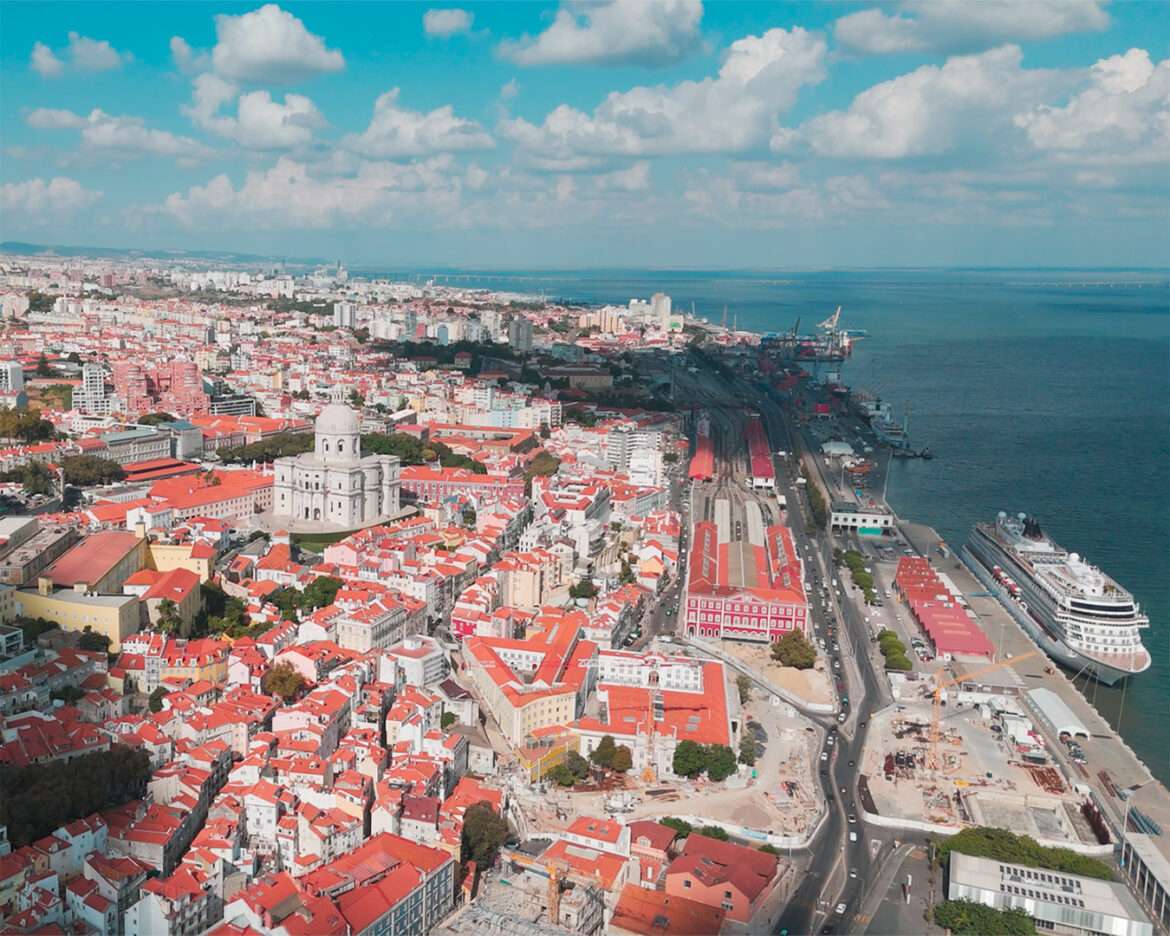
Visited: 6 October 2026, on a call of MS Amadea. We came up the Tagus before dawn and sailed again at 18:00. The photographs are my own, taken that day.
Lisbon is one of the easier European ports to do without a tour. Most ships tie up at Jardim do Tabaco, the long quay under Alfama, and the quarter starts about 500 m away on the other side of the road. Praça do Comércio is ten to twelve minutes along the water, flat the whole way. A ten-hour call leaves roughly eight hours ashore — enough for the old town on foot, or for one thing inland and the old town afterwards.
Where do cruise ships dock in Lisbon?
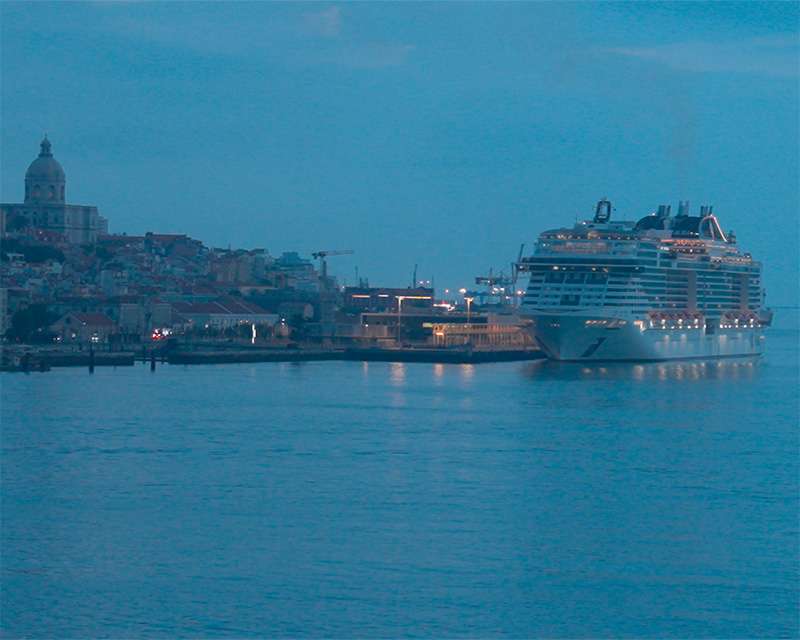
At Jardim do Tabaco, also called the Santa Apolónia quay: a continuous berth of about 1,500 m on the north bank of the Tagus, at the eastern edge of Alfama. Overflow ships and some mid-sized vessels go to Alcântara, roughly 3 km west towards the 25 de Abril bridge. Rocha Conde de Óbidos is now rarely used for cruise calls. There is no tendering in Lisbon.
From the gangway at Jardim do Tabaco the numbers are short. The edge of Alfama is about 500 m. Praça do Comércio is about 1 km, ten to twelve minutes on the level along the waterfront. Santa Apolónia station and its metro stop are five to ten minutes, depending which gangway you use. São Jorge castle is twenty to twenty-five minutes uphill. Taxis run roughly €10 to €15 into the centre on the regulated tariff. If your ship is at Alcântara the arithmetic changes and the tram or the ship’s shuttle becomes the sensible choice.
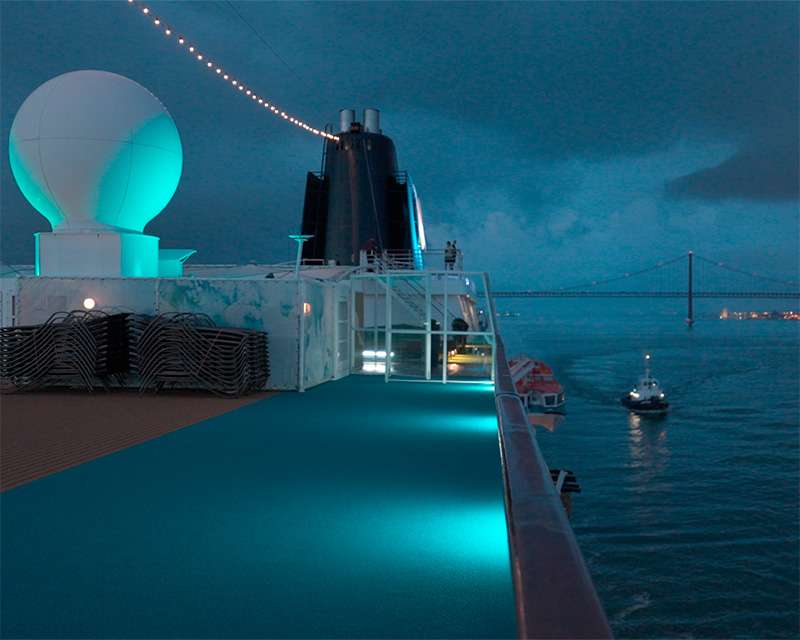
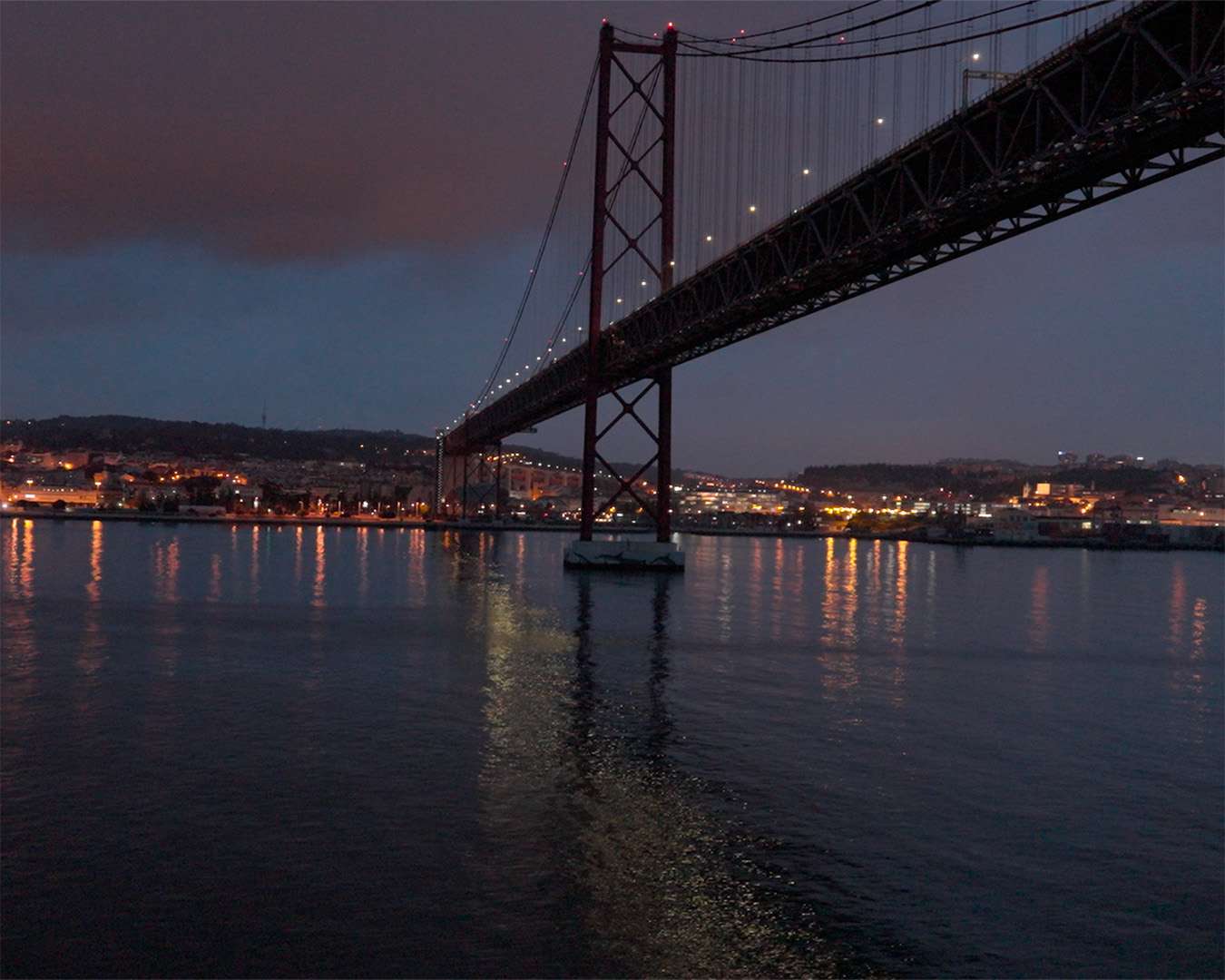
The arrival is worth losing sleep over. Ships come up the river in the dark and pass under the 25 de Abril bridge with the city already lit to starboard. It opened in 1966 as the Ponte Salazar and was renamed after the revolution of 25 April 1974: a kilometre of free span — 1,013 m — and the first thing you see of Lisbon.
Can you walk into Lisbon from the cruise port?
From Jardim do Tabaco, yes, and there is not much to decide. Alfama begins across the road. Baixa and Praça do Comércio are a flat kilometre west along the water. The castle is the only climb, and nothing in the historic centre needs a ticket to reach.
What walking will not give you is Sintra, Cabo da Roca or Belém. Those lie twelve to forty kilometres out, and they are the reason most people book something.
What I did with the day
A coach inland to Queluz, then west to Cabo da Roca, then back along the coast through Cascais and Estoril. The afternoon I spent alone in Alfama, which is directly opposite the terminal. The inland half was the ship’s excursion. The afternoon was not, and it was the better half.
Palácio Nacional de Queluz: a summer house that became a hiding place
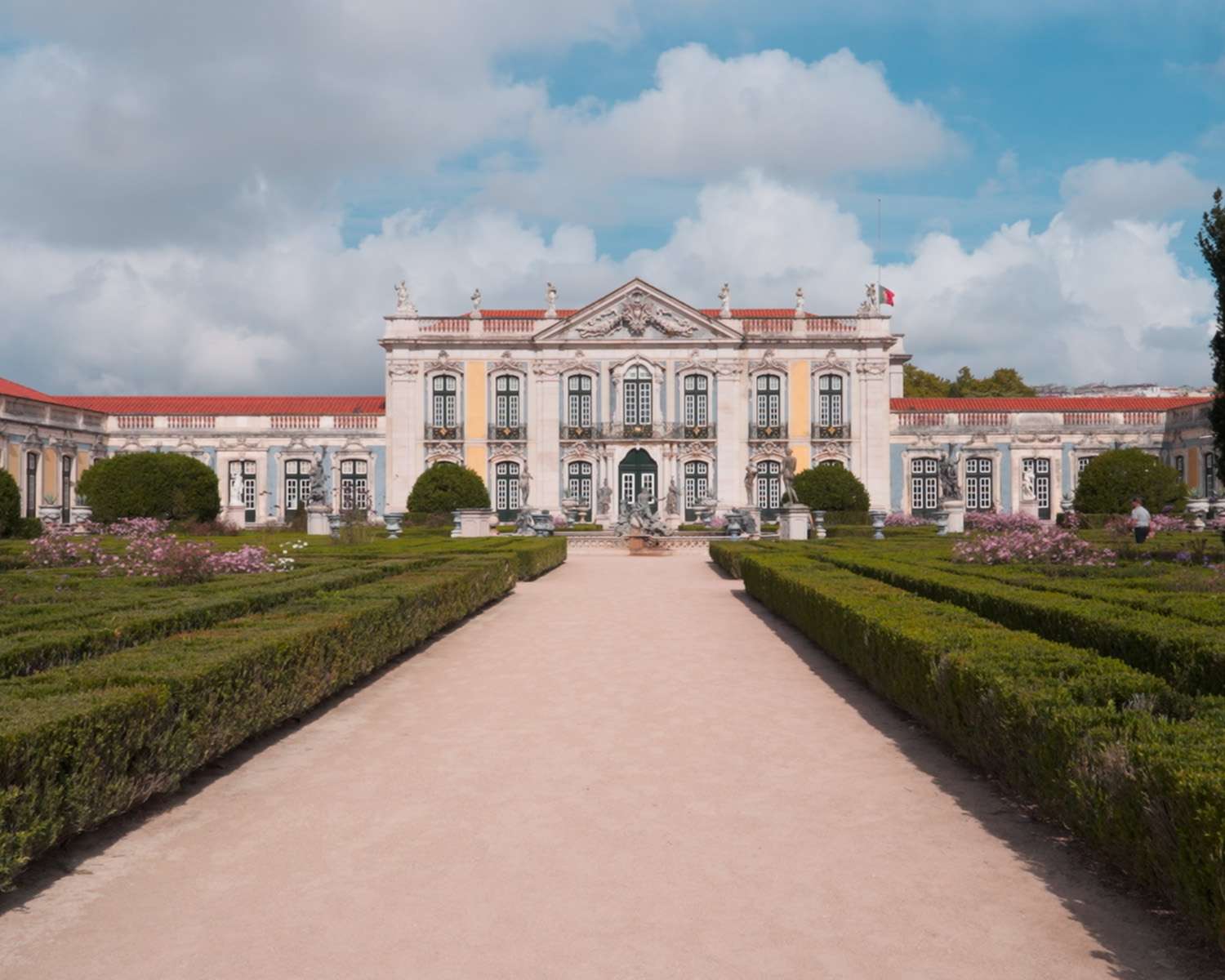
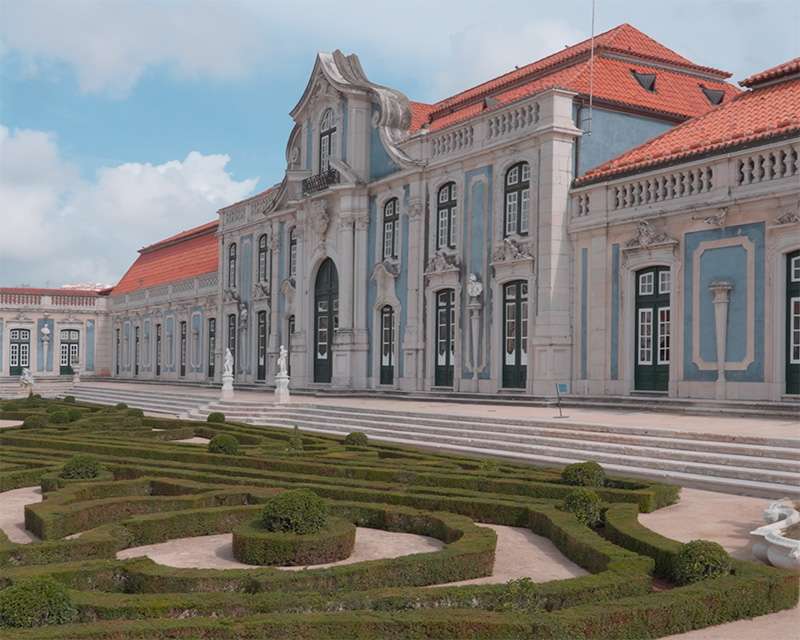
Twelve kilometres from the centre of Lisbon stands a palace built as a summer retreat. Work began in 1747 for Dom Pedro of Braganza, brother of King José I. Mateus Vicente de Oliveira started it; the French architect Jean-Baptiste Robillion carried it on and gave it the rococo interiors and the gardens. Pink render, mirrors, and a scale that stays domestic — this was never meant to be a seat of government.
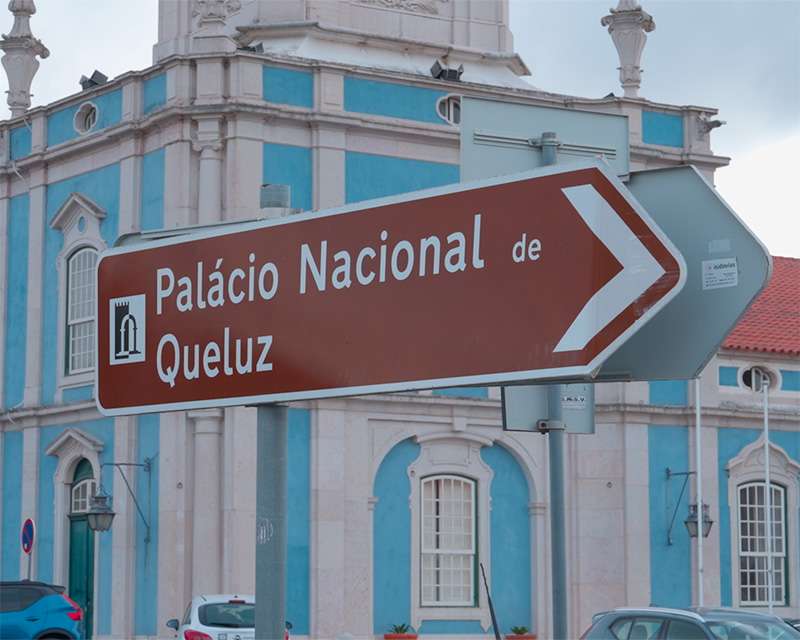
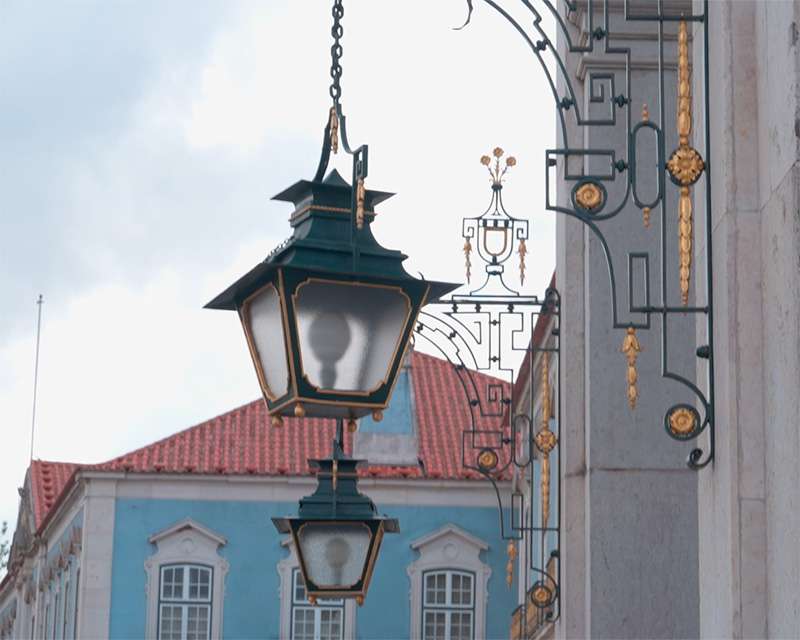
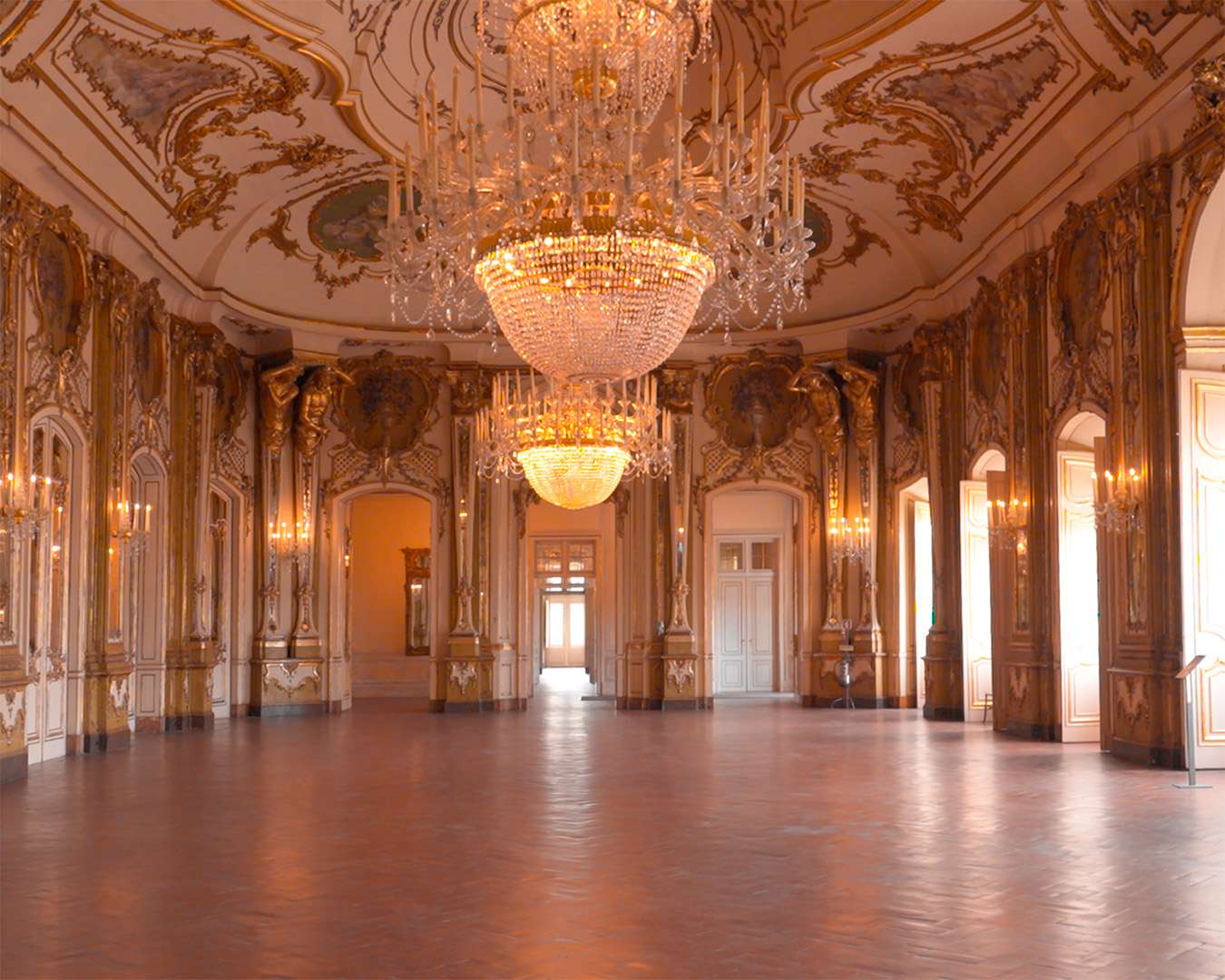
Robillion designed the Ambassadors’ Hall in 1757. Black and white marble on the floor, and on the ceiling the royal family at a concert.
Pedro married his niece Maria. She became queen, he king consort, and after his death in 1786 her mental health broke down. From 1794 the court lived at Queluz permanently — which had the effect of keeping the monarch out of public view. In 1807 the family fled Napoleon for Brazil. Maria died in Rio nine years later and never came back.
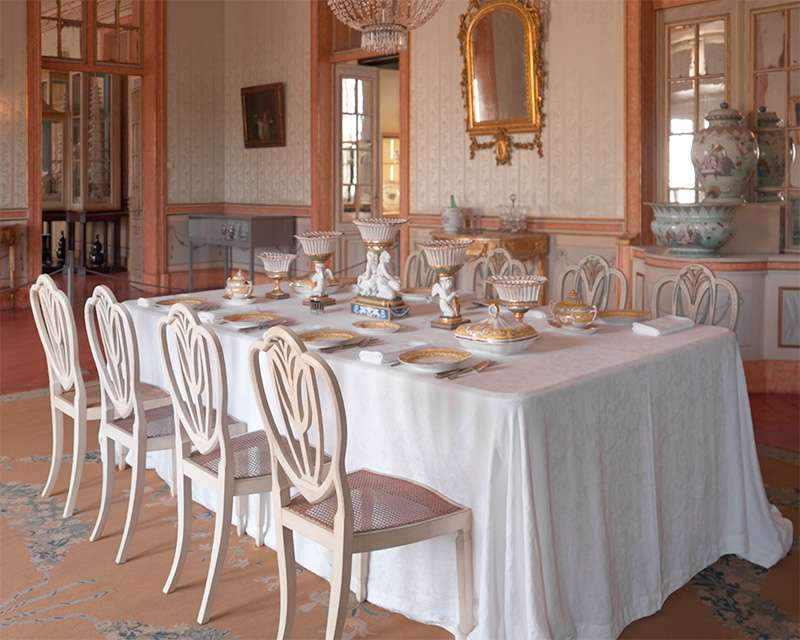
The dining table is still laid. Nobody has eaten at it for two hundred years.
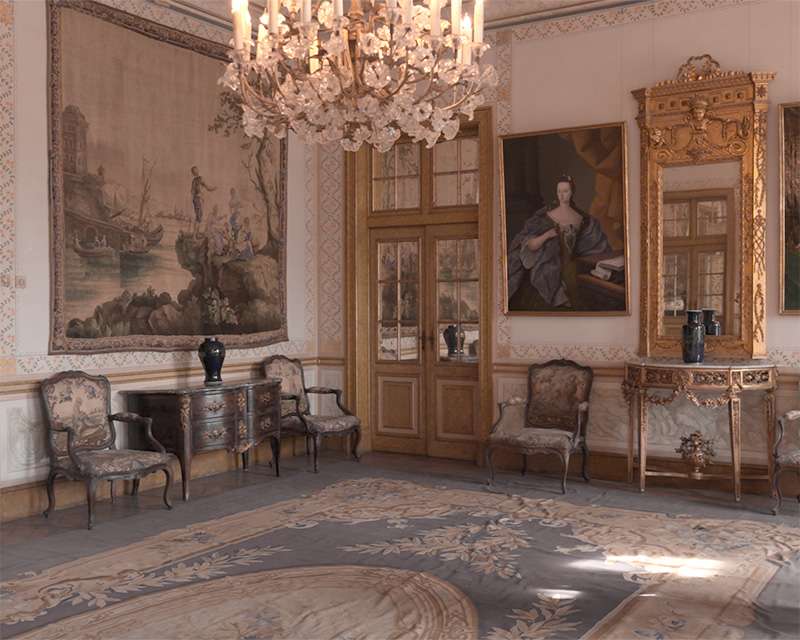
Palace and gardens cost €13 for adults, €10 for 6 to 17s and over-65s, €35 for a family of four; the gardens alone are €6. The palace opens 09:00 to 18:00, the gardens to 18:30, with last admission at 17:30. The ticket office shuts between twelve and one, though the machines keep working.
On your own it is straightforward: eighteen minutes from Rossio to Queluz-Belas on the Sintra line, a zone 2 ticket at €1.85, then about fifteen minutes on foot through residential streets with brown signs at the corners.
Cabo da Roca: twenty minutes is not enough
Forty kilometres further west, Europe stops. Cabo da Roca is the westernmost point of mainland Portugal, of continental Europe and of the Eurasian landmass, at 38°46′51″N, 9°30′02″W. The Romans called it Promontorium Magnum; in the age of sail it was simply the Rock of Lisbon. The cliffs here run to well over a hundred metres, and the lighthouse beacon stands 165 m above the Atlantic.
The lighthouse was ordered in 1758 and built in 1772 — the first in the country raised from the ground as a lighthouse rather than adapted from an existing tower or beacon. It is still working.
On the stone cross is a line from Camões: where the land ends and the sea begins. For five hundred years that was not a metaphor but a position report.
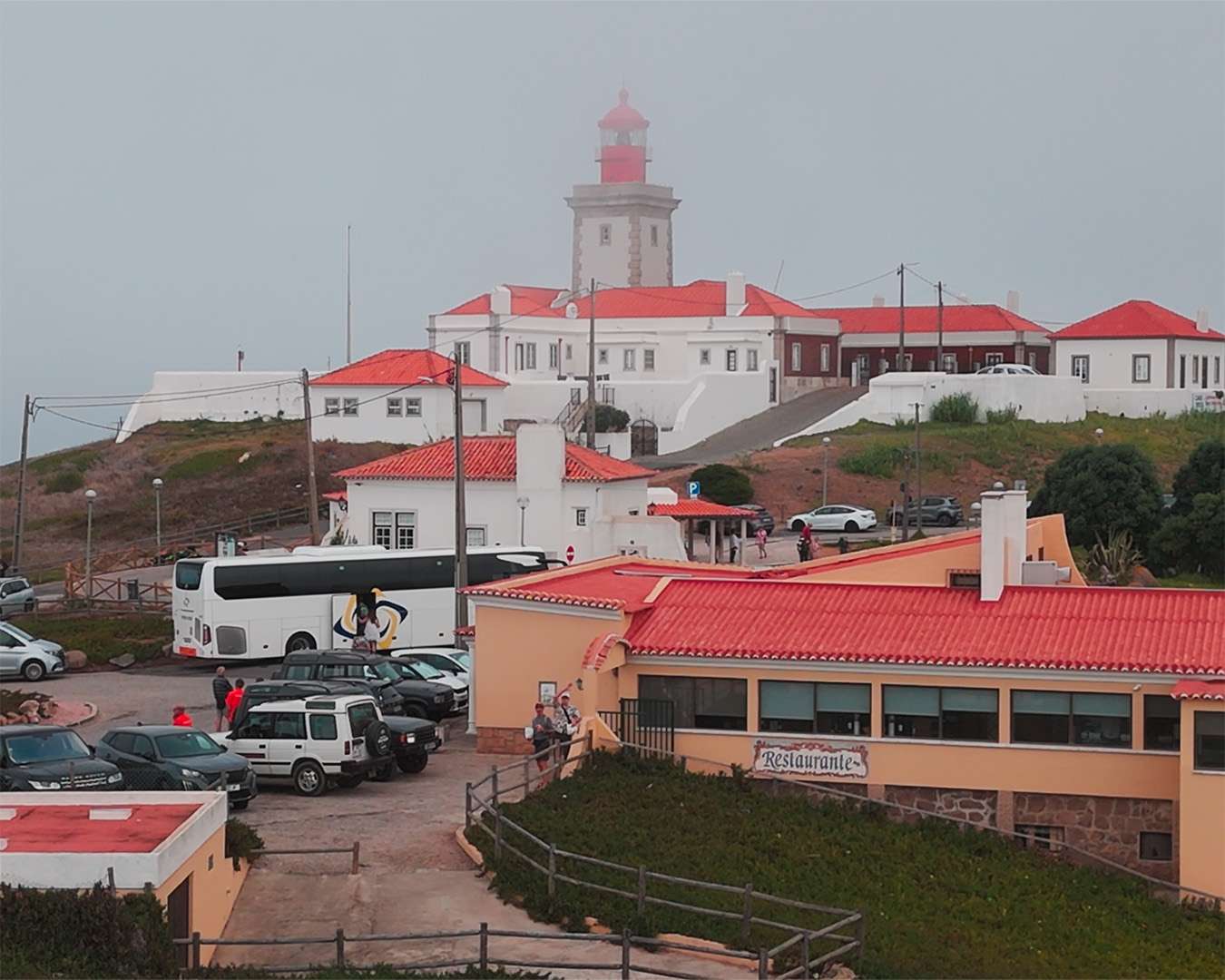
We had twenty minutes. That is exactly the time it takes to walk from the coach to the cross, make the picture and walk back, and it is the single thing I would change about the day. The cape has a cliff path, several viewpoints and weather that moves while you stand in it — the sea was in haze when we were there and the light changed twice in those twenty minutes. An hour is the minimum. Half a day would not be wasted.
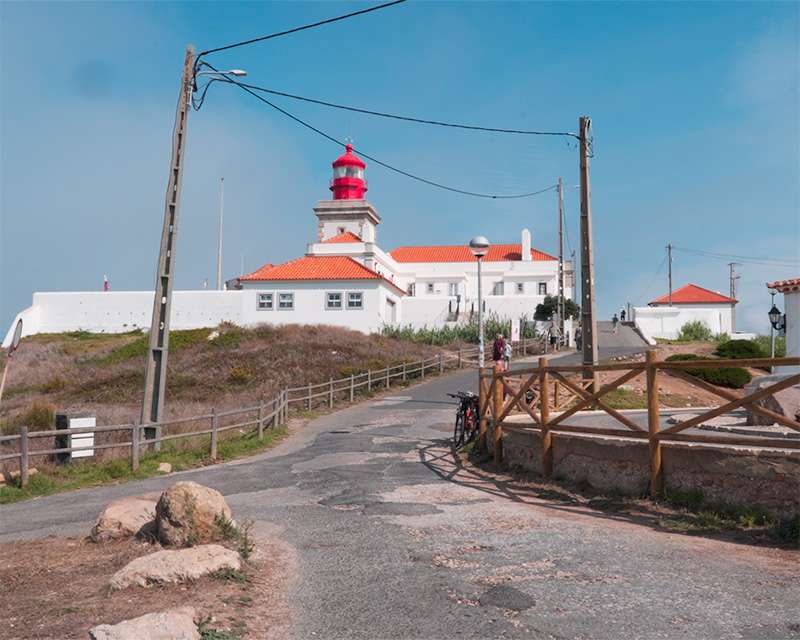
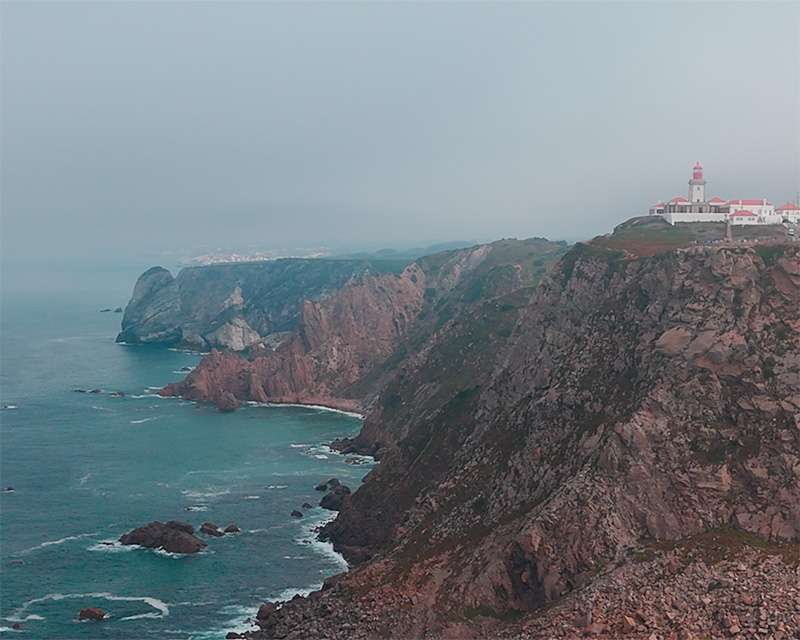
The cape itself, the cross and the viewpoints cost nothing. Only the lighthouse courtyard and its interpretation centre are ticketed, by Parques de Sintra, from €5, open 09:30 to 17:30 with last admission at 17:00.
By public transport it is the train from Rossio to Sintra, then bus 1624 towards Cascais: about 35 minutes, €4.50 from the driver, roughly every half hour. Bus 1253 leaves from outside Sintra station and takes about 45 minutes. Either way this eats most of a port day, so check the return times before you commit to it.
Cascais and Estoril on the way back
The coast road returns through dunes, wind and long beaches, then Cascais, which lived on fish before it lived on visitors, and Estoril.
The casino at Estoril opened in 1931. Portugal stayed neutral in the Second World War, and the place acquired a reputation as common ground for dispossessed royalty and for agents of both sides; it is widely said to have given Ian Fleming the setting for Casino Royale. The reputation is better documented than the specifics, so treat the Bond part as a story. The neutrality is the more interesting half: it was run as a business model.
Alfama needs an afternoon of its own
The name comes from the Arabic al-hamma, the hot springs. Under Moorish rule this quarter was the whole city. In 1755 Lisbon fell down in an earthquake and Alfama stayed standing — it sits on rock rather than on river sediment, which is the entire explanation.
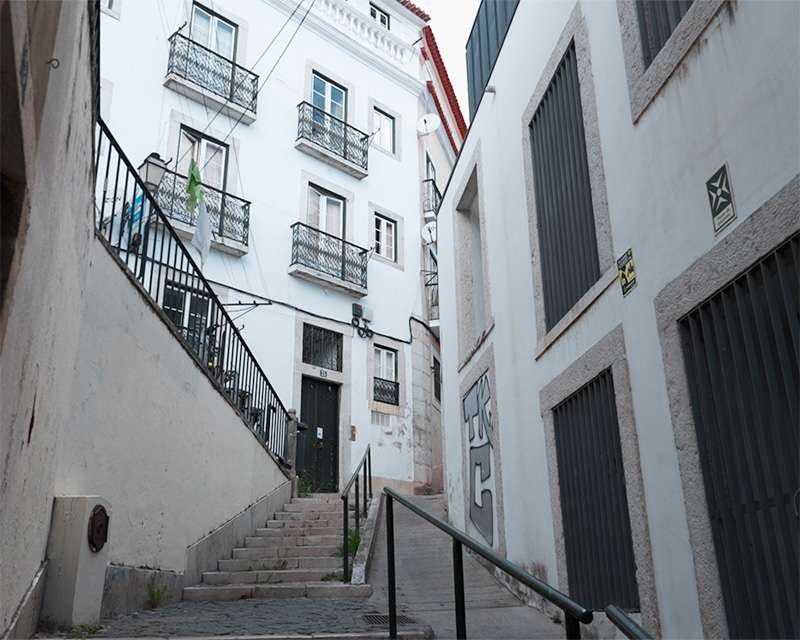
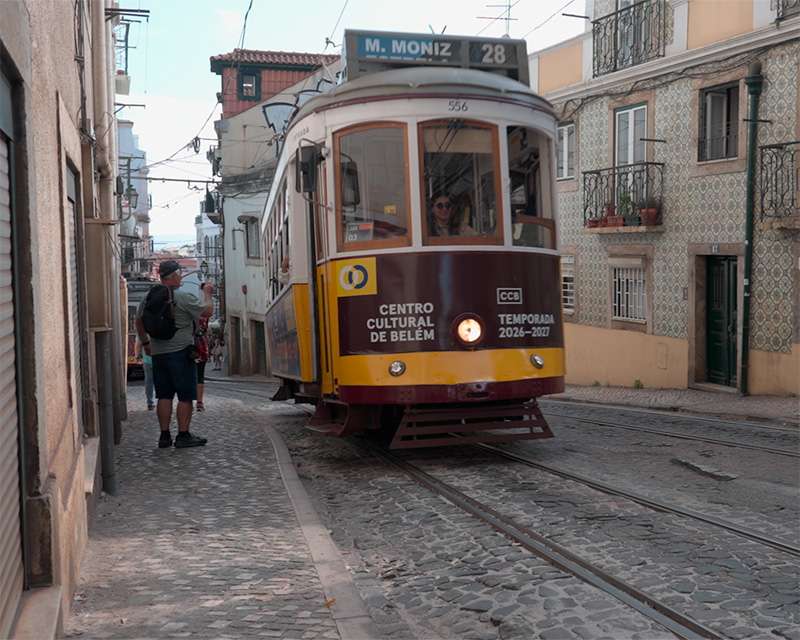
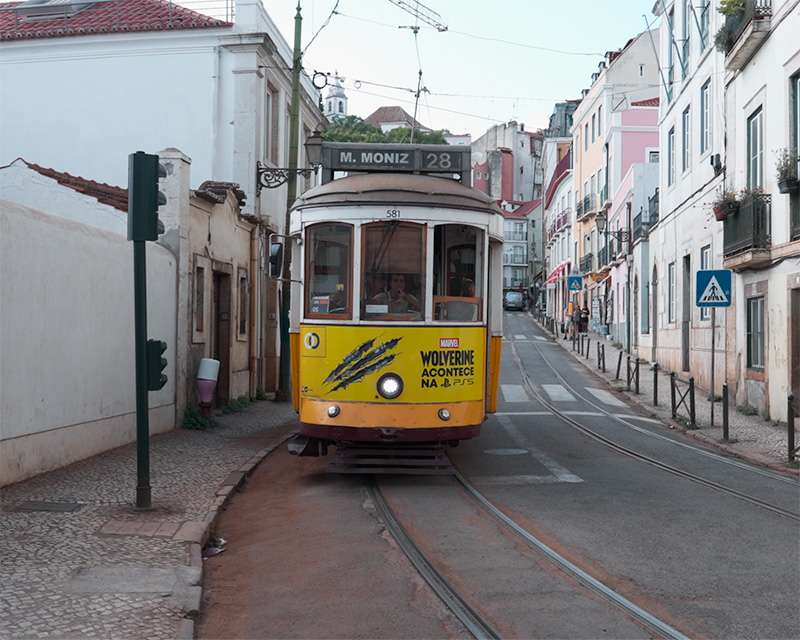
What survived is not a monument but a structure. Stairs instead of streets. Washing overhead. And the number 28, pushing through lanes it looks too wide for.
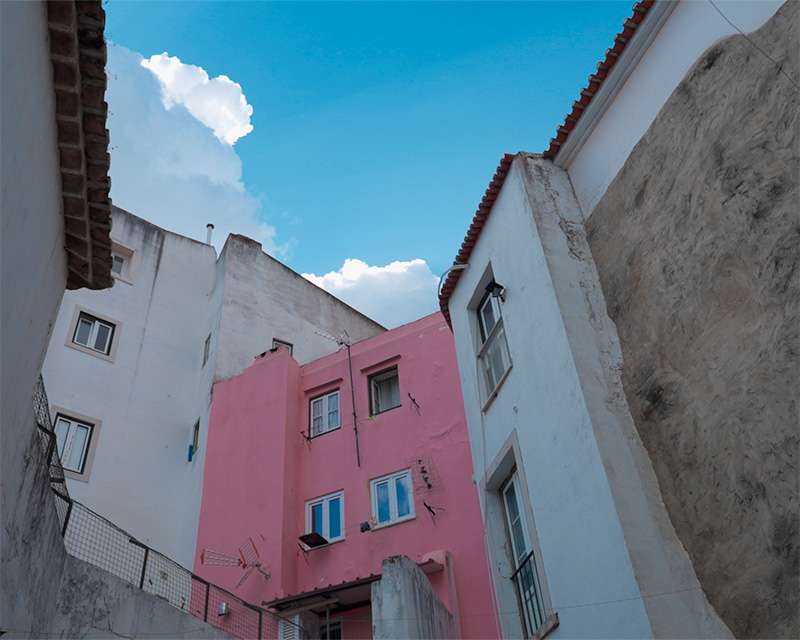
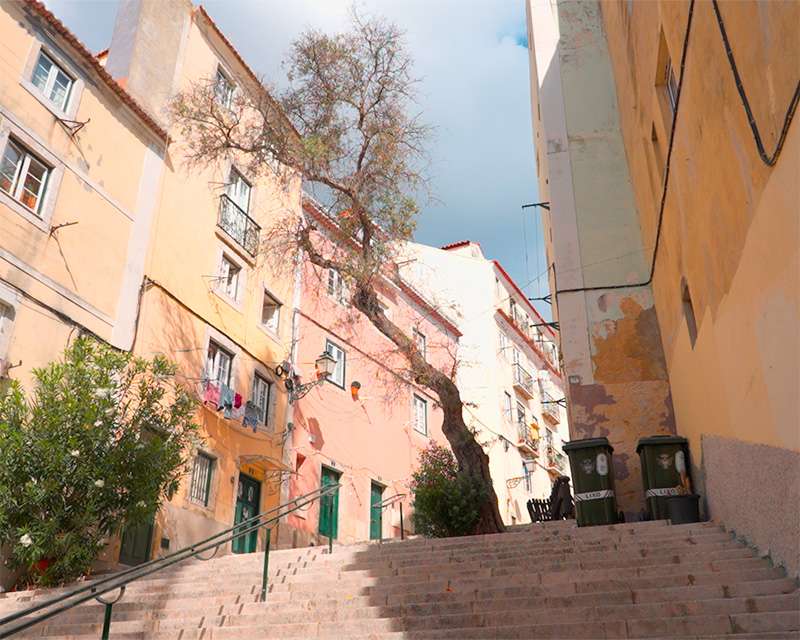
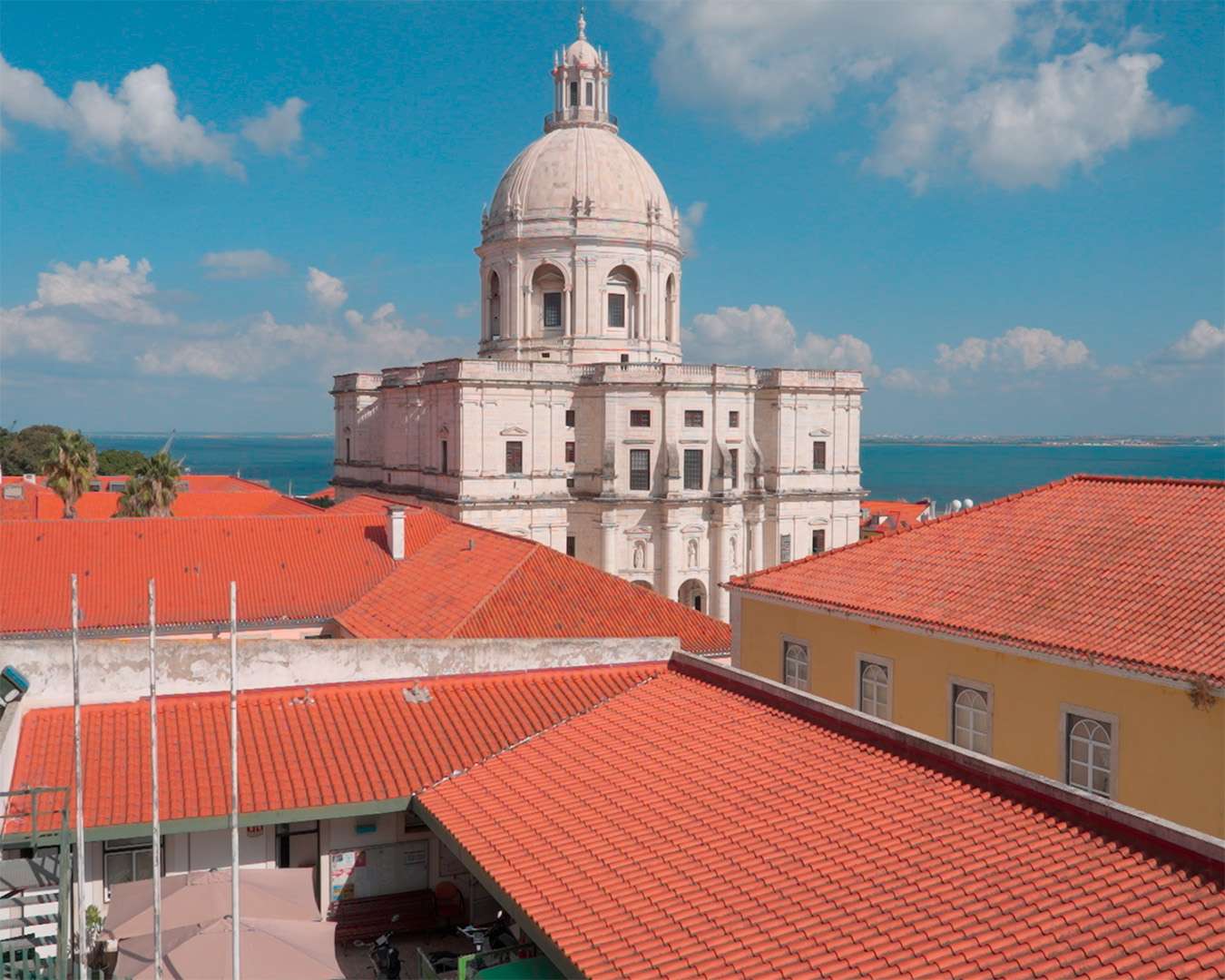
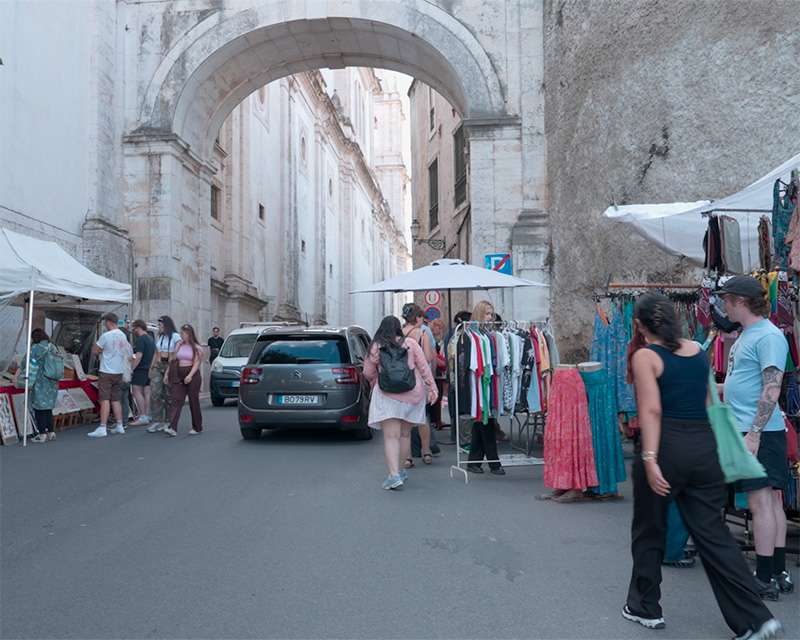
Above the roofs, a dome. Santa Engrácia was begun in 1681 and finished in 1966: two hundred and eighty-five years. Obras de Santa Engrácia is still the Portuguese phrase for something that will never be done. Since 1916 the building has served as the National Pantheon — Amália Rodrigues and Eusébio are buried there, Camões and Vasco da Gama have cenotaphs. Beside it, on Campo de Santa Clara, the stalls were out when I came through — an art and flea market under the archway that carries a building across the street. This is the Feira da Ladra, and it runs every Tuesday and Saturday.
This is the part of Lisbon to do alone and on foot. A coach cannot get into it. A guided group moves at the pace of its slowest member on a staircase, and the quarter only works when you are free to take the wrong turning and come out somewhere you did not plan. Give it three hours rather than one.
Tram 28 runs from Martim Moniz to Campo de Ourique through Graça, Alfama, Baixa and Estrela. It is standing room only from about ten in the morning to six in the evening; if you want a seat, board at one of the two termini rather than in the middle. A single bought from the driver is €3.30, against €1.90 for a Carris/Metro single on a Navegante card. The 24-hour Carris/Metro ticket is €7.25 and pays for itself after about four rides.
What does a day in Lisbon cost?
| Item | October 2026 | Note |
|---|---|---|
| Walk, Jardim do Tabaco to Alfama | free | about 500 m; the quarter begins across the road |
| Taxi, quay to the centre | €10–15 | regulated tariff |
| Train, Rossio to Queluz-Belas | €1.85 single, zone 2 | 18 min, then about 15 min on foot |
| Queluz palace and gardens | €13 adult, €10 youth and 65+ | gardens only €6; last admission 17:30 |
| Bus 1624, Sintra to Cabo da Roca | €4.50 from the driver | about 35 min, roughly every 30 min |
| Cabo da Roca: cape, cross, viewpoints | free | car park and paths are public |
| Cabo da Roca lighthouse courtyard | from €5 | 09:30–17:30, last admission 17:00 |
| Tram 28, single from the driver | €3.30 | €1.90 as a Carris/Metro single on a Navegante card |
| 24-hour Carris/Metro ticket | €7.25 | worth it from about four rides |
Figures I could not confirm from two sources are left out rather than estimated. Ferry and suburban rail fares change every January, so check the current table before you budget tightly.
Ship’s tour or on your own?
Split it, and be honest about which half is which.
The coach earns its price for Queluz and Cabo da Roca. Both are out of reach on foot, and doing them by train and bus on a port day means watching the clock from mid-morning onwards. What the coach does badly is give either place enough time: ours allowed twenty minutes at the westernmost point of Europe, which is a photograph rather than a visit.
Alfama is the opposite case. It is across the road, it costs nothing, and the group format works against it. Walk it.
Whatever you choose, be back at the quay 45 to 60 minutes before all-aboard. From Alfama that walk is short and downhill, which is the genuine luxury of this port.
Photographs: where to stand, and what the light does
The first picture of this port is made before anyone goes ashore, and it is made from the bow. Ships come up the Tagus in the dark, the bridge passes overhead, and the city lies lit along the starboard side. Long exposure, something solid to brace against, and no flash from the deck behind you — which you cannot control, so pick a quiet corner.
Queluz is a difficult interior. The rooms are lit from the garden side through tall windows and are dark at the back, which means the obvious frame — the whole room — has a four-stop range in it. Work with the window rather than against it, and let the far wall go.
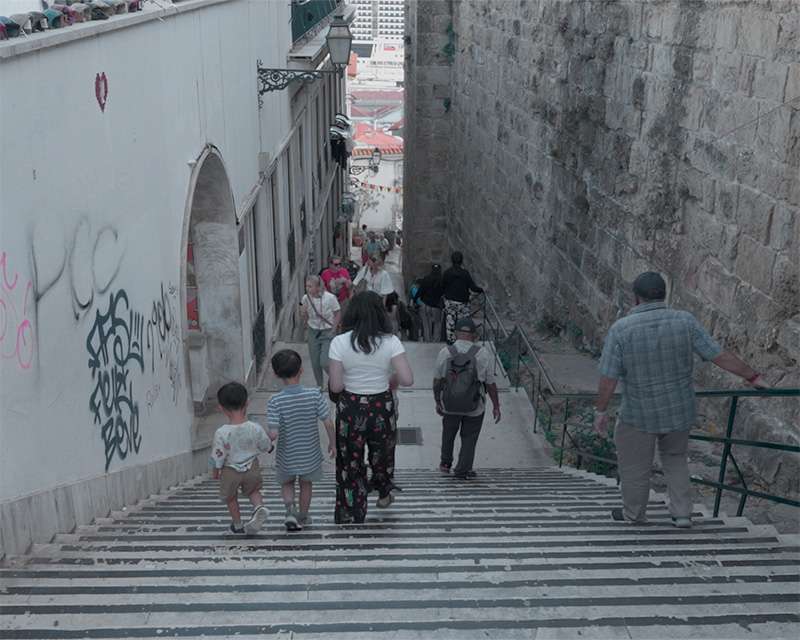
In Alfama the best frames are not the alleys but the places where the structure shows: a staircase crossing a lane, washing against render, the dome standing over the roofs from the viewpoints along the ridge. The alleys themselves are narrow and high-contrast, and at midday the shadow does the composing for you, badly.
For tram 28, frame the street first and wait for it. Chasing the tram gives you the back of the tram.
What I would do differently next time
An hour at Cabo da Roca instead of twenty minutes. If the excursion cannot give it, go to Sintra and the cape independently and leave Queluz for another call — the palace is the easiest of the three to reach on your own anyway, eighteen minutes on a suburban train.
And a full afternoon in Alfama rather than part of one. It is the only thing in Lisbon that is directly outside the ship, and it is also the one place where hurrying removes the point.
Related: Funchal: half a day in Madeira’s capital on your own · Praia da Vitória: Angra do Heroísmo on your own · All cruise ports on your own · All Portugal stories · Diesen Artikel auf Deutsch lesen