
South Greenland is the gentler face of the world’s largest island — fjords, sheep farms and small towns rather than endless ice. The focus here is Narsaq, a town of 1,242 people on Tunulliarfik Fjord, founded in 1830, where icebergs drift down from the inland ice and the Ilimaussaq mountains stand behind the painted houses. Most cruise ships anchor off the town and tender in, which makes this one of the ports where going ashore on your own is the normal case rather than the adventurous one. It is also a port where the length of the call is an estimate rather than a promise: wind and drifting ice can close the way out of the fjord and bring a ship’s recall forward by hours. The articles here are written from days ashore — where the tender lands, what two hours actually allow, what the museum holds and when the light is worth the walk uphill.
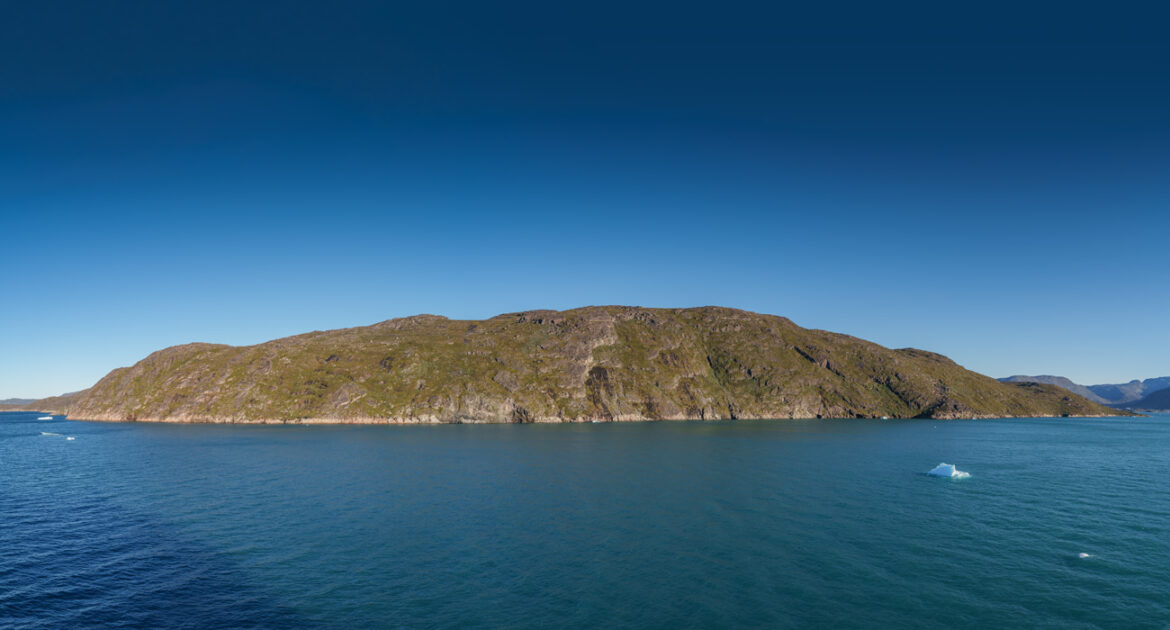
Visited: September 2025, on a call of MS Amera. Figures below checked October 2026 — verify against the linked sources before you sail.
Narsaq is a tender port, and doing it on your own is the normal case rather than the adventurous one: the ship anchors off the town, the boat takes about 15 minutes, and the landing is in Narsaq itself. What you cannot plan is how long you get. On our call everyone was recalled after roughly two hours, because wind and drifting ice were closing the way out of the fjord.
Narsaq cruise call at a glance
| Berth | No cruise pier. Ships anchor off the town and tender in; the commercial quay is small and used by local traffic |
| Tender | About 15 minutes each way on our call |
| Ashore | Roughly two hours before the recall; about three hours door to door including both tender legs |
| Town | 1,242 inhabitants (2025). Founded 1830 as Nordprøven; Narsaq means “plain” |
| Position | On Tunulliarfik Fjord, about 25 nautical miles up from open water |
| Main sight | Narsaq Museum at the old harbour, in houses from the town’s founding period |
| Difficulty | 1 out of 5 on foot. The difficulty here is not the walking, it is the schedule |
| Return buffer | Stay within 20 minutes’ walk of the tender landing for the whole call |
Where does your ship anchor in Narsaq, and how long is the tender?
There is no deep-water cruise berth at Narsaq. Ships anchor off the town in Tunulliarfik Fjord and run tenders in; ours took about 15 minutes each way. The town’s own quay is a small L-shaped commercial pier used by fishing and coastal traffic, not by cruise ships.
The approach matters more here than the landing. Narsaq lies some 25 nautical miles up the fjord from open water, and bergy bits and small icebergs are normal on that run. Noonsite, writing for yachts rather than for passengers, puts the problem plainly: anchoring outside the harbour can become a problem because bergy bits turn hazardous once the wind picks up, and skippers are told to ask Ice Central for current conditions before committing. A cruise ship at anchor in the same fjord is subject to the same arithmetic, which is why the next section is the one that actually decides your day.
How long do you actually get ashore — and why the ice can cut it short
We were scheduled for longer. About two hours after the first tender landed, the ship sounded a long blast and everyone had to come back aboard immediately. Strong wind had set in and icebergs were drifting into the fjord, between the anchorage and open water. The decision was not about the weather ashore, which was fine; it was about whether the ship could still get out.
Nothing on the published port pages prepares you for this. They describe a tender port with a museum and coloured houses, which is accurate and useless on the day. The honest version is: in a South Greenland fjord, the length of your call is a working estimate, not a promise, and it can be shortened by conditions you cannot see from the gangway. Narsaq was the last Greenlandic port of that voyage — the next stop was Canada — and the margin the bridge needed was the margin we lost ashore.
The practical consequence is simple. Treat the published all-aboard time as the latest possible end of the call, not the likely one, and do not build a plan whose payoff comes in the last hour.
What fits into two hours in Narsaq on foot
Enough, as it turns out, because the town is 1,242 people and the landing puts you inside it rather than outside. Narsaq sits in an open valley — the name means “plain” — with painted wooden houses, the Ilimaussaq mountains behind and the fjord in front. It was founded in 1830 as Nordprøven, and it remains a working place: fishing is the mainstay, and the harbour lands fish and shellfish for processing rather than for display.
What South Greenland has and the rest of the island mostly does not is agriculture. The climate here is mild enough for sheep farming and for growing vegetables, which is why the hills behind the houses look grazed rather than empty. For two hours, the sensible shape of a visit is the harbour first, then the slope above the houses for the view over the valley and the water, and the museum if it is open.
Marked hiking trails lead to viewpoints above the town. On a full call they would be the obvious thing to do. On a shortened one they are exactly the plan you regret, which is the point of the buffer section below.
Is the ship’s excursion worth it in Narsaq?
No line publishes a Narsaq price, because Narsaq is rarely the advertised stop. What the South Greenland programmes do price is the neighbouring calls, and those are the only honest yardstick available:
| Ship’s excursion elsewhere in Greenland | Duration | Price |
|---|---|---|
| Walking tour of Qaqortoq | about 1.5 hrs | €49 |
| Visiting Greenlanders at home | about 1.5 hrs | €55 |
| Iceberg safari by boat, Ilulissat | about 1 hr | €179 |
Phoenix Reisen, MS Amadea 2027 programme, prices checked April 2026. These are not Narsaq prices — that call is not in the programme — but they set the scale: about €49 buys ninety minutes of guided walking in a Greenlandic town of comparable size. Narsaq is small enough to cross on foot in that time without anyone leading you, which is the whole argument of this page.
In a town this size, an excursion buys you a guide, not access. The landing is central, the streets are walkable and nothing is gated. That is a different proposition from a port where the sight sits 40 kilometres inland and the coach is the only way to reach it.
I am not going to quote an excursion price here, because on our call the question was settled for everybody by the recall before it could be tested, and I have no figure I can stand behind. What I can say is that the structural argument for booking — guaranteed transport to something you could not otherwise reach — does not apply in Narsaq. The argument that does apply is the one about the ship waiting for its own tours, and in a port where the call can be cut short, that is worth more than usual.
Narsaq Museum: what it holds, and the hours nobody publishes
The museum stands at the old harbour, in some of the oldest houses in the town, dating from its founding in 1830. The collections cover the Norse settlers who arrived in South Greenland from 982 under Erik the Red and disappeared in the fifteenth century, together with kayaks, domestic interiors from different periods and social classes, and a memorial house for the poet, priest and painter Henrik Lund.
Opening hours and admission are not published anywhere I could find — not on Visit Greenland’s trade pages, and not on any of the cruise-port databases that rank for this town. The museum’s address is Louise Vej B-49 and its telephone number is +299 66 46 53. If your call matters to you, that number is the only reliable way to know whether the door will be open when your tender lands.
How much return buffer do you keep at a tender port with drifting ice?
More than you would anywhere else, and the reason is not the queue. At a tender port the last boat is a hard edge, and in an ice fjord the schedule itself can move forward without warning.
My rule for Narsaq: stay within about twenty minutes’ walk of the landing for the entire call, and keep listening for the ship. A long blast on the horn is a recall, and it is not a suggestion. If you want the viewpoint walk above the town, do it first and leave the harbour and the museum for the end — they are the parts you can abandon mid-sentence.
Where the photographs are
The fjord does most of the work. Small icebergs drift down from the inland ice and pass the town close in, so the contrast that makes Narsaq — painted timber against brown rock, white ice on dark water — is available from the shore without a boat. In September the light stays low and long enough that the hour after landing is already usable.
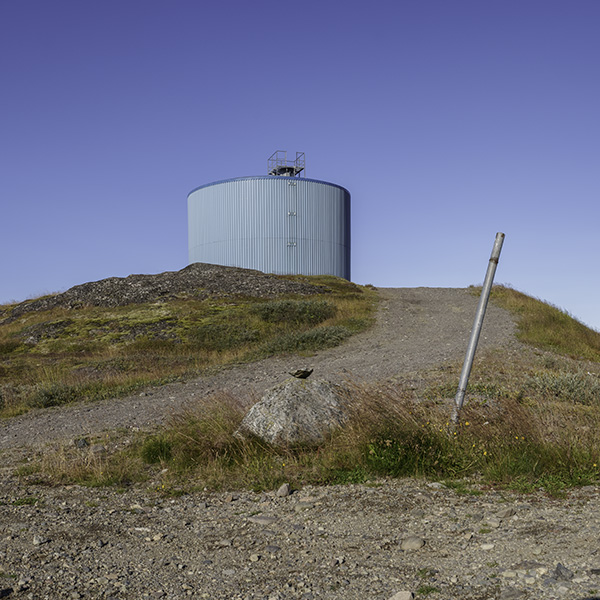
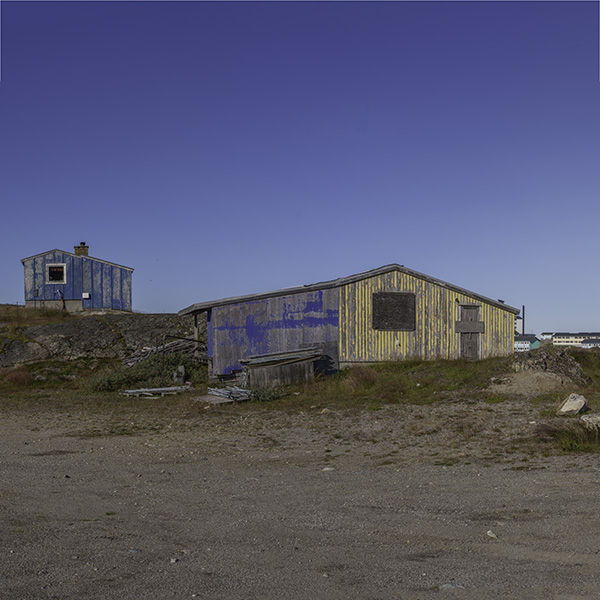
The two frames below are from the edges of the town rather than its centre: a water tank on a gravel hilltop, and a weathered shed with a blue house on the rise behind it. They are what South Greenland looks like away from the harbour postcard, and they took five minutes each.
Practical sources: Noonsite, Narsaq docking and ice · Visit Greenland, Narsaq Museum · Statistics Greenland (population)
Ports on this route — Iceland and Greenland: Hesteyri in the Westfjords · Snæfellsnes: Kirkjufell and Arnarstapi · Iceland’s Golden Circle · Inside the Langjökull ice tunnel · Akureyri to Lake Mývatn · Hiking to Hengifoss · All cruise ports on your own
Written by Jan Madeus — ship’s videographer at sea since 2008. I go ashore in the same ports as the passengers, with the same few hours and the same deadline. More about me.