Visited: 7 October 2026, on a call of MS Amadea at Leixões. The boat left the Ribeira quay at 16:00 and was back in under an hour. The photographs are my own, taken that day.
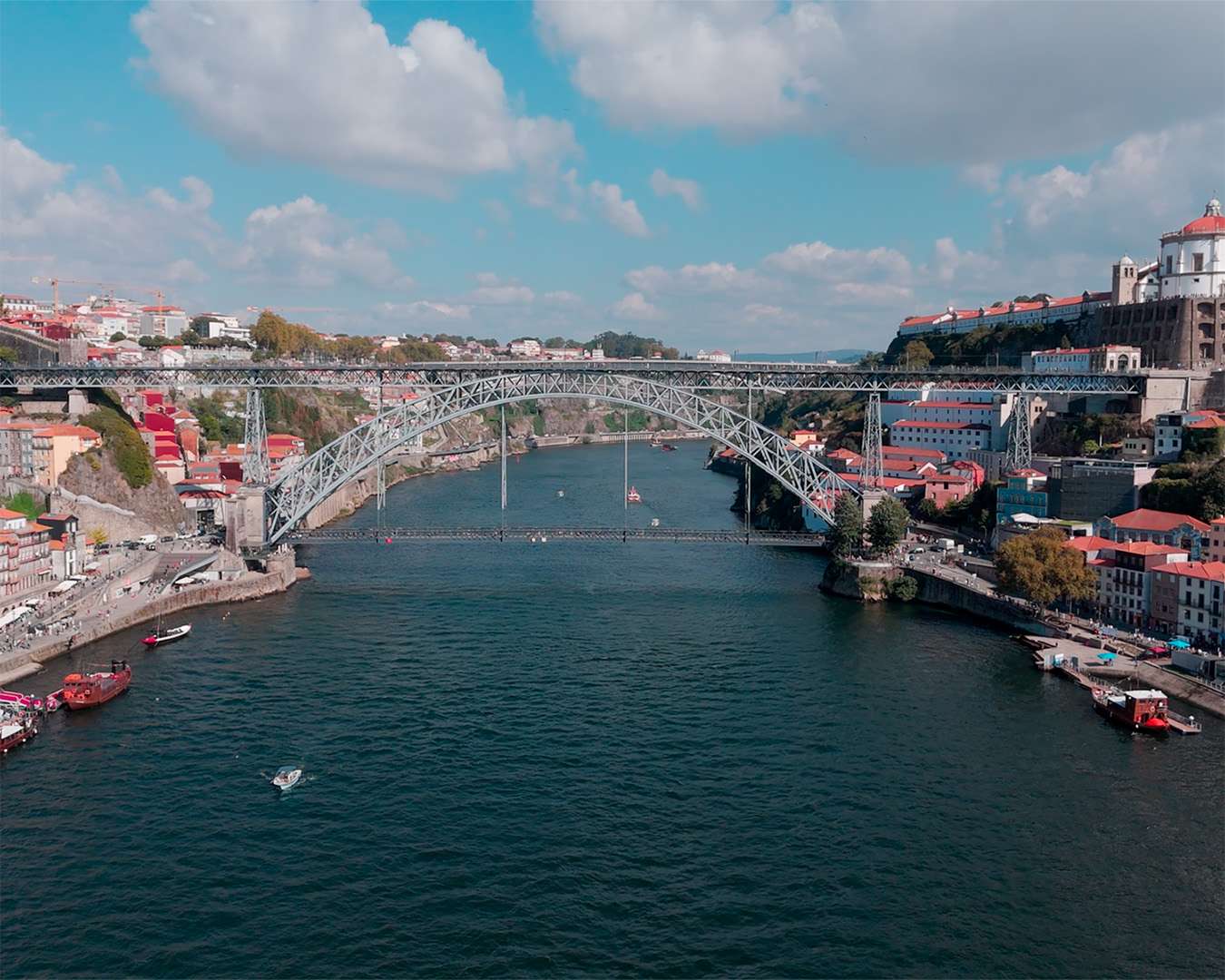
The six bridges cruise is a 50-minute loop on the Douro, upstream to the Freixo bridge and back down to the river mouth, for €18 to €20 in 2026. It is worth doing for one reason: it is the only way to see all six bridges from below, in sequence, in the order they were built. It is not worth doing as a substitute for time in Porto — and if you arrive by cruise ship at Leixões, that is exactly the trade you are making.
What is the six bridges cruise in Porto?
A flat-bottomed boat built in the shape of a rabelo, the old port wine barge, running a fixed circuit between the Ribeira quay in Porto and the Cais de Gaia on the south bank. Upstream as far as the Freixo bridge, downstream as far as the Arrábida, then back. Four operators sell what is effectively the same trip; in October 2026 the price ran from €18 to €20 for adults, and the boats take roughly 60 people.
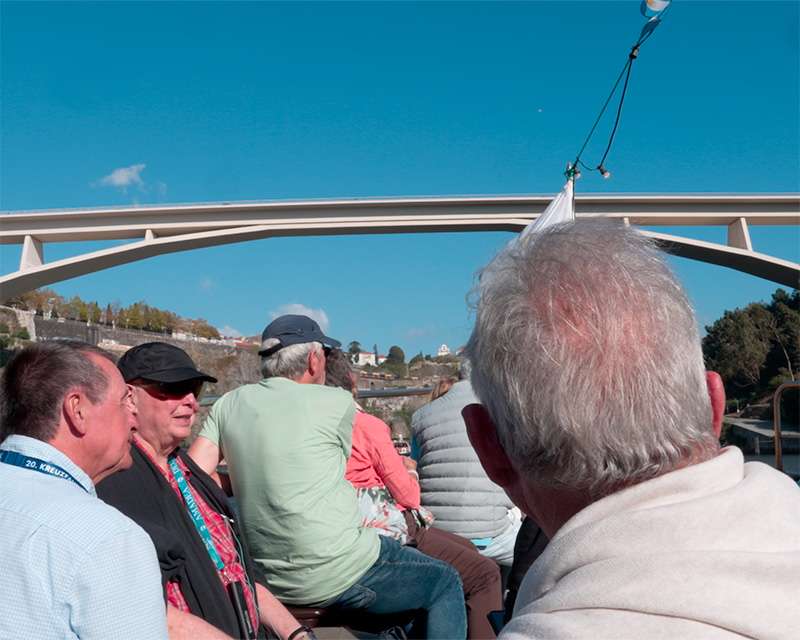
Commentary is a recording, played in sequence as each bridge passes overhead. Ours was in German, which tells you how the market is organised: the boats are filled by coach parties and the tape is switched to match. Expect to be handled rather than guided.
Which bridges do you actually pass?
Six, built across 150 years. Three of them were world records on the day they opened.
| Bridge | Opened | Main span | Why it matters |
|---|---|---|---|
| Maria Pia | 1877 | 160 m | Longest iron arch in the world; built by Gustave Eiffel’s firm |
| Luís I | 1886 | 172 m | Longest arch in the world; two decks; by Théophile Seyrig |
| Arrábida | 1963 | 270 m | Longest concrete arch in the world; by Edgar Cardoso |
| São João | 1991 | 250 m | Took the railway off the Maria Pia; Cardoso again, 28 years later |
| Freixo | 1995 | 705 m long | The motorway crossing; by António Reis and Daniel de Sousa |
| Infante | 2003 | 280 m | One of the shallowest concrete arches anywhere: it rises just 25 m |
The sequence is the story. The Maria Pia came first, in 1877, and it was the first large work of Gustave Eiffel’s firm — though the calculations were largely Théophile Seyrig’s. When the city put the next crossing out to tender a few years later, Eiffel bid again and lost. The contract went to Seyrig, his former partner, working with a Belgian company, and the bridge he delivered in 1886 was longer than the one he had helped Eiffel build: 172 m, on two decks, a world record of its own.
The Maria Pia carried trains for 114 years. In 1991 the São João took the railway, and the older bridge has stood there ever since with nothing to do.
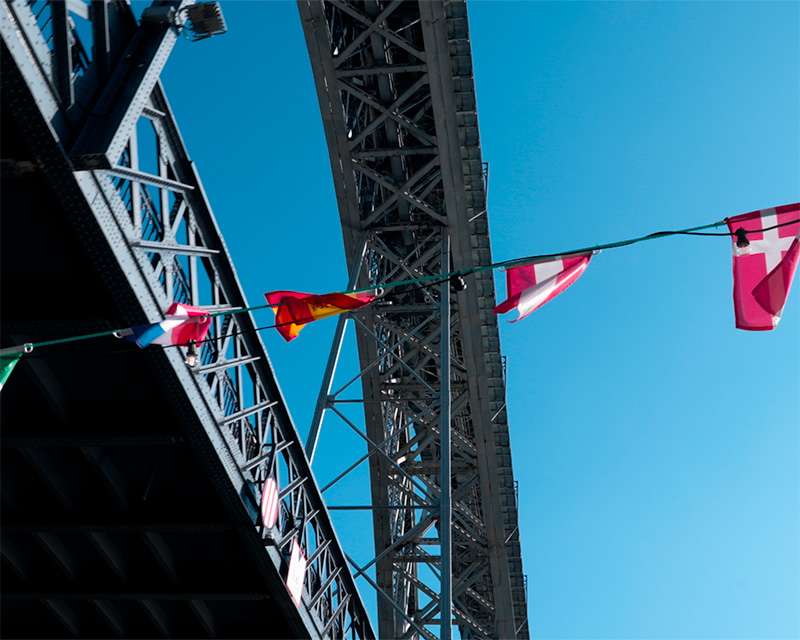
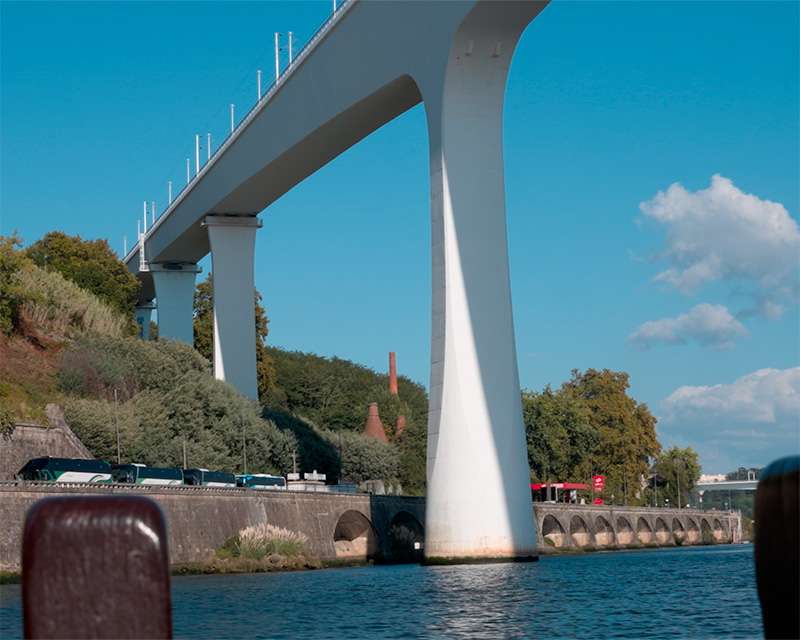
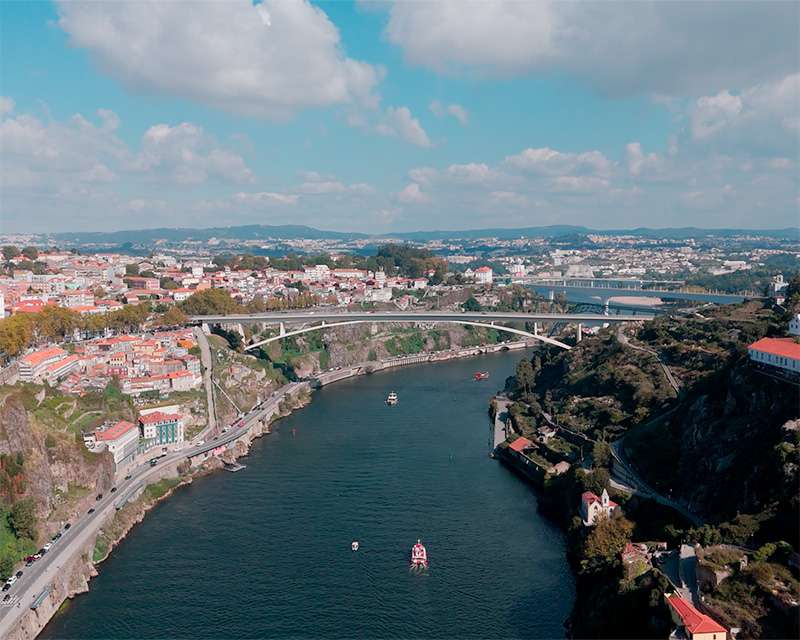
Edgar Cardoso’s two bridges bracket the same idea from opposite ends. The Arrábida of 1963 was the largest concrete arch in the world, 270 m downstream near the river mouth. The São João of 1991 is the one that made the Maria Pia redundant — built by the man who had, three decades earlier, already set the record the Arrábida still carries in the guidebooks. The Infante of 2003 is the subtle one: 280 m of concrete that rises only 25 m above its foundations, which is why from the boat it reads as a line rather than an arch.
The bridge that is no longer there
Before the iron, there was a bridge made of boats: twenty of them moored side by side with a roadway laid over the top, designed by Carlos Amarante and opened in 1806. The middle section could be swung aside to let river traffic through.
On 29 March 1809 French troops broke into the city. People fled south across the bridge of boats, and it failed under them. Estimates of the dead run to around 4,000. The Alminhas da Ponte, a bronze relief of 1897 on the Porto bank, marks the place. The boat passes it in about four seconds, and the recording does not stop.
Why the boat is shaped like that
The rabelo was built for a river that no longer exists. Flat bottom, almost no draught, steered with a long oar from a platform at the stern — everything about it answers a Douro that was fast, shallow and full of rapids. It brought the port wine down from the upper valley.
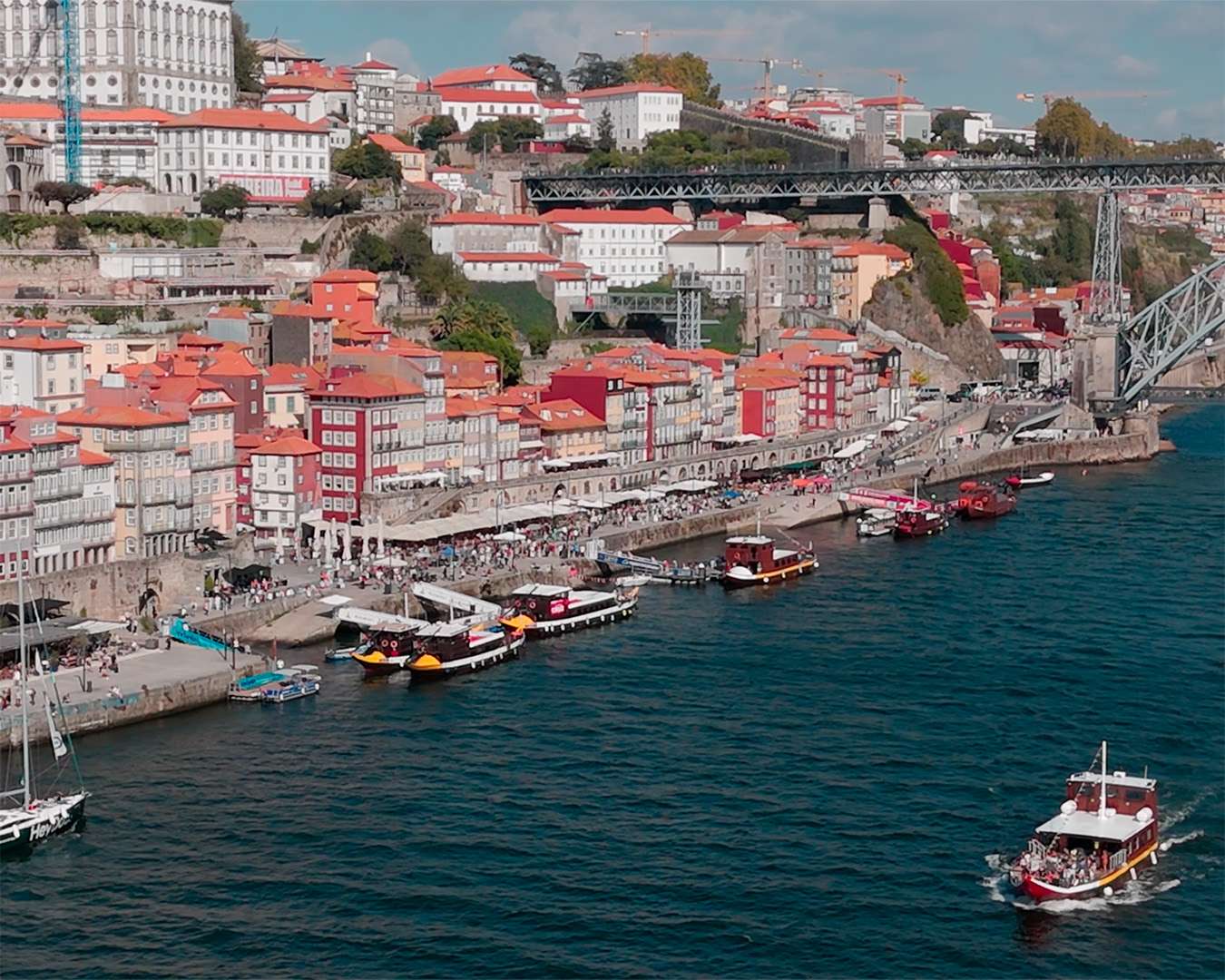
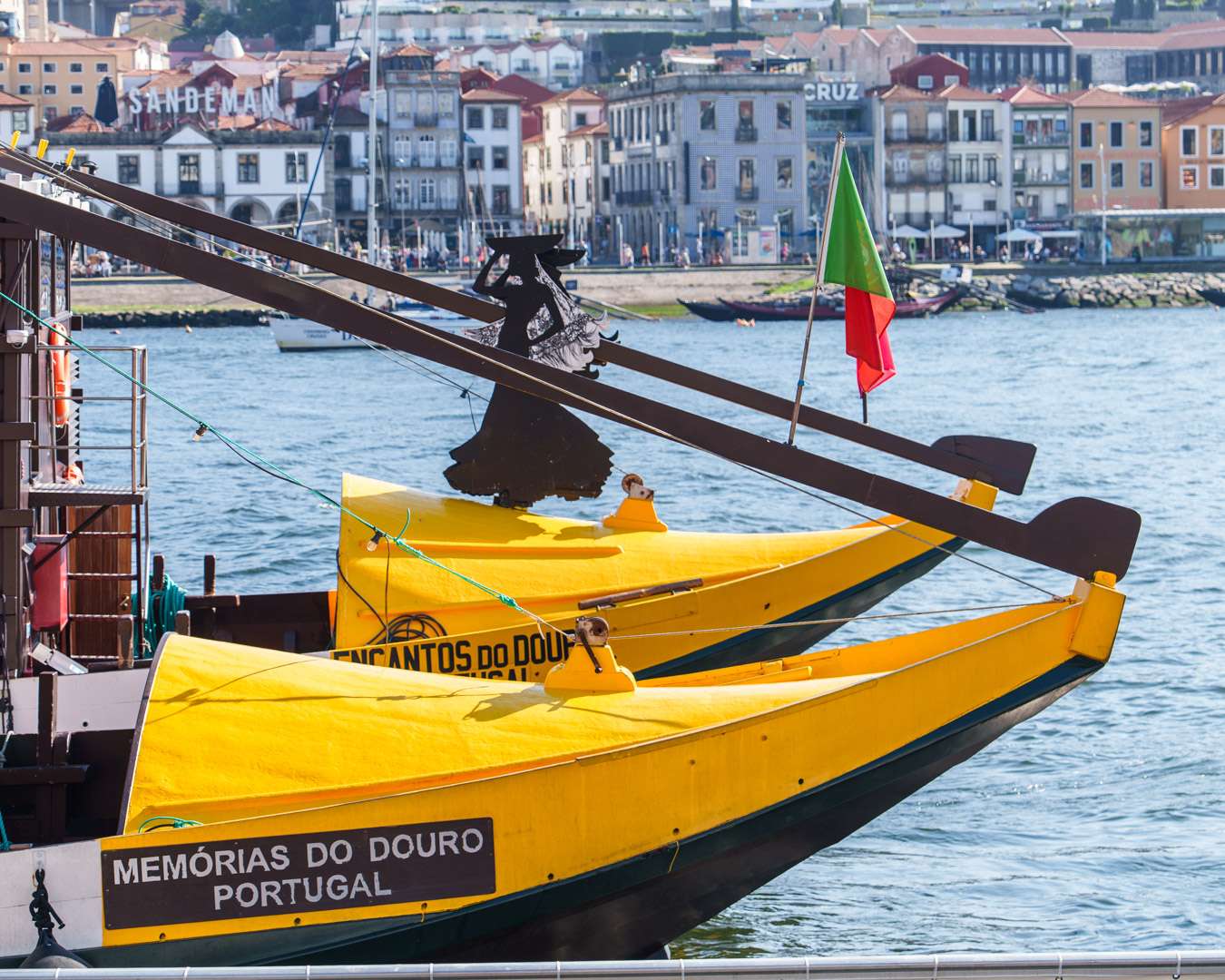
In the eighteenth century the largest rabelos carried between 70 and 100 casks, each pipe holding roughly 550 litres. In 1779 the law set the limit at 70, on safety grounds. By 1961 only six boats were still working, and the last commercial voyage is said to have been made in 1964. Then came the dams, from the late 1960s onwards. The river went quiet, the rapids disappeared, and the design that had solved them became decoration. The yellow boats moored along the Gaia quay below the Sandeman and Cruz signs are advertising now, not transport.
What the river does not show you
While records were being set over the water, the city behind the facades was housed differently. Narrow corridors led off the streets into back yards, and in the yards stood rows of one-room houses: the ilhas. Around 1900 roughly a third of Porto lived in them. A dwelling ran from about nine to sixteen square metres — a kitchen and a room — with a shared tap and an outside toilet for every five to seven houses.
They are not history. More than a thousand ilhas survive, with more than 13,000 people living in them. You see none of this from the boat, and that is worth knowing while you are on it: the river front is the part of Porto that was built to be looked at.
Is the six bridges cruise worth it?
Yes, with two conditions.
It is worth it if you want the bridges, and particularly if you want to photograph them. Fifty minutes gives you six crossings from underneath, in sequence, from a moving platform at water level — a viewpoint you cannot reach any other way, and the single best argument for the trip.
It is not worth it if your time ashore is short. The boat costs you an hour on the water plus the walk to the quay and the queue, which on a port day is closer to ninety minutes of your budget. Spent in the Ribeira and up the hill into the old town, those ninety minutes would show you more of the city.
And be clear about what it is not: it is not a guided tour. The commentary is a tape, the boats run full, and the turnaround at the quay is brisk. Treat it as a river crossing with a view and you will not be disappointed by it.
Doing it from a cruise ship at Leixões
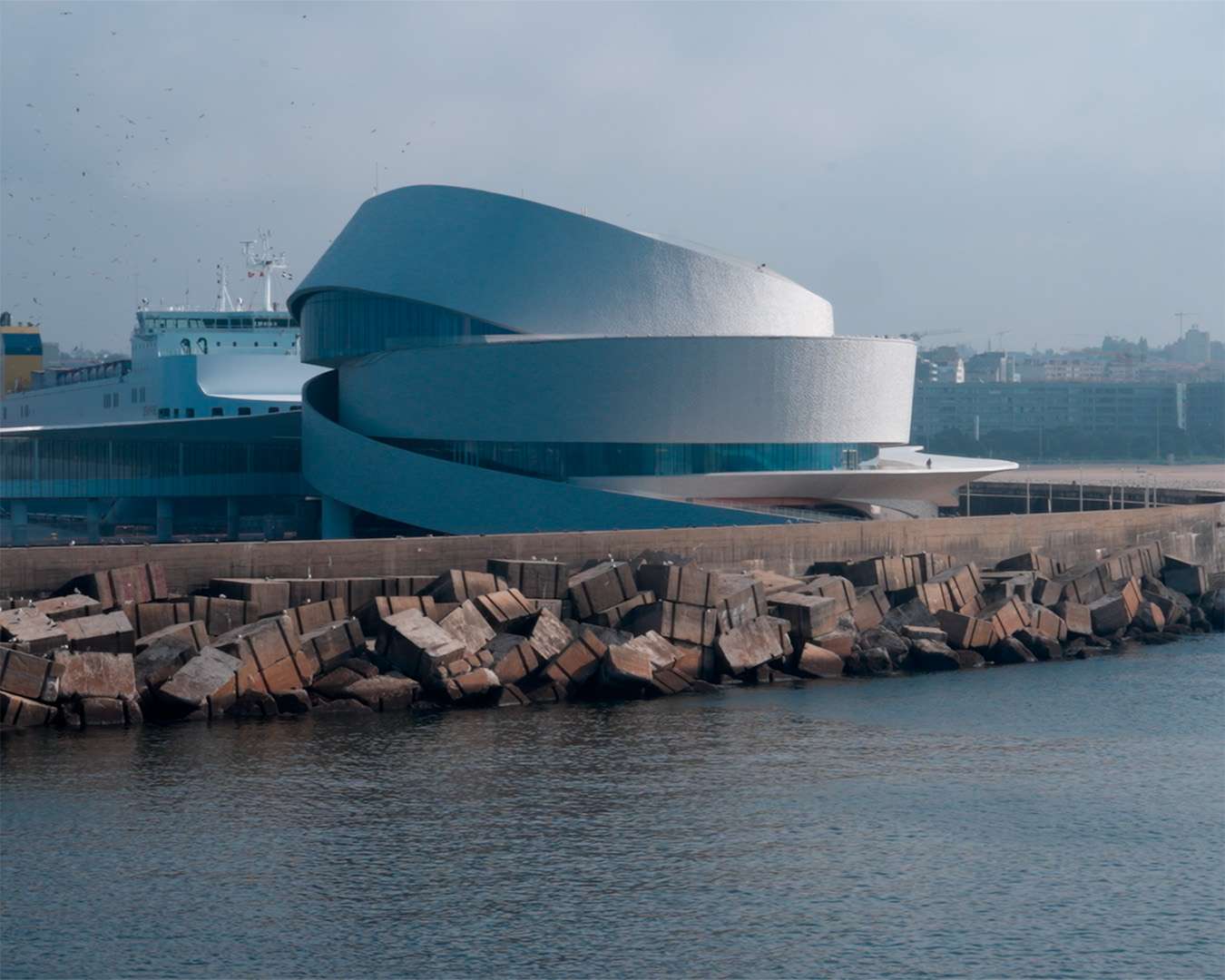
Cruise ships do not come up the Douro. They berth at Leixões, an artificial harbour at the mouth of the Lecça in Matosinhos, begun in 1884 and opened to steamers in 1886. The cruise terminal — the white spiral on the south breakwater, by Luís Pedro Silva — was inaugurated on 23 July 2015. The old town of Porto is about 9 to 10 km away, which is a bus or a metro ride, not a walk.
We went in by coach in the afternoon: a panoramic drive through Porto first, which in heavy traffic is mostly a view of other traffic, then the boat at 16:00. It worked, and it was also the wrong shape for the city. Porto needs half a day at the least and a full day if you can get it — the Ribeira, the climb into the old town, São Bento, and the walk across the upper deck of the Luís I are all on foot and all need time that an afternoon excursion does not have.
If you are doing it independently from the terminal: the gate is about 900 m from Matosinhos Sul station, roughly eleven minutes on the flat, and metro line A runs into Trindáde in about 25 to 30 minutes. An Andante card costs €0.60 and a single fare €1.40 to €1.85 depending on the zone the machine prices for your route; bus 500 follows the coast for around €2.50 to €3 paid to the driver, and a taxi is roughly €15 to €20 each way. I took the ship’s coach on this call, so those figures are checked against two sources rather than against my own ticket — verify the fare at the machine before you budget tightly.
Whatever you choose, be back at the terminal 45 to 60 minutes before all-aboard. The road from the city runs along the coast and it is the one part of the day that traffic can lengthen without warning.
Photographs: where to sit and what the light does
Sit on the left going upstream. That puts the Porto bank — Ribeira, the funicular, the lower deck of the Luís I — on your side for the half of the trip where the boat is close to it, and it puts the sun behind you in the afternoon.
The bridges are not the pictures. The undersides are. From water level an iron bridge is a lattice against sky and a concrete one is a single curve, and both work better cropped hard than framed whole. A 16:00 departure in October gives low, raking light under the arches and a bright sky above them, which is a four-stop range: expose for the metal and let the sky go.
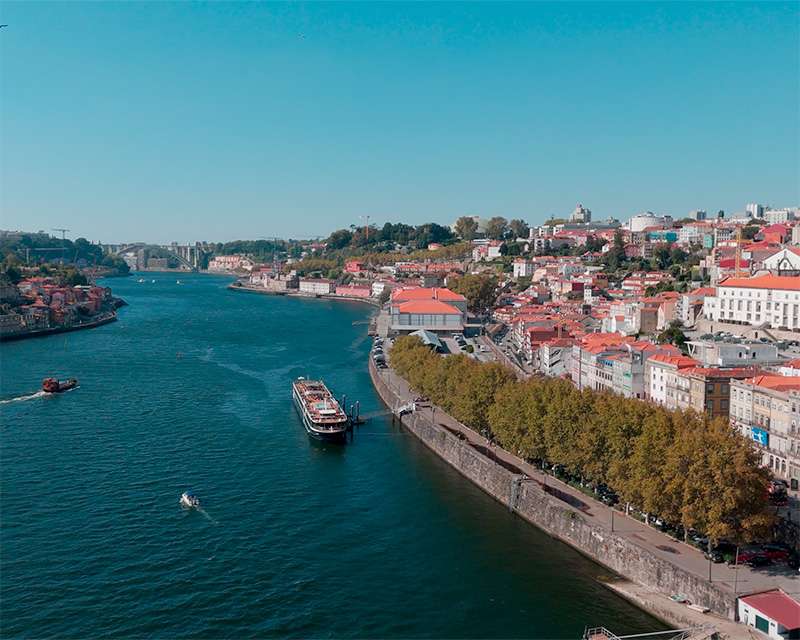
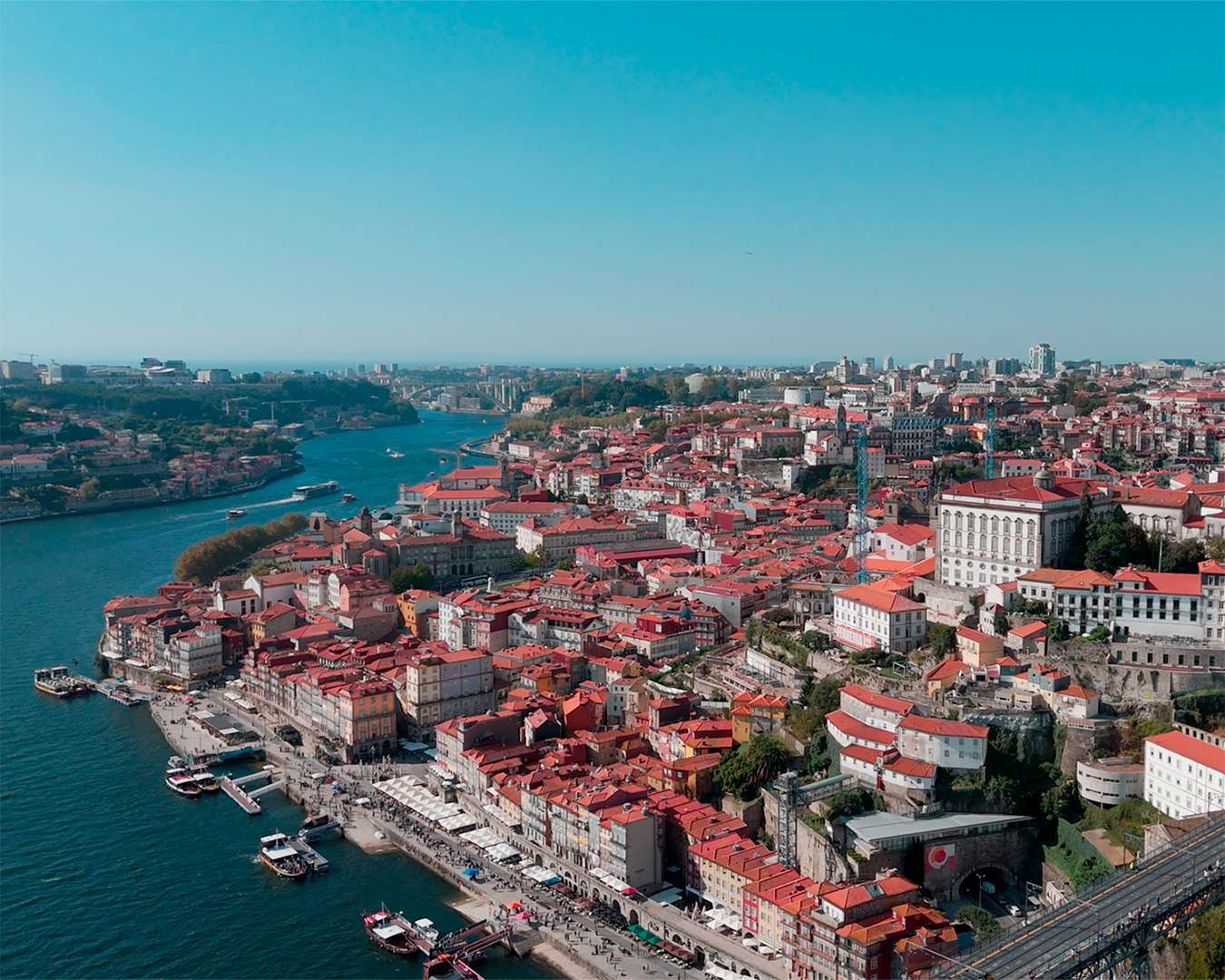
The elevated frames in this article are from the coach, crossing the bridges. If the panoramic drive is part of your excursion, keep the camera out for it — the view down onto the Ribeira from a bridge deck is better than anything available from the boat.
What I would do differently next time
Go in independently, early, and give Porto the whole day. Metro to Trindáde, down through the old town to the river on foot, and the boat late in the afternoon if there is time left for it — in that order, so the city gets the good hours and the river gets the leftovers rather than the other way round.
And twenty minutes at the Alminhas before boarding. Standing where the bridge of boats failed changes what the next fifty minutes are about.
Related: Lisbon cruise port on your own · Funchal: half a day in Madeira’s capital on your own · All cruise ports on your own · All Portugal stories · Diesen Artikel auf Deutsch lesen