
Visited: on several calls at Honfleur, and once as an excursion from Le Havre.
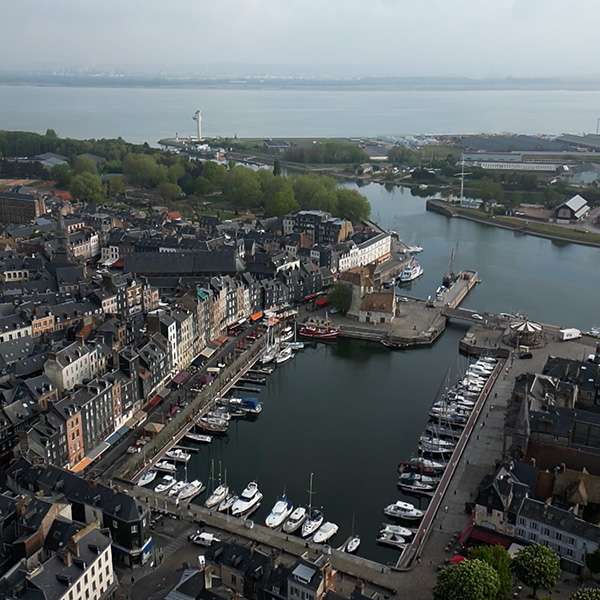
Honfleur is a small harbour town on the south bank of the Seine estuary in Normandy, across the water from Le Havre. Its centre is the Vieux Bassin, a rectangular dock cut in 1681 and ringed by tall, narrow houses faced in slate. Behind it lies an old town of cobbled lanes and, a few streets in, the largest wooden church in France. Half a day is enough to see it; most people wish they had a full one.
Dates and details checked September 2026.
Where is Honfleur?
Honfleur sits at the mouth of the Seine, on the Calvados side, directly opposite Le Havre. The Pont de Normandie crosses the estuary just north of the town, which puts Le Havre about twenty-five minutes away by road and Paris a little over two hours.
The position explains the town. For centuries this was the last sheltered harbour before the open Channel, which made it a port of departure rather than a destination — and it is why a place this size has a history out of proportion to its population.
The Vieux Bassin: the old dock at the centre of Honfleur
The Vieux Bassin is the reason most people come, and it is younger than it looks. The dock was cut in 1681 by order of Colbert, at the urging of the admiral Abraham Duquesne, and finished in 1684. It replaced a narrower harbour, and making room for it meant pulling down part of the town’s western fortifications — which is why the medieval walls have almost entirely gone while a seventeenth-century dock survives intact.
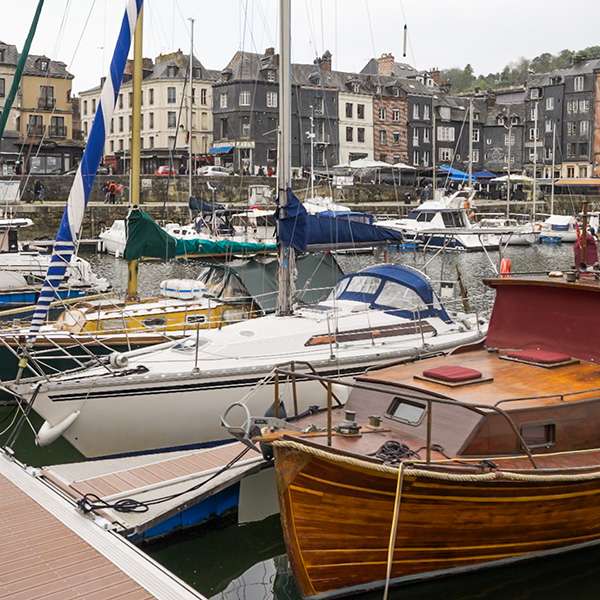
What gives the basin its character is the height of the houses on the Quai Sainte-Catherine: narrow plots built upward instead of outward, several of them six or seven storeys, their fronts hung with slate against the weather off the estuary. The water is nearly still, so on a calm day the whole row is doubled in it. That reflection is the picture everyone takes, and it is worth taking.
The basin is a working marina, not a museum. Fishing boats still lie on the outer quays, and the restaurants along the north side fill from midday. It is small — you can walk around it in ten minutes.
Honfleur old town: the lanes behind the quay
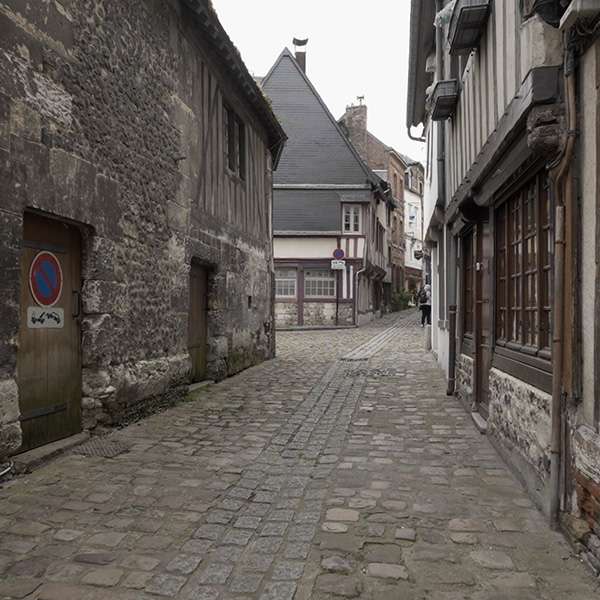
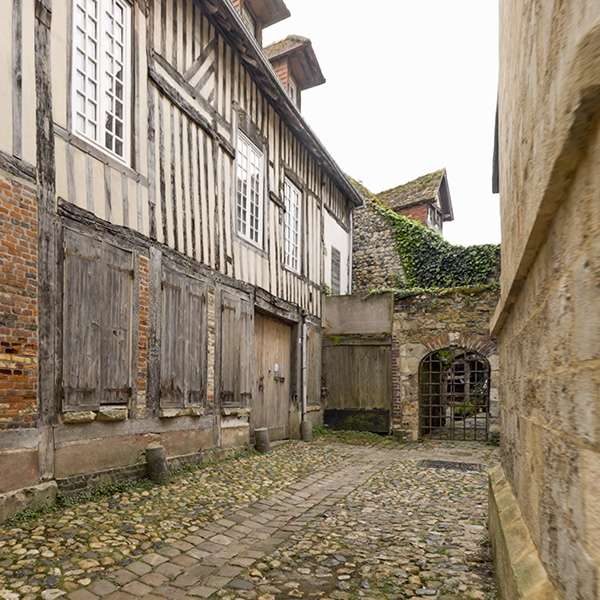
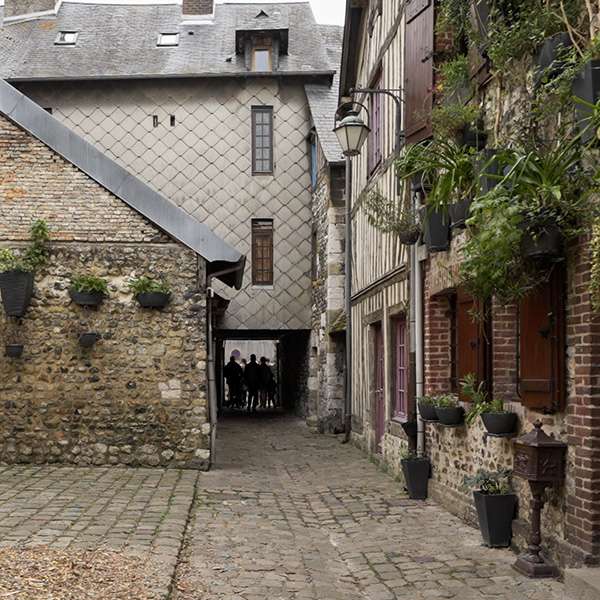
The old town begins one street back and is easy to miss if you stay on the water. The lanes climb gently away from the basin — Rue du Dauphin, Rue des Logettes, Rue de la Prison — in half-timbered and slate-clad houses, with courtyards opening off them and workshops and galleries at street level.
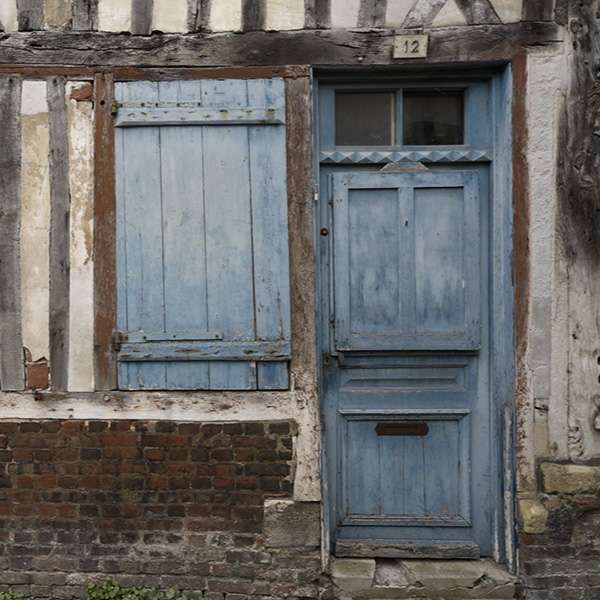
It is a compact quarter and there is no route to follow. Go up one lane and down the next; the town is too small to get properly lost in, and the details are the point: worn cobbles, a blue door in a timber wall, the way slate is used as cladding rather than roofing.
Sainte-Catherine: the church the shipwrights built
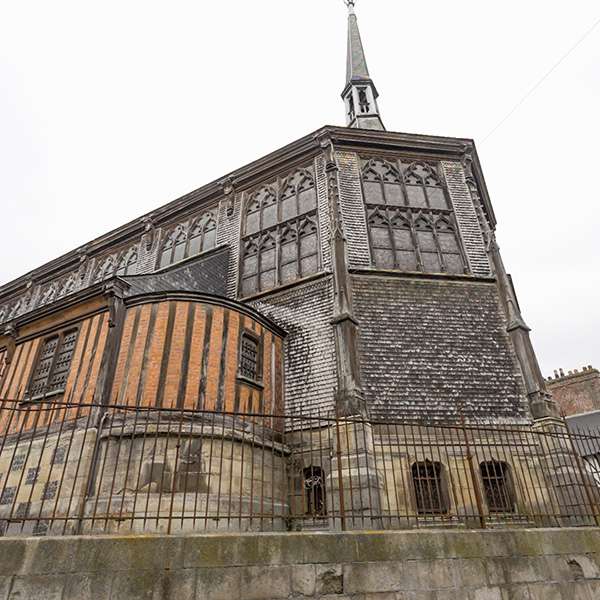
Église Sainte-Catherine is the one building here that is genuinely unusual, and it is a few steps from the market square.
The stone church that stood on the site was destroyed in the Hundred Years’ War. When the town rebuilt, it had no money for masonry but it had a shipyard, so the work went to the maîtres de hache — the axe masters of the Honfleur yards — who used oak from the Touques forest and the only technique they knew. The first nave went up from 1460; a second was added in 1496 as the population grew, and both were extended in the following century.
The result is a church built like a hull. Stand under the first nave and look up: the timber vault is an upturned boat, the same curve and the same jointing. It is the largest wooden church in France with a separate bell tower — and the tower is separate for a practical reason. It was put at a distance, on top of the bell-ringer’s house, so that a lightning strike on the tallest thing in town would not take the congregation with it.
The Lieutenance, and what is left of the fortifications
At the seaward end of the basin stands the Lieutenance, a stone building that was the lodging of the king’s lieutenant — the royal governor of the town. It is the only significant piece of Honfleur’s fortifications still standing, everything else having gone when the dock was dug.
It takes two minutes and needs no ticket. Worth knowing what you are looking at, though: it is not a decorative leftover but the last stone of the walled town that the Vieux Bassin replaced.
The painters: Boudin, Monet and the Saint-Siméon farm
Honfleur has a stronger claim on the beginnings of Impressionism than its size suggests. Eugène Boudin was born here, and it was Boudin who worked outdoors on this estuary and talked the young Monet into doing the same. Courbet, Jongkind and Monet all gathered at the Ferme Saint-Siméon above the town — the group is remembered as the Saint-Siméon school, and the farm is now a five-star hotel.
The town museum carries Boudin’s name and holds work by him and his circle; the bell tower of Sainte-Catherine is an annexe of it. Erik Satie was born here too, in 1866, and his birthplace is open as a museum of its own.
What all of them were after is still there, and it is the reason the light in Honfleur is worth planning around: an estuary this wide, this shallow and this exposed produces a sky that changes every twenty minutes.
Honfleur and Quebec: the port Champlain sailed from
In 1608 Samuel de Champlain’s expedition sailed from Honfleur and founded Quebec. It is the town’s largest footnote and is marked around the harbour, and it fits the pattern: Honfleur was where ships left from, not where they arrived.
Arriving by cruise ship: Honfleur or Le Havre
Honfleur is its own cruise port for ships of moderate size, and that is the version worth having. The berth lies about twenty minutes on foot from the old town along the waterside — a real walk, but a flat and straightforward one — and the ship usually also runs a shuttle bus that covers it in about fifteen minutes. Either way you need no excursion at all to reach the Vieux Bassin.
Larger ships cannot get in. For them the town is a shore excursion from Le Havre, roughly twenty-five minutes over the Pont de Normandie. I have done it both ways, and the difference is not the drive but the clock: from Le Havre you are on somebody else’s schedule; from the Honfleur berth you are on your own.
The ship’s excursions from Honfleur — and what to do instead
When the ship lies at Honfleur, the excursion desk sells you the town along with the country behind it. The list usually looks like this.
| Excursion | Time | Worth booking? |
|---|---|---|
| Guided walk in Honfleur | about 2.5 h | No — the old town is twenty minutes away on foot and too small to get lost in |
| Panoramic drive, Pays d’Auge | about 3.5 h | Yes — Beuvron-en-Auge and the Calvados country need wheels |
| Deauville and Honfleur | about 4.5 h | Yes for Deauville; the Honfleur half you already have |
| Étretat | about 4 h | Yes — a good hour each way, and the cliffs are the reason to go |
The pattern is the one that runs through this whole series. Anything inside the town is a walk you can take yourself; anything beyond it needs a vehicle. The guided walk covers Sainte-Catherine, the old salt warehouses and the Lieutenance in about ninety minutes — all of them in this article, and all of them free to stand in front of. The inland trips are a different matter: Beuvron-en-Auge, Deauville and Étretat are not reachable on foot and have no useful public transport from the quay.
If the call is long enough to choose, the honest split is a morning on foot in Honfleur and an afternoon excursion inland — not the other way round.
How long do you need, and when to go
Three hours covers the basin, the old town and Sainte-Catherine at a reasonable pace. A full day lets you add the Boudin museum and the walk up towards the Côte de Grâce for the view back over the estuary.
Spring and early autumn are the better seasons — the light is long, the crowds are thinner, and Honfleur in August is a town of its own size trying to hold several times its population. The Saturday market on the Place Sainte-Catherine is worth timing a visit around if you can.
Photo notes
The Vieux Bassin is a reflection problem. The row on the Quai Sainte-Catherine doubles in the water only when the air is still, and the basin is sheltered enough that this happens often — early morning most reliably, before the restaurants set out and the first boats move.
The houses are tall and the quay is narrow, so a wide lens is not optional if you want the whole row. Inside Sainte-Catherine the opposite applies: the light is low and even, the wood eats it, and the vault only reads as a hull if you get far enough back to see the curve.
Related: St Peter Port, Guernsey · Jurassic Coast Adventure · Santiago de Compostela · All cruise ports on your own
Written by Jan Madeus — ship’s videographer at sea since 2008. I go ashore in the same ports as the passengers, with the same few hours and the same deadline. More about me.