
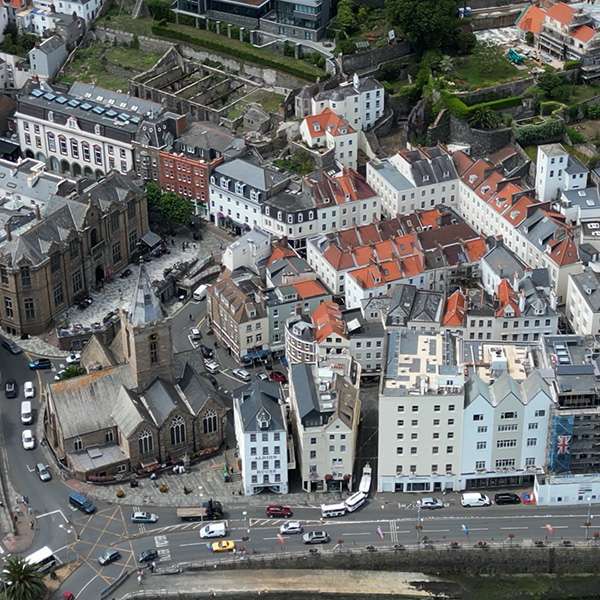
Visited: July 2025, on a call of MS Amadea.
St Peter Port is the capital of Guernsey, on the island’s east coast, looking across the Little Russel channel to Herm and Sark. It is Guernsey’s only town: steep cobbled lanes stacked above a marina, a thirteenth-century castle on the harbour mouth, and Victor Hugo’s house of exile high above the rooftops. The centre can be walked in an afternoon.
Opening times and prices below checked September 2026 — verify before you travel.
Where is St Peter Port, and which country is it in?
St Peter Port is on Guernsey, in the Channel Islands. Guernsey is a British Crown Dependency: self-governing under the Crown, not part of the United Kingdom and not part of France. Its international code is GG and its postcodes begin GY, which is why addresses here look neither quite British nor quite foreign.
The Channel Islands lie off the Normandy coast, much closer to France than to England — Guernsey is about 45 kilometres from the French mainland and roughly 120 from the English south coast. St Peter Port faces east, towards France and the smaller islands.
Guernsey is a British Crown Dependency, not part of the United Kingdom. It has its own government, its own postage stamps and its own pound, which circulates alongside sterling at par. Street names run in both English and Guernésiais, the island’s Norman French, and the result is a town that looks British at first glance and stops looking it the moment you read a sign.
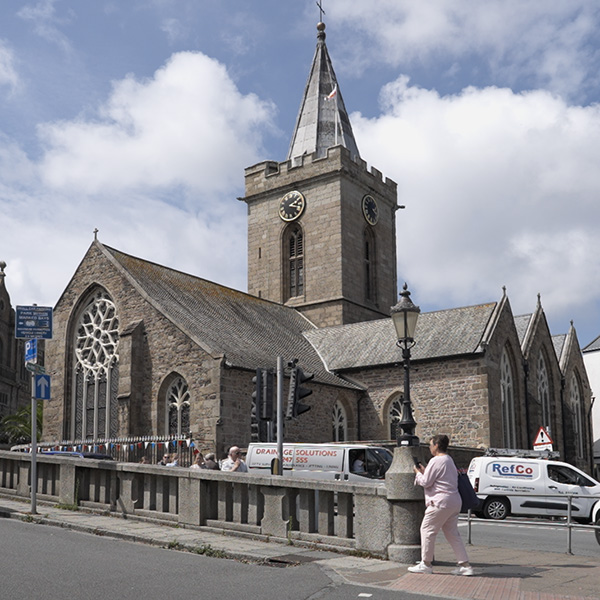
Is St Peter Port the capital of Guernsey?
Yes. St Peter Port is the capital and the seat of the island’s parliament, the States of Guernsey. It is also one of Guernsey’s ten parishes, and the only one that amounts to a town — everything else on the island is village, lane and field.
That is worth knowing before you arrive, because it sets expectations correctly. A capital city this is not. It is a harbour town whose centre you can cross on foot in fifteen minutes, and whose scale is part of what makes it worth the trip.
Things to do in St Peter Port
The town works as a walk rather than a list. It rises steeply from the seafront, and the stepped lanes and Victorian terraces above the High Street keep opening onto sudden views of the harbour, the castle and the islands on the horizon.
Four things are worth planning around: Castle Cornet at the harbour mouth, Hauteville House above the town, Candie Gardens for the view, and the old harbour at low water. The first two cost money and have seasons. The last two are free and depend only on when you are there.
Candie Gardens deserve the half hour. The public gardens hold heated Victorian glasshouses and a statue of Victor Hugo looking out to sea, and the outlook from the terrace is the best in town without a ticket.
Castle Cornet, the fortress on the harbour mouth
Castle Cornet has guarded the entrance to the harbour since the thirteenth century, first as a fortress on its own tidal island, later as a governor’s residence, and now as a museum complex with five small museums and a set of period gardens inside the walls. A causeway connects it to the pier, so you walk out rather than take a boat.
In 2026 it is open 25 March to 6 September, 10.00 to 17.00. Admission is £12 for adults and £3 for children aged 7 to 17 and students. The noon-day gun is fired daily by staff in scarlet uniform, and a free guided tour at 10.30 fits neatly before it — the ramparts are where you want to be at noon.
Hauteville House: Victor Hugo’s years of exile
Victor Hugo lived in exile on Guernsey from 1855 to 1870, and Les Misérables was finished here. Hauteville House, the tall white house he bought above the town, is preserved close to the state he left it in, and it is not an ordinary writer’s house: Hugo decorated it himself, floor to ceiling, in carved oak, tapestry and salvaged furniture, ending in a glass look-out at the top with a view towards the French coast he could not return to.
In 2026 it opens May to September, Thursday to Tuesday, 10.00 to 16.00, closed Wednesdays. Admission is £12 for adults and £10 concessions, free for under-18s. Visits are by guided tour only, in groups of up to ten and lasting about an hour, and booking is essential — this is the one thing in St Peter Port you cannot improvise on the day.
Herm and Sark: the islands from St Peter Port
Two of the smaller Channel Islands are day trips from the harbour, and both are car-free.
Herm is a mile and a half long and reached by the Travel Trident catamaran from Crown Pier in about twenty minutes, roughly hourly through the summer, £14–16 return. Sark is about fifty minutes each way and has no tarmac roads at all — horse carriage, bicycle or on foot. Sark needs a full day; Herm can be done in half of one.
How to get to St Peter Port
By air, Guernsey Airport sits about six kilometres from the town and is served year-round from several UK airports; Aurigny is the island’s own airline.
By sea, Condor Ferries — now part of the Brittany Ferries group — runs to St Peter Port from Poole and Portsmouth in England, from St Malo in France, and across to Jersey. The terminal is in the town itself, so you arrive where you want to be rather than at an outlying port.
Arriving by cruise ship
St Peter Port is a tender port: there is no cruise berth, ships anchor in the Little Russel, and the harbour rules require the ship’s passengers to come ashore in local licensed launches rather than the ship’s own boats. Landing is at Albert Pier, in the middle of town.
If that is how you are coming, the timings, costs and return buffer are set out separately in Saint Peter Port Cruise Port on Your Own, which covers the half-day version of this town.
The tide, and when to walk the harbour
Guernsey’s tidal range is about ten metres, among the largest anywhere. It rebuilds the harbour twice a day, and the old harbour at low water is the sight nobody puts on a postcard: the boats lying keeled over on clean wet sand, masts tilted, the working waterfront turned into something closer to a sculpture garden.
Check the tide tables before you plan the day, not after. High water and low water are two different towns, and only one of them is photographable.
Questions people ask about St Peter Port
Which country is St Peter Port in? Guernsey, a British Crown Dependency in the Channel Islands. It is not part of the United Kingdom, though the UK handles its defence and foreign affairs, and it is not part of France despite lying 45 kilometres off the Normandy coast.
What does GG mean in a Guernsey address? GG is Guernsey’s international country code. Local postcodes run GY1 to GY10, with St Peter Port itself in GY1. An address ending “St Peter Port, GY1” is in the town centre.
Is St Peter Port the capital of the Channel Islands? No. The Channel Islands have no single capital: St Peter Port is Guernsey’s, St Helier is Jersey’s, and the two islands are separate jurisdictions with separate parliaments.
How long do you need in St Peter Port? Half a day covers the town on foot with Castle Cornet. A full day adds Hauteville House or a boat to Herm. Two days if you want Sark as well.
Can you walk from the harbour into town? Yes — the landing at Albert Pier is in the town centre, and the High Street begins a couple of minutes from the quay. Nothing in St Peter Port needs transport; the only effort is uphill.
What is the currency in Guernsey? The Guernsey pound, issued locally and worth the same as sterling, which also circulates freely. Guernsey notes are not generally accepted back in the UK, so spend them before you leave.
Related: Saint Peter Port Cruise Port on Your Own · Honfleur, Normandy · Jurassic Coast Adventure · All cruise ports on your own
Written by Jan Madeus — ship’s videographer at sea since 2008. I go ashore in the same ports as the passengers, with the same few hours and the same deadline. More about me.