
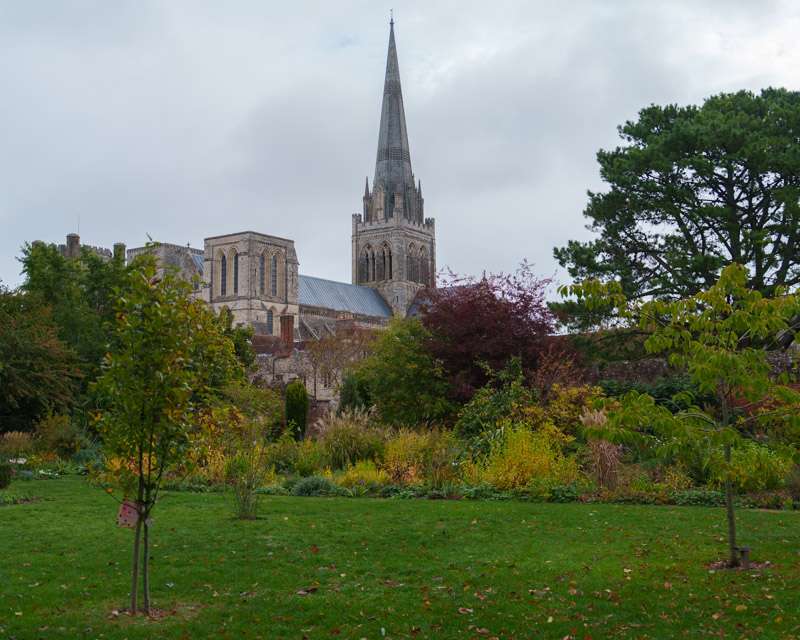
Visited: 15 October 2026, on a call of MS Amadea at Portsmouth International Port. The photographs are my own, taken that day.
Chichester is a good half hour east of Portsmouth by coach, and it is the one excursion of this port day you can just as easily do alone: the train runs direct from Portsmouth Harbour, takes 30 to 36 minutes and costs from about £10 single. The ship’s coach cost €79. For that you get the ride, a talk outside the cathedral and two and a half hours of free time in the town — enough for the cathedral, the Market Cross and a stretch of Roman wall.
The Chichester excursion at a glance
| Port of departure | Portsmouth International Port. MS Amadea lay alongside from 07.00 to 18.00 on 15 October |
| Journey time | About 30 minutes by coach on the dual carriageway, some 28 km east |
| Duration | About 3.5 hours in all, of which roughly 2.5 hours are free time in the town |
| Price | €79 (Phoenix Reisen, MS Amadea 2026/27 programme, prices from August 2026) |
| On your own | Train from Portsmouth Harbour, direct, 30 to 36 minutes, about 55 services a day, single from £9.80. The terminal is 2.8 km from Portsmouth & Southsea station — on transit calls a free port shuttle runs into the centre |
| Cathedral | Mon–Sat 9.00–17.00, Sun 12.30–14.30. Entry free, recommended donation £7 per person. Groups of six or more must book ahead |
| All on foot | Cathedral, Market Cross, city wall and Pallant House all sit inside the Roman walls, less than ten minutes apart. Flat, no climb |
| Return buffer | 45 to 60 minutes before all-aboard. Going by train, add the port shuttle to that |
| Visited | 15 October 2026, MS Amadea. Prices checked October 2026 |
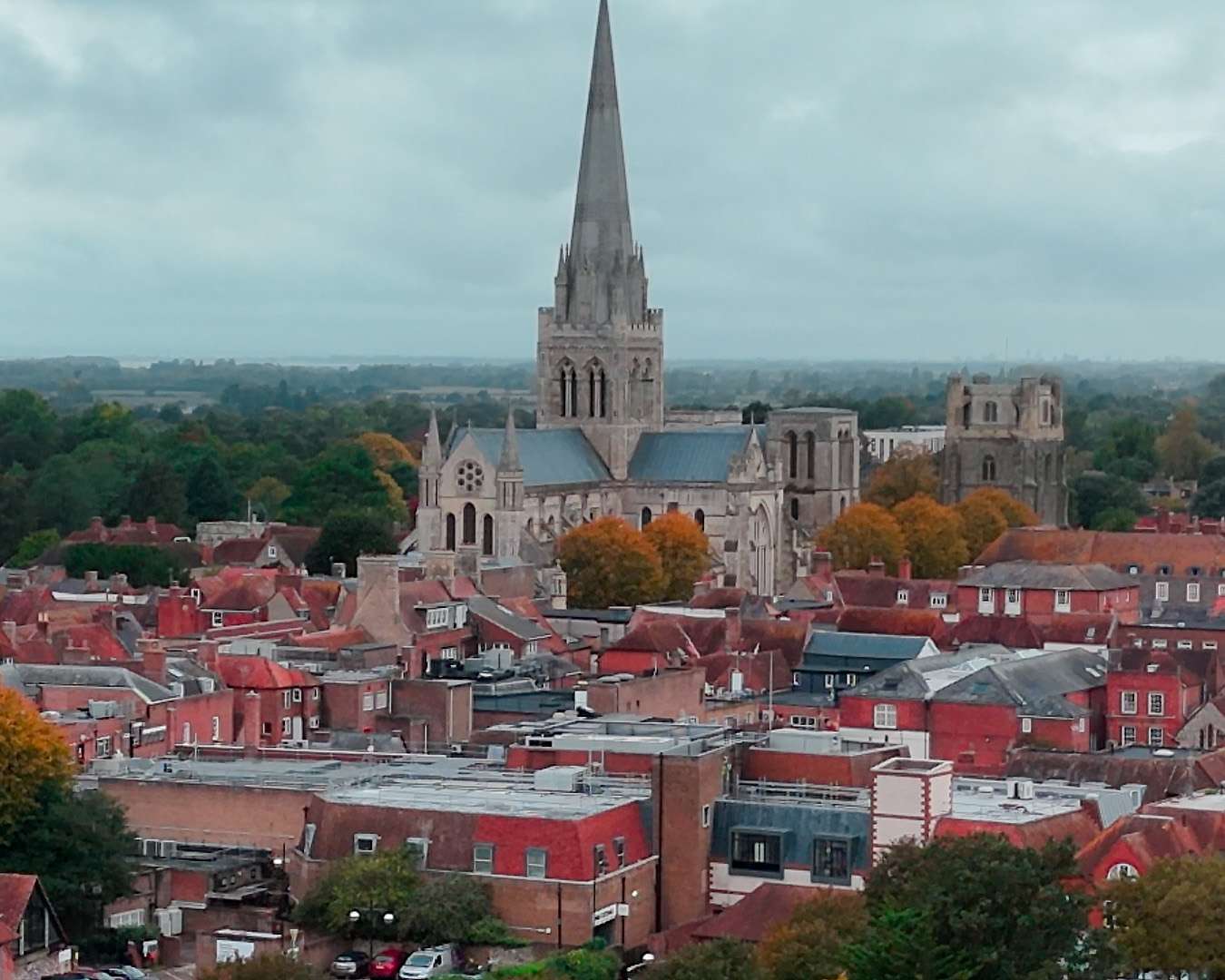
Ship’s coach or train? What Chichester from Portsmouth really costs
This is the port day where the arithmetic is worth doing.
The train from Portsmouth Harbour to Chichester runs direct, takes 30 to 36 minutes, goes about 55 times a day and costs from £9.80 single. Return is therefore around twenty pounds — for two people together, less than one place on the coach. Amadea lay in port for eleven hours. Time is not the constraint on this day.
The catch is not the train but what comes before it. The cruise terminal is not the town centre: it is 2.8 km to Portsmouth & Southsea station, and the walk crosses port and ferry ground beside fast roads. On transit calls a free port shuttle serves several stops in the centre — ours ran all day. Without that shuttle the train journey turns into a taxi fare.
So what the €79 buys is not the distance. It is the fixed seat, somebody watching the clock, and a talk outside the cathedral. The two and a half hours of free time the programme promises are the two and a half hours we got — the excursion delivers what it advertises. The question is only whether that is worth eight times the fare when the shuttle is running anyway.
What you can do in Chichester in two and a half hours
Considerably more than in most port towns, and the reason is the street plan. The Romans laid it out and it is still legible: four main streets — North, South, East and West — crossing at right angles. The crossing point is the exact centre of town, and the Market Cross stands on it. From there it is under ten minutes to the city wall in any direction.
First hour: the cathedral. It stands on West Street, two minutes from the Cross. The interior with its modern artworks takes the best part of an hour if you do more than walk through it.
Next half hour: the Market Cross and a stretch of the pedestrianised centre. Chichester has about 29,400 residents (2021 census) and a high street that lives off them rather than off visitors.
Third half hour: out onto the City Walls Trail. The circuit on and beside the Roman wall is 2.4 km; half an hour covers a good quarter of it and gets you back.
Last half hour: either Pallant House Gallery — at £17, with last entry an hour before closing, it is tight on two and a half hours but possible — or a coffee and back to the coach in good time.
What does not fit: the full wall circuit, the Novium Museum with its Roman baths, and both of those together with the gallery.
Chichester Cathedral: opening times, entry and the catch for groups
The cathedral is open Monday to Saturday from 9.00 to 17.00 and on Sunday only from 12.30 to 14.30. Entry is free; the recommended donation is £7 per person. Individual visitors need not book. There are guided tours at 11.30 and 14.30, about 45 minutes each, and spire tours booked in advance.
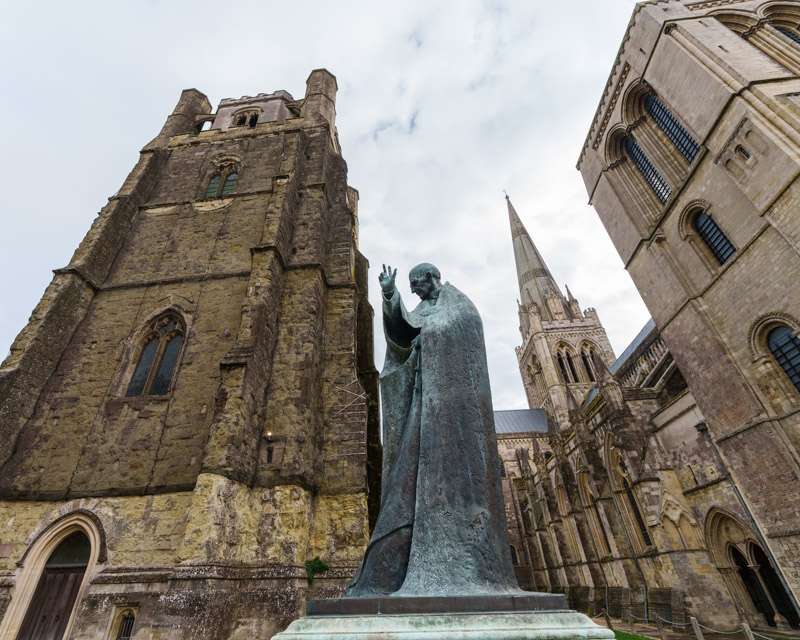
For coach parties there is one line in the small print that explains the shape of the visit: groups of six or more must book ahead, and a booking charge applies to groups. The ship’s programme puts it as explanations being given “at the exterior visit” — the talk happens outside, and you go in afterwards on your own. That is not a failing of the excursion but the cathedral’s own rule, and for the visitor it is rather an advantage: you are not standing in a group in the quire, you go at your own pace.
Travelling independently, take the 11.30 tour. It costs nothing beyond the donation and answers in 45 minutes most of what you would not work out alone.
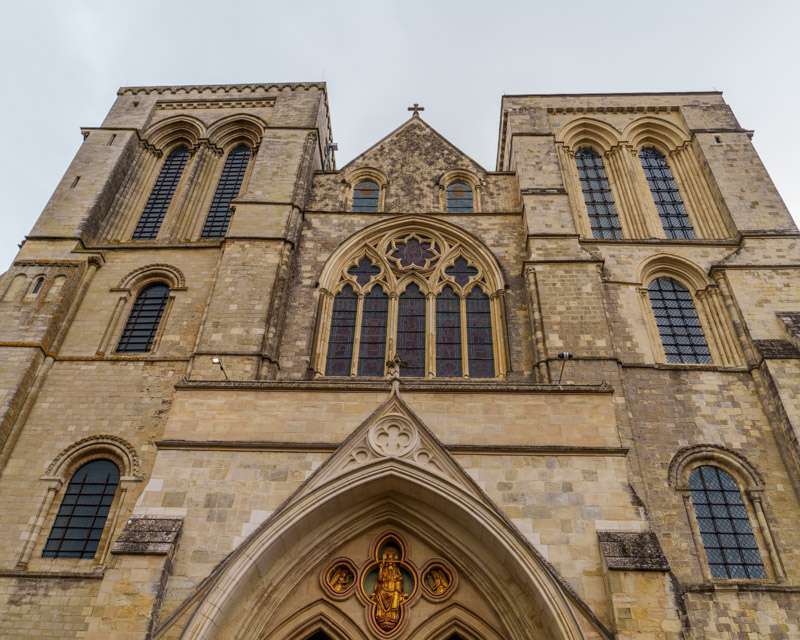
A building in layers: 1075 to 1861
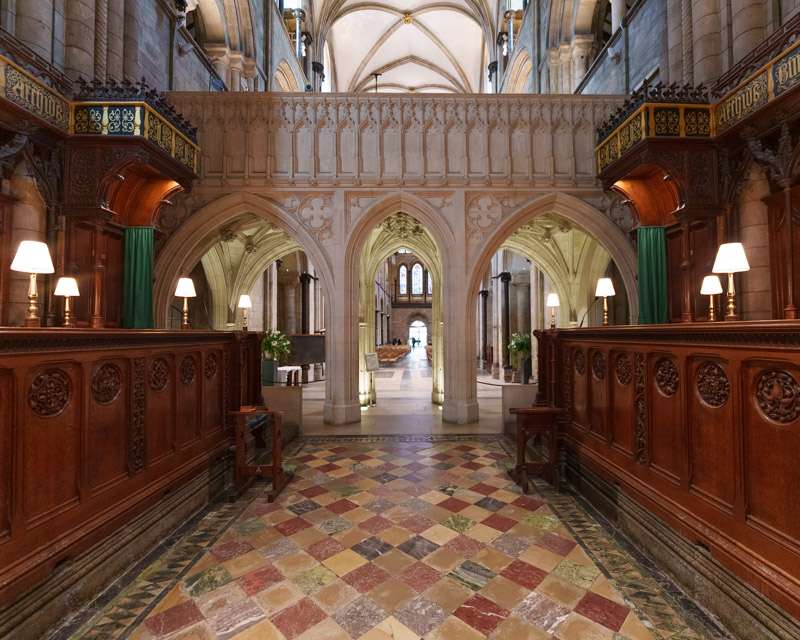
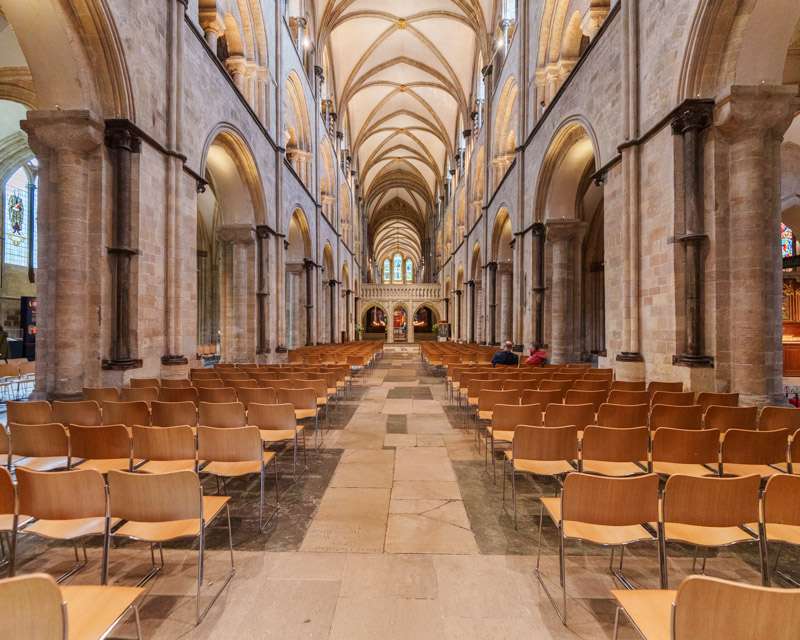
The bishop’s seat moved from Selsey to Chichester in 1075, at the point when the Normans were marking the conquered country with churches. The cathedral was consecrated in 1108 under Ralph de Luffa. It burnt out in 1187 and was reconsecrated in 1199; the rebuilding replaced the wooden ceiling with a stone vault.
What came out of that reads like a palimpsest as you walk through it: Romanesque arcades below, Gothic layers above, all in the same room. You do not need to be an architectural historian to see the seams.
On 21 February 1861 the crossing tower and spire collapsed into themselves. Nobody was hurt; the failure had been announcing itself for days. It was rebuilt as a replica by George Gilbert Scott, from drawings by the fabric architect Joseph Butler, in about five years. The appeal raised £48,000, with contributions from Queen Victoria and Prince Albert.
The present spire is 82 metres and the third tallest in England — and the only medieval English cathedral spire visible from the sea.
Two further things here are unique among England’s medieval cathedrals: the free-standing bell tower of the early fifteenth century beside the west front — no other English cathedral keeps its bells in a separate building — and the double aisles.
Chagall, Piper, Sutherland: modern art in a Romanesque church
This is what makes the building more than another English cathedral. Through the twentieth century it brought contemporary art into the fabric deliberately, and the works do not hang in a side chapel — they hold the main positions.
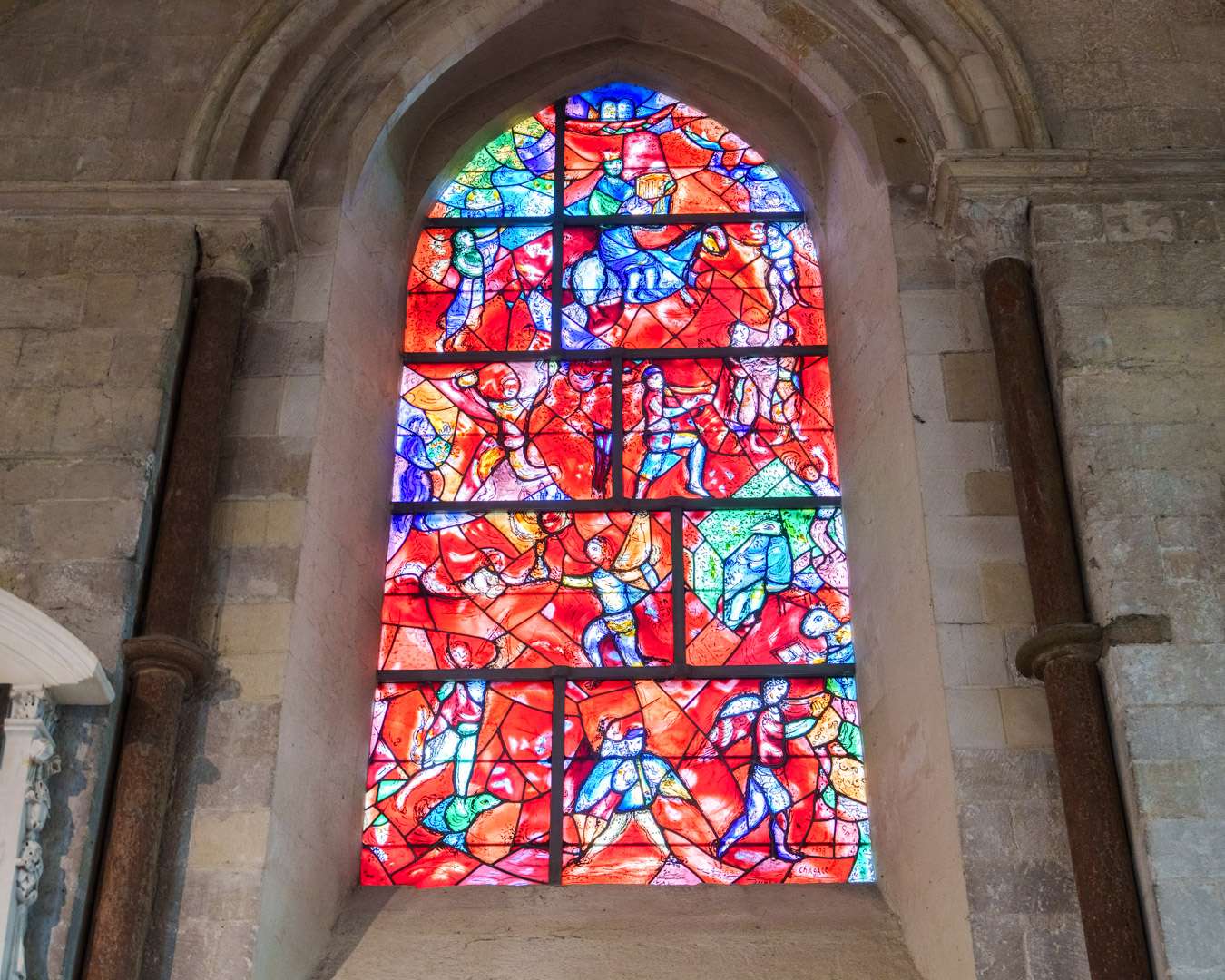
The Chagall window was installed in 1978, when Marc Chagall was over ninety. It is among the last of his great works in glass, and it celebrates Psalm 150 — let everything that has breath praise the Lord. It is worked in red, which in a church full of blue and green glass looks like a mistake until the sun comes through it. And it is one of the few modern works in an English cathedral that does not decorate but answers. It sits in the eastern part of the church; the cathedral’s own plan lists it as point 18.
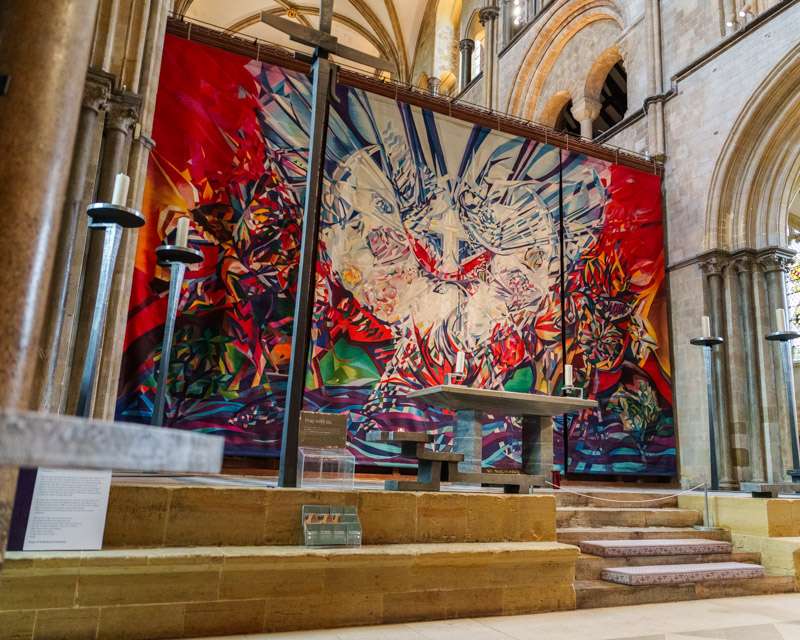
John Piper’s tapestry behind the high altar dates from 1966 and has the Trinity at its centre. Graham Sutherland’s “Noli me Tangere”, painted in 1961, hangs in the St Mary Magdalene Chapel. Add Hans Feibusch’s “Baptism of Christ” of 1951 in the Baptistry in the south-west tower, and Cecil Collins’s “Icon of Divine Light” of 1973, the altarpiece in the Chapel of St Clement.
And then the counterweight: the Chichester Reliefs, two carved stone panels from the second quarter of the twelfth century, found during building work in 1829. They show the raising of Lazarus, and they are nine hundred years older than everything else in this section. Side by side, each makes more sense than it would alone.
The Arundel Tomb and the line every English reader knows
In the north aisle lies a fourteenth-century tomb: Richard FitzAlan, tenth Earl of Arundel, and his second wife Eleanor of Lancaster. The two lie side by side in stone — and they are holding hands. The tomb originally stood in Lewes Priory and came here after its dissolution in 1537.
Philip Larkin wrote a poem about it in 1955, “An Arundel Tomb”, and its closing line has passed into the language. Knowing it changes how you stand in front of the stone. Larkin himself later pointed out that the joined hands may be a restorer’s addition — which does not make the poem worse, only more English.
Noviomagus: why the town looks the way it does
The Romans called the place Noviomagus Reginorum — the new market of the Regni, a Celtic tribe settled here before the conquest. After the invasion of AD 43 Chichester was built up into one of the most important administrative centres in southern England, the capital of the Civitas Reginorum.
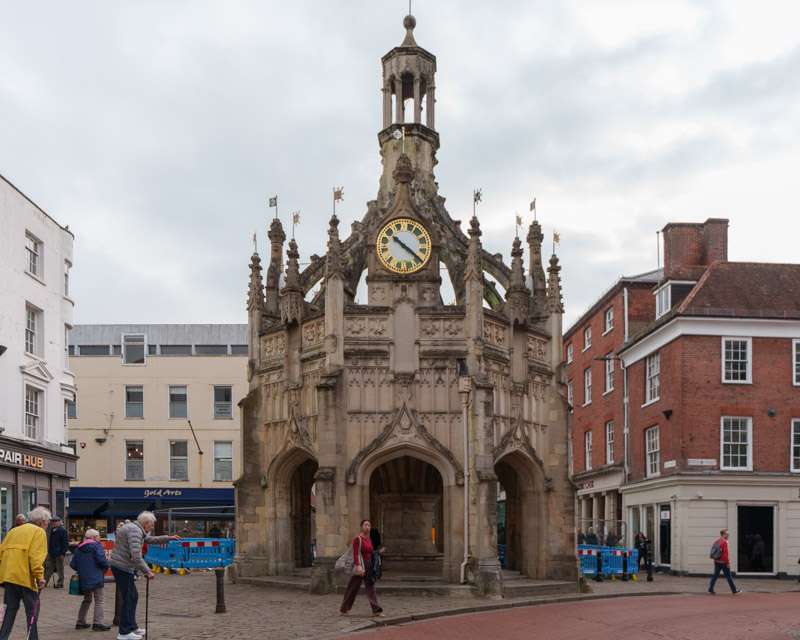
The Market Cross stands where the four Roman axes meet: an octagonal limestone canopy about fifteen metres tall, with finials, arches and a clock that came later. Four dials show the time down the principal streets. It was the gift of Bishop Edward Story — the inscription gives 1501, while the architectural dating runs from 1477 to 1503. Its purpose was not display: it was built so that poor people had somewhere covered to sell their wares. It counts among the best preserved medieval market crosses in England.
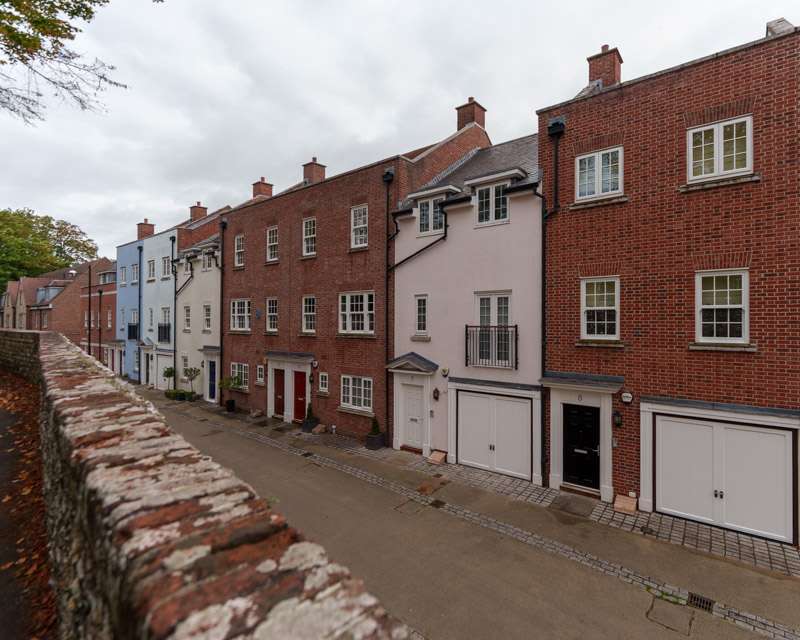
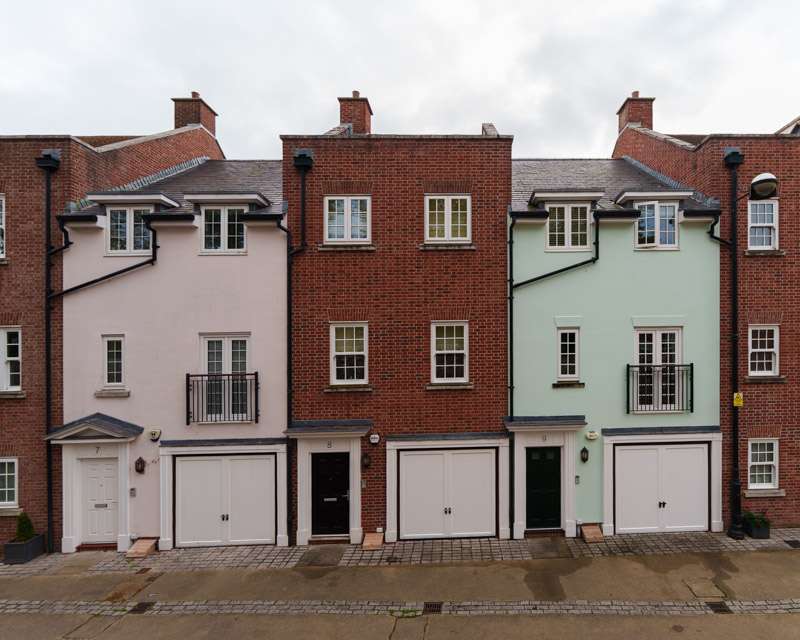
The city wall is Roman, built around AD 200, enclosing roughly 40 hectares over a circuit of about 2.4 km. Some eighty per cent of the ring survives; what you see today has been renewed over centuries, but the line has not moved. Walking the City Walls Trail means walking a line drawn some 1,800 years ago. It is free and open at any time, marked with plaques set into the ground; for a short visit the eastern stretch repays the walk best, because terraced houses stand directly on the rampart there.
Pallant House and the Festival Theatre
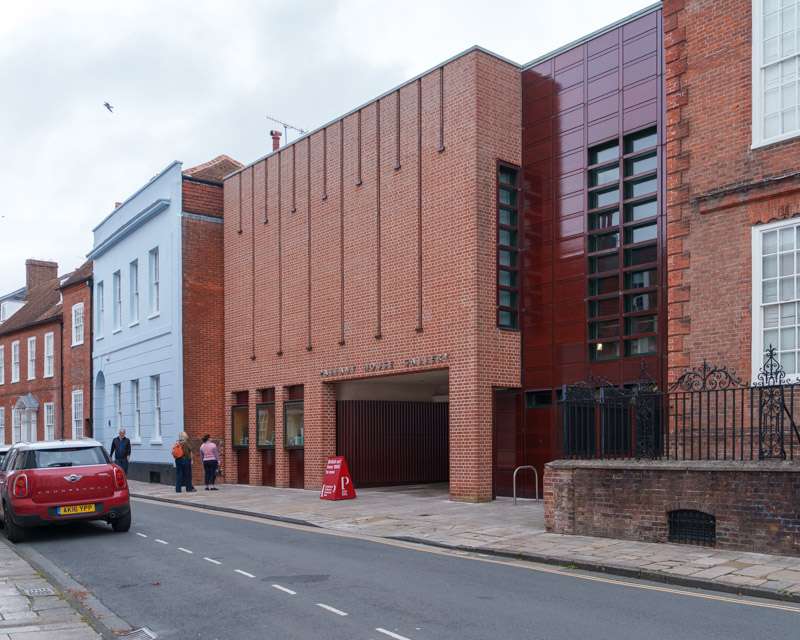
Pallant House Gallery shows modern British art in a townhouse of 1712 with a brick extension beside it. Tuesday to Saturday 10.00–17.00, Sunday 10.00–16.00, closed Monday, last entry an hour before closing. £17 for adults, free for under-18s, £8.50 for 18 to 25. On two and a half hours it is the decision against everything else; on a day of your own by train it is the reason to come.
Chichester Festival Theatre opened in 1962, founded by Leslie Evershed-Martin, with Laurence Olivier as its first artistic director. The first National Theatre company was formed here. The main house seats 1,206 and the Festival Season runs roughly from April to October. For a port day that is not a sight but an explanation: this small town has a theatre that London watches.
What a day in Chichester costs
| Item | October 2026 | Note |
|---|---|---|
| Ship’s excursion “Chichester” | €79 | about 3.5 hrs, of which 2.5 free; coach both ways, a talk outside the cathedral |
| Train, Portsmouth Harbour to Chichester | from £9.80 single | direct, 30–36 min, about 55 services a day, Southern |
| Port shuttle, terminal to the centre | free | transit calls only, several stops |
| Chichester Cathedral | free, recommended donation £7 | Mon–Sat 9.00–17.00, Sun 12.30–14.30; groups of 6+ must book |
| Guided tour of the cathedral | included in the donation | 11.30 and 14.30, about 45 minutes |
| Market Cross, city wall, City Walls Trail | free | open at any time, 2.4 km circuit |
| Pallant House Gallery | £17 adults, under 18 free, 18–25 £8.50 | Tue–Sat 10.00–17.00, Sun 10.00–16.00, closed Mon |
| For comparison: Buckler’s Hard excursion | €85 | about 4 hrs, same port day |
| For comparison: London panoramic drive | €109 | about 9 hrs, of which some 4 on the coach |
| For comparison: Stonehenge and Salisbury | €139 | about 7.5 hrs |
Prices I could not confirm are left out. Excursion prices from the MS Amadea 2026/27 programme, dated August 2026; admissions and opening times checked with the cathedral and the gallery in October 2026.
Photography in the cathedral: what is allowed
Non-flash photography for personal use is explicitly welcome — not during services and special events. What is not allowed: tripods and monopods, selfie sticks, and photographs or recordings of the cathedral choir at any time. Drones need prior permission.
For an English cathedral that is generous, and it has a practical consequence. Without a tripod, and in the light that comes through these windows in October, the hand decides. The Chagall window takes a short exposure because it is lit from behind; the nave does not. If you want both, you need a quiet minute against a pillar.
15 October was overcast from end to end — flat light, white sky. Outside that means no shadow on the west front, but no drawing in the sky either. For the interior it is the better condition, because the windows are not fighting hard sun.
What I would do differently next time
Go independently — not because the excursion is poor, but because the port day holds more. Two and a half hours in Chichester is a fair allowance, and the coach gets you back on time. But with eleven hours in port, a free port shuttle and a direct train every few minutes, those same two and a half hours become a whole day, and €79 becomes twenty pounds. Then there is room for the cathedral, the full wall circuit and Pallant House.
And get into the cathedral earlier. The 11.30 tour is the natural way in, and it puts you inside before midday, before the coach parties arrive.
Common questions about Chichester from Portsmouth
How far is Chichester from Portsmouth?
About 28 kilometres east, roughly 30 minutes by coach on the dual carriageway. By train from Portsmouth Harbour it is 30 to 36 minutes with no change.
Can you visit Chichester without the ship’s excursion?
Yes, and on this port day it is the obvious answer. The train runs direct, about 55 times a day, from £9.80 single. The condition is the free port shuttle into the centre — from the terminal it is 2.8 km to Portsmouth & Southsea station across port ground.
What did the ship’s excursion cost?
€79 for about 3.5 hours, of which two and a half were free time in the town, coach both ways and a talk outside the cathedral (Phoenix Reisen, MS Amadea 2026/27, prices from August 2026).
Is there an admission charge at Chichester Cathedral?
No. Entry is free with a recommended donation of £7 per person. Open Monday to Saturday 9.00–17.00 and Sunday 12.30–14.30. Groups of six or more must book ahead.
Where is the Chagall window?
In the eastern part of the cathedral; the cathedral’s own plan lists it as point 18. It was installed in 1978, when Chagall was over ninety, and celebrates Psalm 150. Non-flash photography is allowed; tripods are not.
Is two and a half hours enough for Chichester?
Yes. The cathedral, the Market Cross and a stretch of Roman wall all sit inside the walls, less than ten minutes apart, and nothing involves a climb. It only gets tight if Pallant House Gallery is to come as well.
Sources for the figures in this article: opening times, donation, tours and photography rules from Chichester Cathedral, artworks and dates from its art pages; building history, spire collapse and bell tower from the cathedral entry; the Market Cross from Chichester Cross; the city wall from Britain Express; population and Roman name from the town entry; the theatre from the Festival Theatre entry; train times and fares from Trainline; the gallery from Pallant House Gallery. Excursion prices and durations from the MS Amadea programme.
Written by Jan Madeus — ship’s videographer, at sea since 2008. I go ashore in the same ports as the guests, with the same few hours and the same all-aboard time. More about me.
Related: Portsmouth Cruise Port on Your Own — how far you get without a ticket · Buckler’s Hard from Portsmouth · Cruise Ports on Your Own — every port guide
Ports on this route — the British Isles: Portsmouth Cruise Port on Your Own · Falmouth Cruise Port on Your Own · St Ives from Falmouth · St Mary’s and the Isles of Scilly · Saint Peter Port on your own · All cruise ports on your own