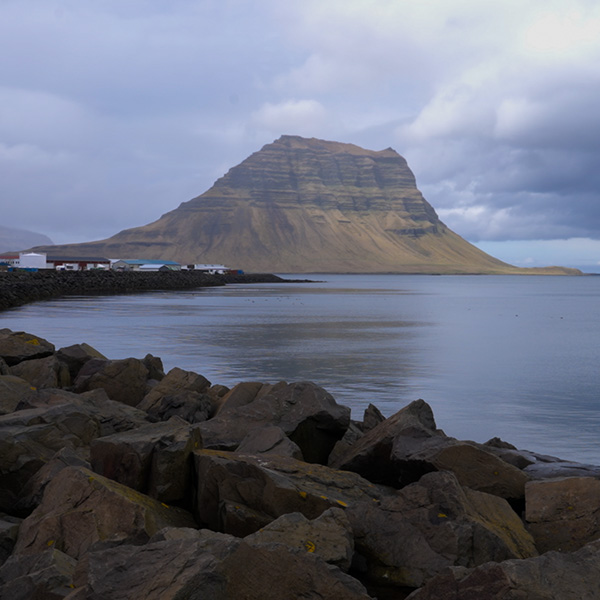
The Snæfellsnes Peninsula packs most of Iceland into one drivable day: Kirkjufell above Grundarfjörður, the Snæfellsjökull glacier volcano (1,446 m), the black pebble beach of Djúpalónssandur, the cliff walk from Arnarstapi to Hellnar and the lone black church at Búðir. From Reykjavík it is roughly 180 km (about 2.5 hours) to Grundarfjörður; the loop around the peninsula’s tip adds another 90 km. Entry to Snæfellsjökull National Park is free — you pay only for parking at the main stops and for the optional lava-cave tour. This is how our day unfolded, with current costs at the end.
Visited: May 2026. Prices and opening hours below checked August 2026.
Our journey begins in Grundarfjörður, a small fishing village nestled beneath the dramatic peak of Kirkjufell, Iceland’s most photographed mountain. With its iconic, symmetrical shape rising beside a cascading waterfall, this natural landmark sets the tone for the landscapes that follow – wild, poetic, and full of legends.
From Grundarfjörður, we set off to explore the Snæfellsnes Peninsula, often described as “Iceland in Miniature” for its incredible variety of landscapes: glaciers, lava fields, volcanic craters, rugged coastlines, black beaches, and charming fishing villages.
Snæfellsjökull: The Glacier of Legends
Our route winds through small coastal settlements as we approach the mystical Snæfellsjökull Glacier. This 1,446-meter-tall, ice-capped stratovolcano is not just a geological wonder but a cultural one. It famously served as the fictional gateway to the Earth’s core in Jules Verne’s Journey to the Center of the Earth. Icelanders have long considered the area around Snæfellsjökull a place of energy and mystery, with tales of trolls, spirits, and hidden people.
Djúpalónssandur: The Black Pebble Beach
Our next stop is Djúpalónssandur, a striking black pebble beach that was once home to a thriving fishing village. While little remains of the village today, the area holds historic remnants of its seafaring past. A short walk leads us to an observation platform, offering sweeping views of the North Atlantic and the curved shoreline scattered with polished lava pebbles. Near the beach, you’ll also find four ancient “lifting stones” – once used to test the strength of fishermen.
Malarrif Visitor Centre and the Vatnshellir Cave
We make a short stop at the Malarrif Visitor Center, where interactive exhibits provide insights into the geology and ecology of the peninsula. Managed by the Snæfellsjökull National Park, it’s a perfect place to deepen your understanding of the unique natural forces shaping the region.
Arnarstapi: Cliffs, Seabirds and the Walk to Hellnar
The route continues to Arnarstapi, a picturesque village on the southern coast of the peninsula. The harbor, tucked into lava formations, is home to a lively colony of seabirds, including Arctic terns and kittiwakes. The coastal walking path from Arnarstapi to nearby Hellnar — about 2.5 km one way, 45–60 minutes at a photographer’s pace — features dramatic sea cliffs and basalt formations shaped by centuries of waves and wind – a paradise for photographers and birdwatchers alike.
Búðir: A Church in the Lava
We end our journey in Búðir, where the historic Búðakirkja stands in solitude against a backdrop of lava fields and distant mountains. This black wooden church, built in the 19th century, is one of Iceland’s oldest and most photographed. The contrast between its dark facade and the unusual light-colored sand surrounding it – a result of pulverized seashells left by wolffish – adds to the ethereal atmosphere.
What Snæfellsnes Costs (2026)
| Ship’s excursion from Grundarfjörður | Duration | Price |
|---|---|---|
| Grundarfjörður walking tour | about 3 hrs | €49 |
| Lava field and Viking paths | about 4.5 hrs | €189 |
| Vatnshellir lava cave | about 3.5 hrs | €399 |
Phoenix Reisen, MS Amadea 2027 programme, prices checked April 2026. The cave is the outlier: €399 for three and a half hours, where the entrance ticket bought on the spot is a small fraction of it — what you are paying for is the coach that gets you the 40 km there and back.
Entry to the national park and all the sights above is free — Snæfellsnes charges you through the car parks. Current figures, checked August 2026: Kirkjufell 1,200 ISK (EasyPark app, QR code or machine), Arnarstapi 1,000 ISK (Parka app), Malarrif Visitor Centre 750 ISK (Parka app). The visitor centre itself is free and open daily, roughly 11:00–16:00 — confirm on the park’s website. The one paid attraction worth considering is the Vatnshellir lava cave next to Malarrif: a 45-minute guided descent into an 8,000-year-old lava tube, 5,400 ISK for adults, departures on the hour from 10:00 to 18:00 in summer, groups capped at 16 — book ahead in July and August. Fuel maths for the day from Reykjavík: around 450 km return.
Ports on this route — Iceland and Greenland: Narsaq: two hours ashore · Hesteyri in the Westfjords · Iceland’s Golden Circle · The Golden Circle on a budget · Inside the Langjökull ice tunnel · Hiking to Hengifoss · All cruise ports on your own