
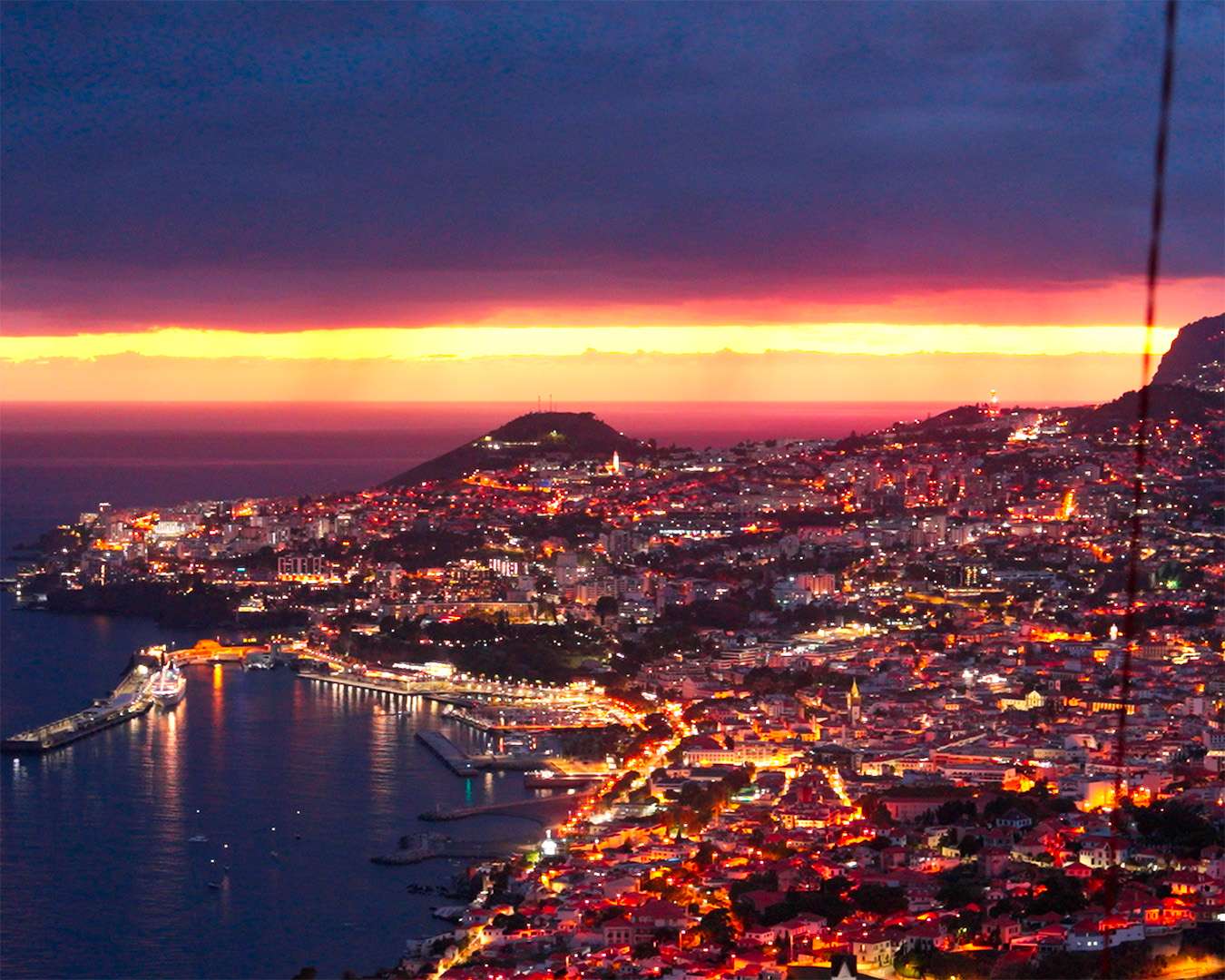
Visited: October 2026, on an overnight call of MS Amadea. The photographs and the menu prices are from that evening.
Most ships leave Funchal before the old town wakes up. On an overnight call you get the other version: the walk in takes 20 to 25 minutes from the berth, the painted lane fills from about seven, and a plate of black scabbard fish costs €13.75. The only part of the evening worth a vehicle is the pair of viewpoints up on the hillside, which you cannot reach on foot.
What time does it get dark in Funchal?
Madeira sits a long way west but keeps western European time, so sunset is late. In October 2026 it fell at 19:55 on the 1st, 19:36 on the 16th and 19:27 on the 24th. The clocks went back overnight on 25 October: sunset that day was 18:26, and 18:20 on the 31st.
That is why so few passengers see the evening here. A ship that sails at six is gone before anything starts. If you are staying, the usable window for the viewpoints opens about half an hour before sunset — low enough for the eastern cliffs to turn red, late enough for the street lighting to be on.
How do you get from the ship into the old town at night?
You walk. From the port gate along the Avenida do Mar it is 1.6 km to the edge of the old town: flat, lit, past the marina the whole way. I took 20 to 25 minutes in each direction. Nothing about it needs a tour or a fare.
If you would rather ride, the official taxi from the terminal into the centre is a fixed €7.50 for up to four people — the cabs are yellow with a blue stripe. Most lines also run a chargeable shuttle, with the fare announced on board.
The two viewpoints above Funchal
Funchal sits in a bowl the tourist board fairly calls a natural amphitheatre, and you cannot see that from inside it. The viewpoints on the slope are the one part of this evening that justifies a coach or a taxi.
Miradouro da Nazaré stands 164 m above the sea, west of the centre in São Martinho. It looks east across the bay: the mole with the ship on it, the marina, and behind them the cliffs that go red in the last minutes of the sun. This is the better of the two if you want your own ship in the frame.
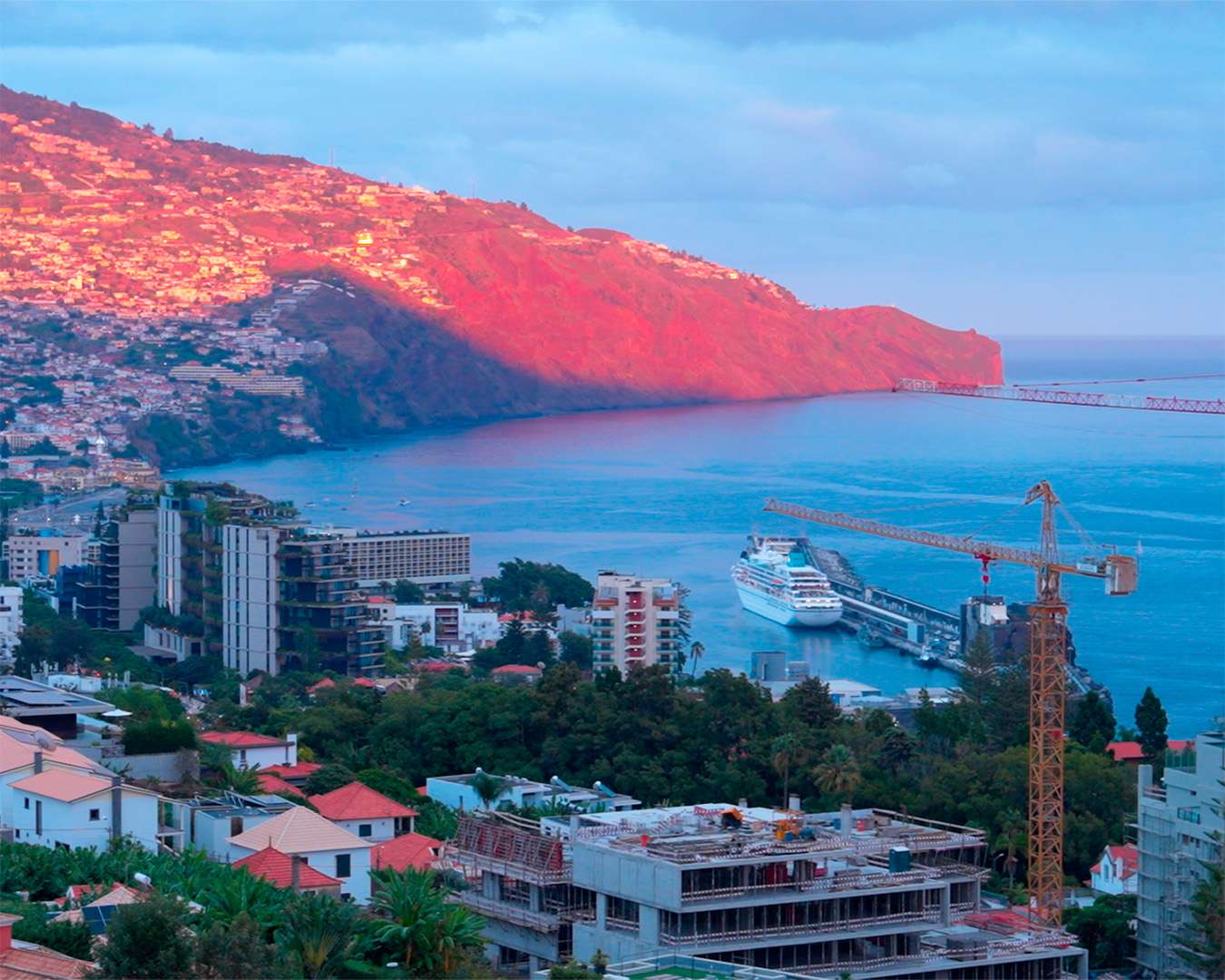
Miradouro do Pináculo stands higher, at 283 m on the Rua Conde Carvalhal in São Gonçalo, at the eastern edge of the municipality — on the road out towards Caniço and the airport. It gives the opposite picture: the whole town side-on, running up its slopes, with the sun going down over open Atlantic. This is the view people have in their heads when they think of Funchal.
Allow ten to fifteen minutes at each. The light does not last longer, and both are roadside pull-ins rather than built viewpoints — arrive late and you are parked behind a coach.
What Rua de Santa Maria is like in the evening
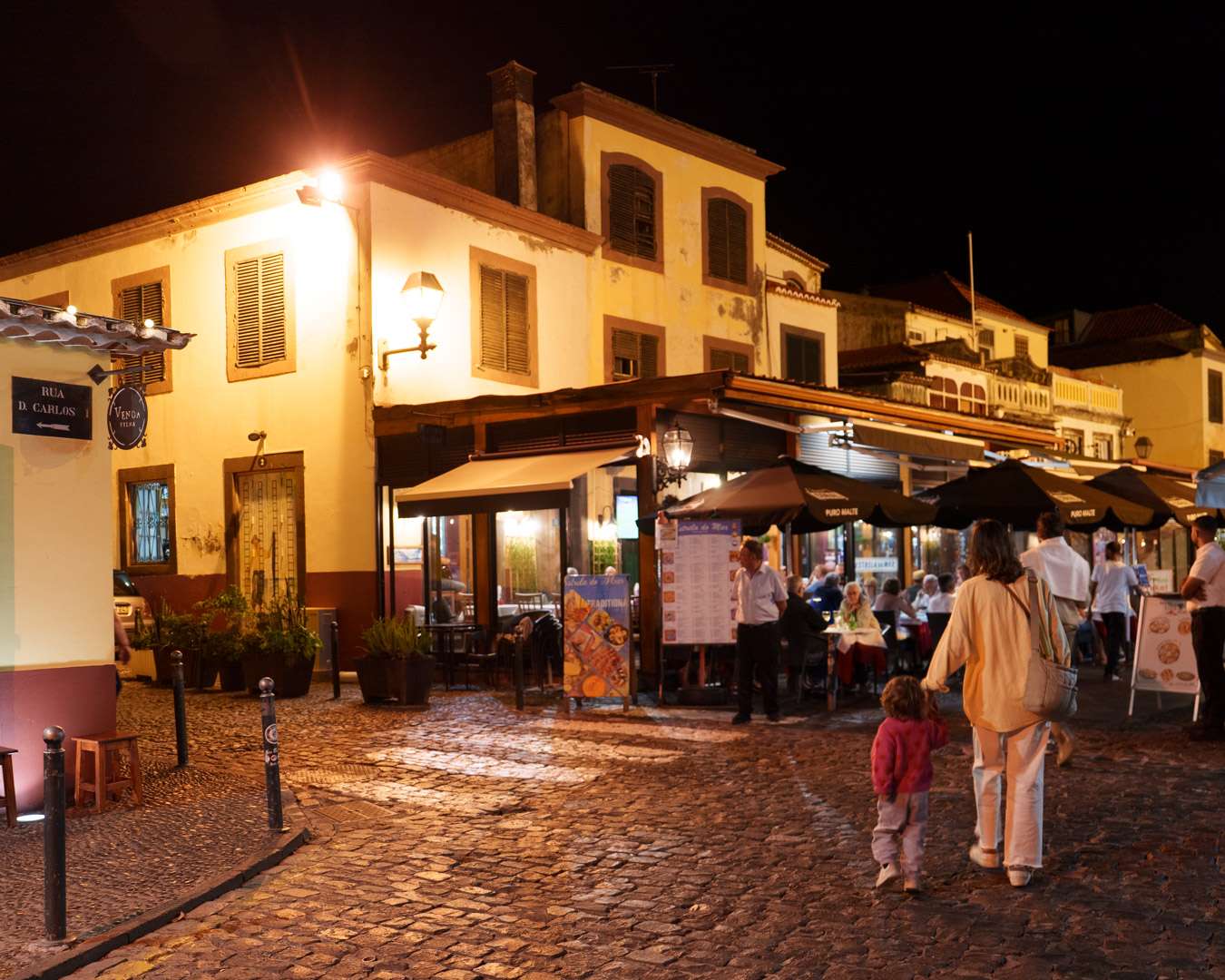
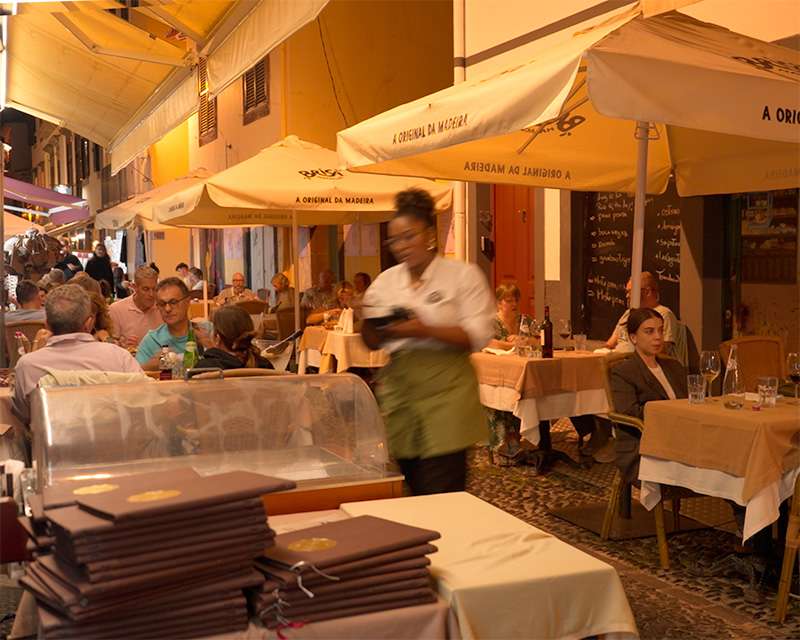
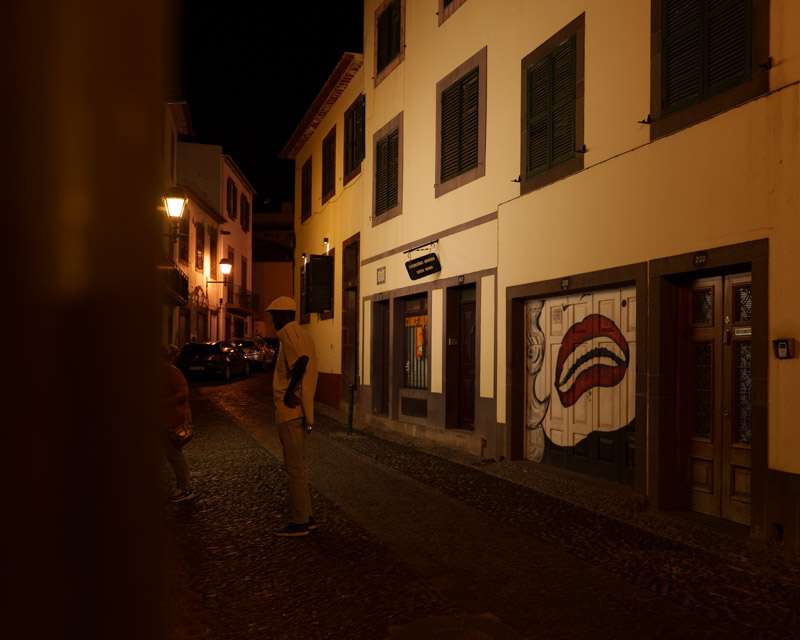
Rua de Santa Maria is the old town’s long lane, known for the two hundred-odd painted doors done since 2011. In the morning it is a photographic subject. In the evening it is a restaurant strip.
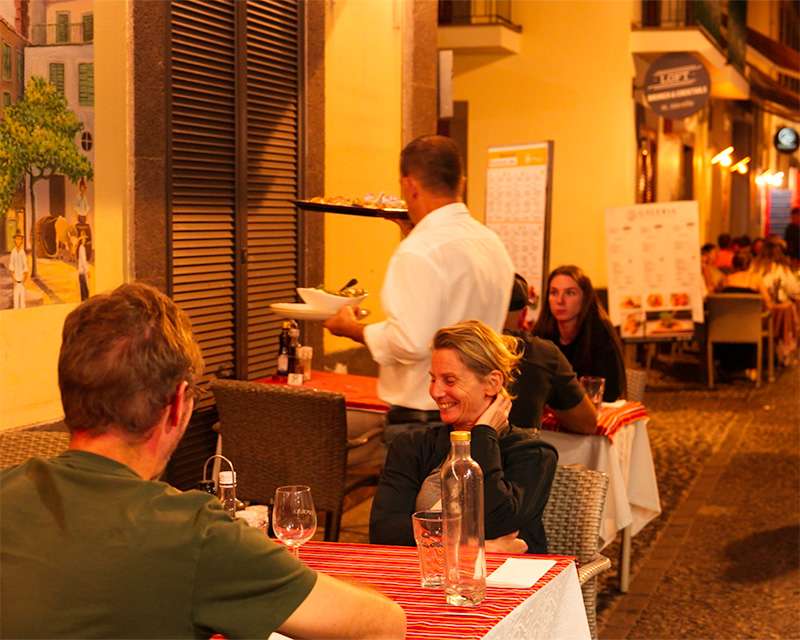
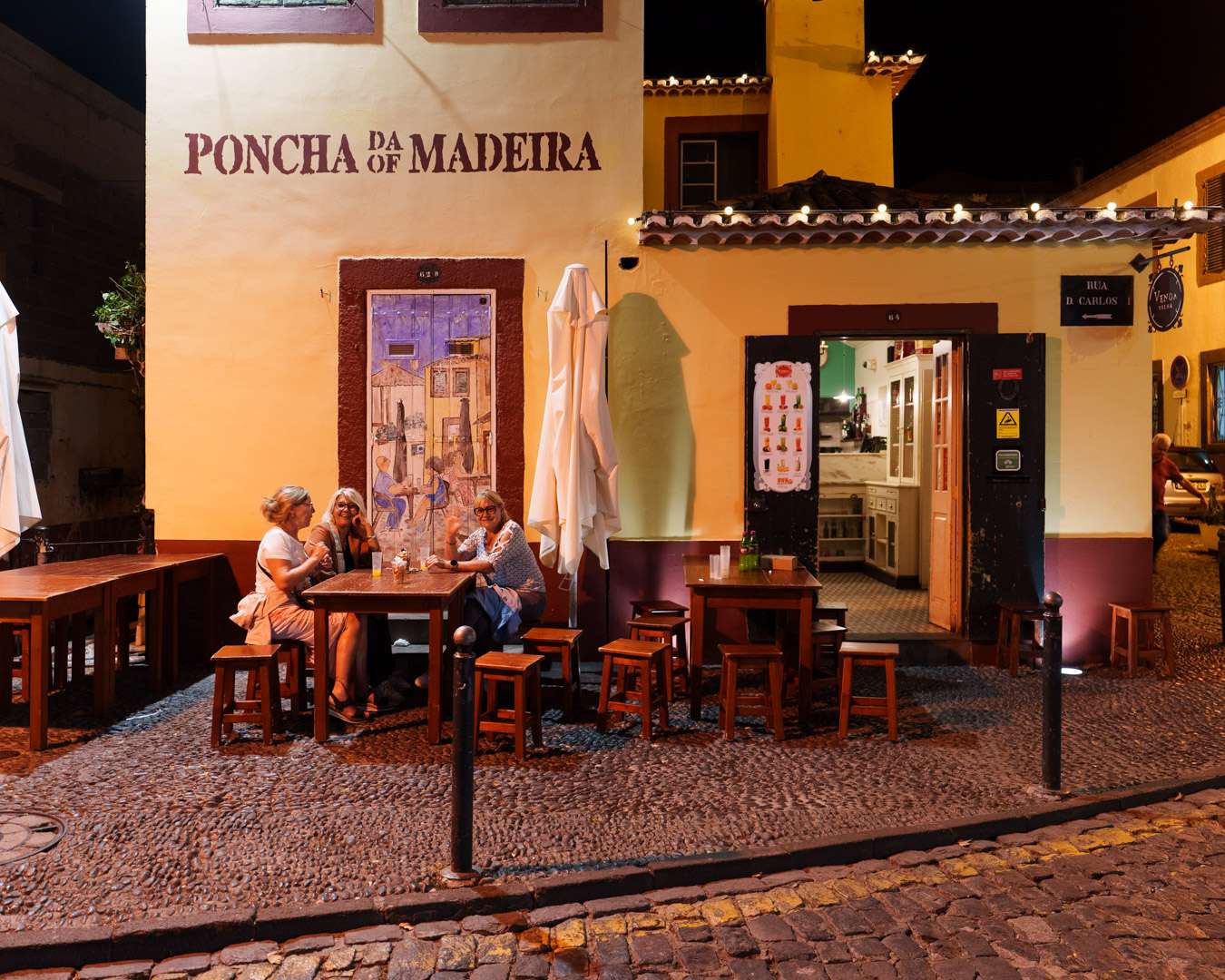
Between seven and eight the tables go out into the middle of the lane, the terraces fill, and someone is standing outside almost every door working the passing trade. If you want to look at the doors, come in the morning. If you want to eat, come now — but expect to be approached.
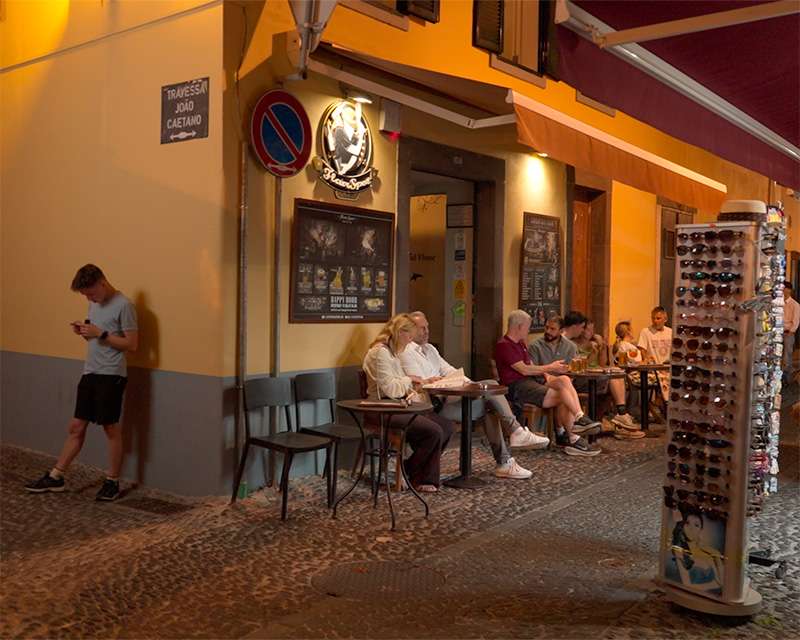
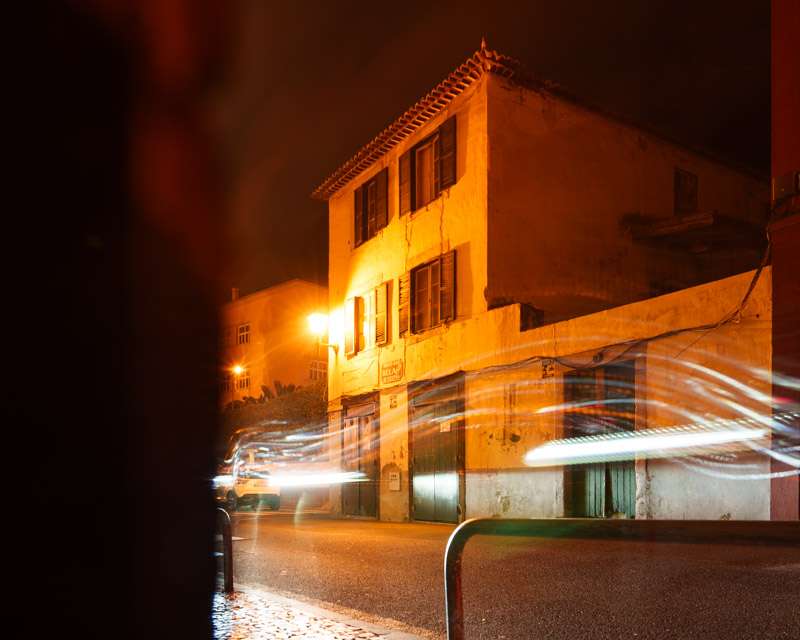
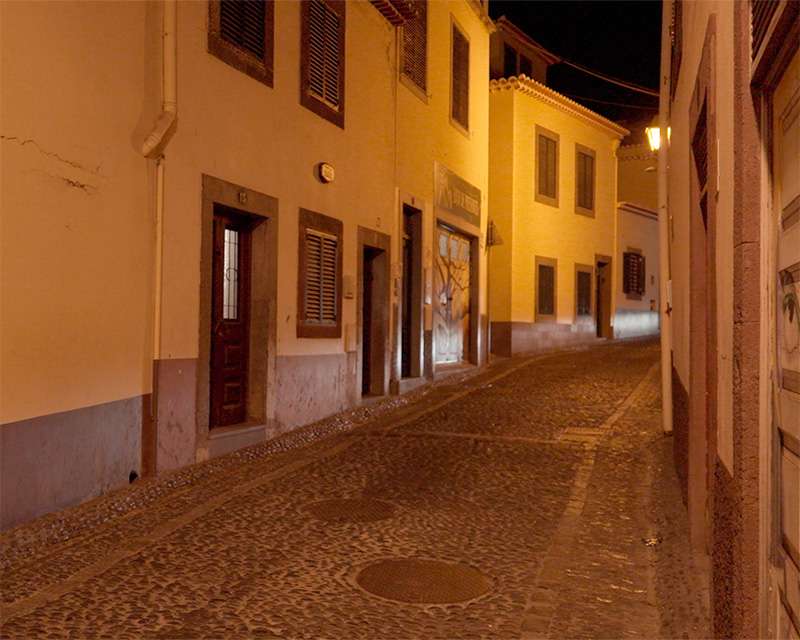
Two lanes away none of it survives. The side streets of the Zona Velha are empty after dark, and that is the reason to be on foot here at all: two minutes from the busiest terrace in Funchal you are alone in an alley with one lamp in it.
What does dinner in Funchal old town cost?
These are two menus photographed on the same evening in October 2026. One is an ordinary house on the lane with its card in five languages; the other is the Panoramic View at the Madeira Story Centre, which sells the view. Side by side they explain the quarter better than any review.
| Dish | On the lane (Oct 2026) | Panoramic View (Oct 2026) |
|---|---|---|
| Soup of the day | €4.10 | €4.50 |
| Fish soup | €4.95 | €6.90 |
| Mixed salad | €9.95 | €11.50 (with fresh cheese) |
| Melon with cured ham | €9.95 | €12.50 |
| Spaghetti bolognese | €10.95 | €14.90 |
| Black scabbard fish fillet | €13.75 | €16.90 |
| Tuna steak | €13.75 | €17.50 |
| Clams Bulhão Pato | €13.50 | €14.90 |
| Fish risotto | €14.95 | €17.90 (prawn) |
| Grilled squid | €15.10 | €19.90 |
| Lagareiro-style octopus | €19.95 | €22.90 |
| Grilled prawns | €19.95 | — |
| Tiger prawns | €27.90 | — |
| Paella / cataplana, two people | — | €45.00 |
| Fish of the day | €40.00 / kg | — |
The cheapest fish on the lane was grilled sardines at €9.95, the cheapest pasta carbonara or bolognese at €10.95. The top of the card is €27.90 for tiger prawns and €40 a kilo for the fish of the day, charged by weight — the line on which bills go wrong.
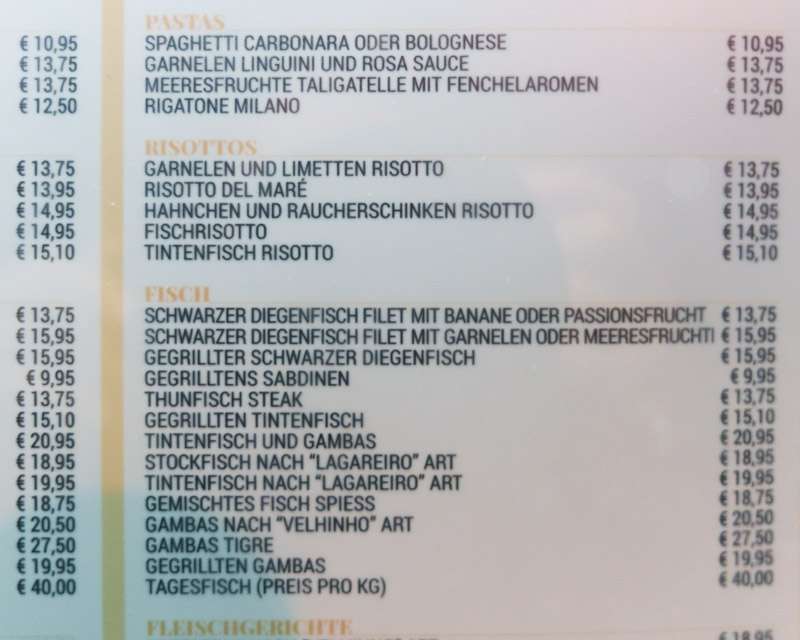
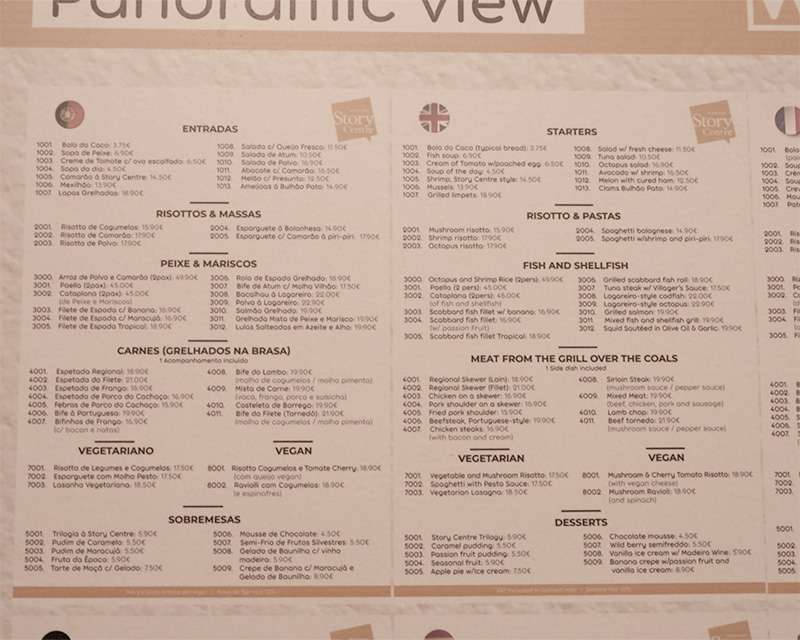
Left, the lane. Right, the Panoramic View at the Madeira Story Centre. Both photographed in October 2026.
Is Rua de Santa Maria a tourist trap?
Not on price, which is not the answer I expected to write.
The assumption about a lane this full is that it must be overcharging. The cards say otherwise. A fillet of black scabbard fish — the island’s own fish — at €13.75, grilled sardines at €9.95 and soup at €4.10 are at the lower end for a pedestrian street in a European island capital in October 2026. For comparison, the same scabbard fillet costs €16.90 at the house with the view, 23 per cent more, and the bolognese there is 36 per cent more. In Funchal the view costs roughly a quarter to a third.
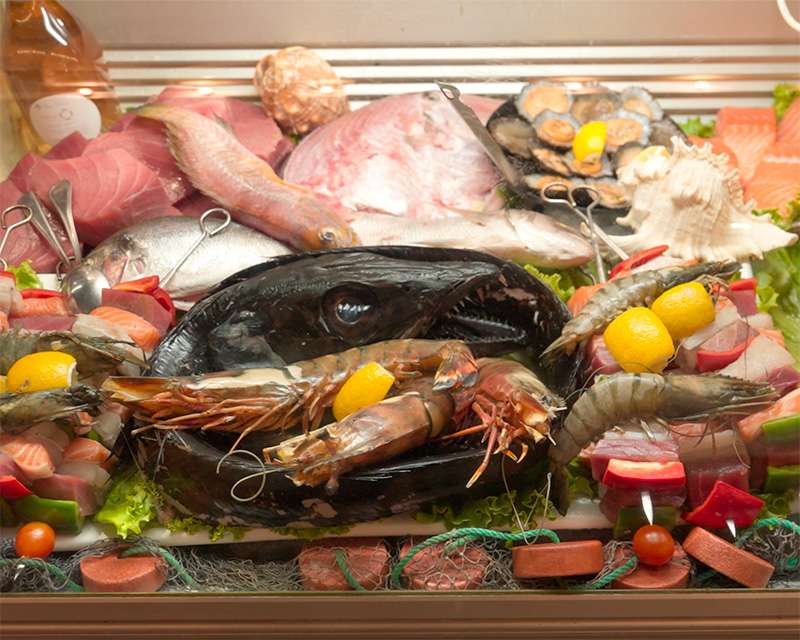
The first caveat is how things are charged. Anything sold by weight or in a shell climbs fast: fish of the day at €40 a kilo, tiger prawns at €27.90, squid and prawns at €20.95. That is where a bill ends up at twice what you had in mind when you sat down.
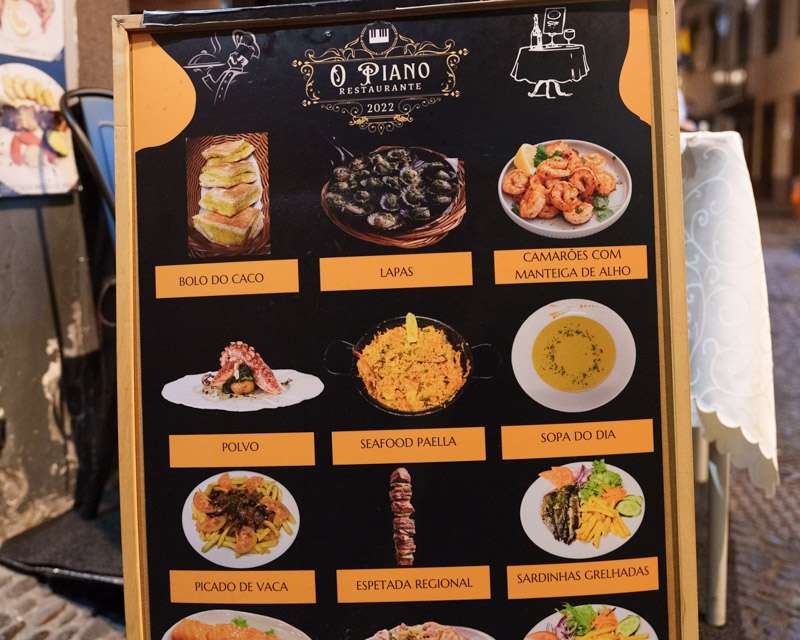
The second is which door you choose. Houses that put photographs of the dishes on a board outside — O Piano Restaurante does, and it is not alone — are built for people who come once. Where the card is text and translated into five languages, the prices were consistently lower. That is an observation from one evening, not a verdict on the cooking.
The supermarket is dearer than the restaurants
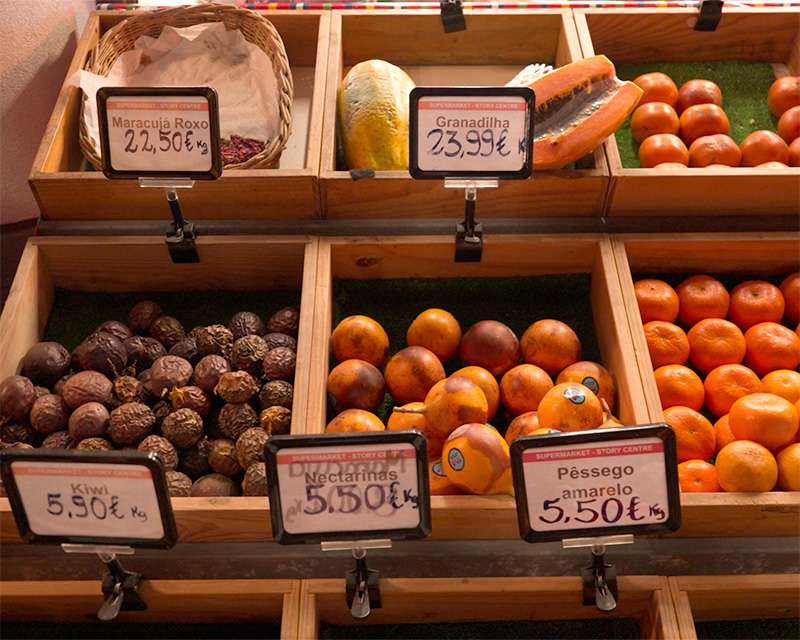
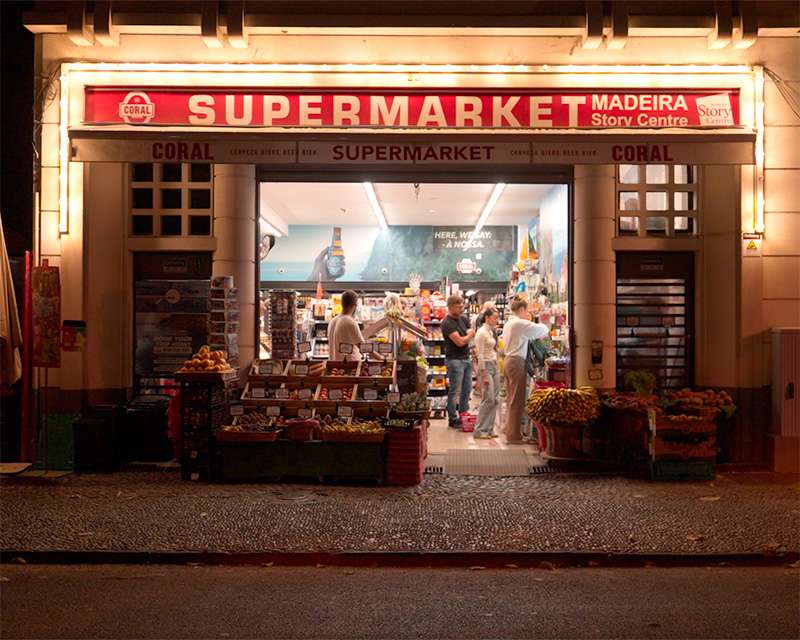
The most interesting price of the evening was not on a menu. In the supermarket at the Madeira Story Centre, in the middle of the old town and open late, passion fruit was €22.50 a kilo and granadilla €23.99. Two crates along, kiwi was €5.90 and nectarines and yellow peaches €5.50 a kilo each.
It is the same mechanism as the market hall in the morning: what leaves as a souvenir costs a multiple of what leaves as food. If you want to taste passion fruit, order it on a plate — scabbard fish with banana or passion fruit was €13.75 that evening.
Evening tour or on your own?
Split. Not for the old town: it is 1.6 km from the ship, the walk is flat and lit, and a lane full of restaurants does not need a guide. For the viewpoints, yes — both are several kilometres out and a few hundred metres up, out of walking range for an evening, and a taxi waiting twice is not obviously cheaper.
On an overnight call the sensible hybrid is to take the tour for the viewpoints and ask to be dropped in the old town rather than ride the coach back. You get the light at the top and the evening at the bottom, and the walk home takes 20 to 25 minutes.
If your ship is not staying the night, keep 45 to 60 minutes in hand before all-aboard. The way back from the old town feels longer than the way out: it rises slightly, and you are doing it in the dark.
Photographing Funchal at night
Three things that worked, and one that did not.
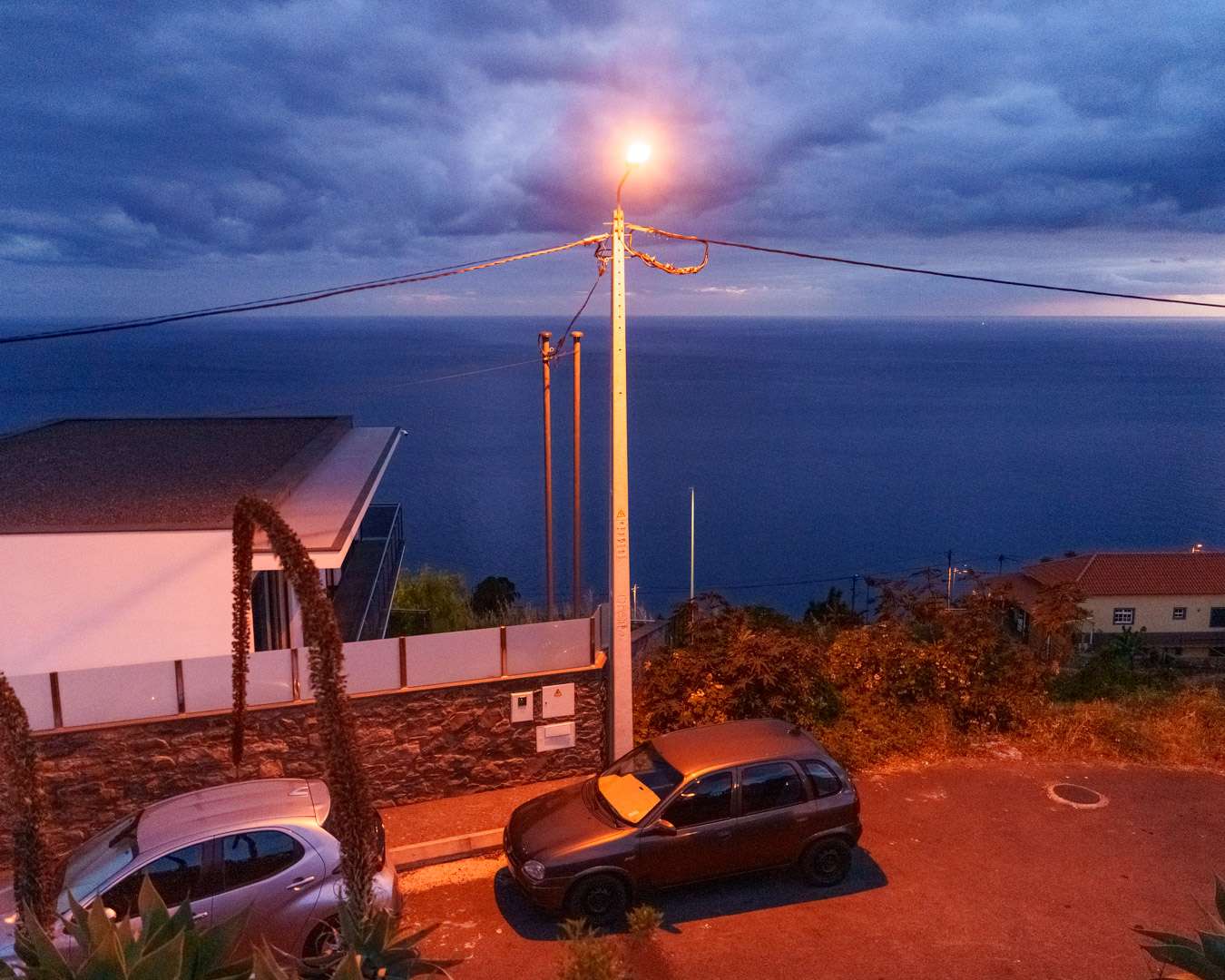
Get to the viewpoints early. The window in which the street lighting is on and the sky is not yet black runs about 25 minutes and opens roughly at sunset. After that the sky is a hole and the picture is only dots.
Shoot the empty lanes, not the full ones. The terraces are bright, colourful and photographed by everybody. The cross streets are better: one lamp, wet stone, a wall. The contrast is manageable and the frame is not interchangeable.
Let something move. A taxi coming through the narrow lane, a long exposure braced against a house wall — that shows the lane rather than the façade.
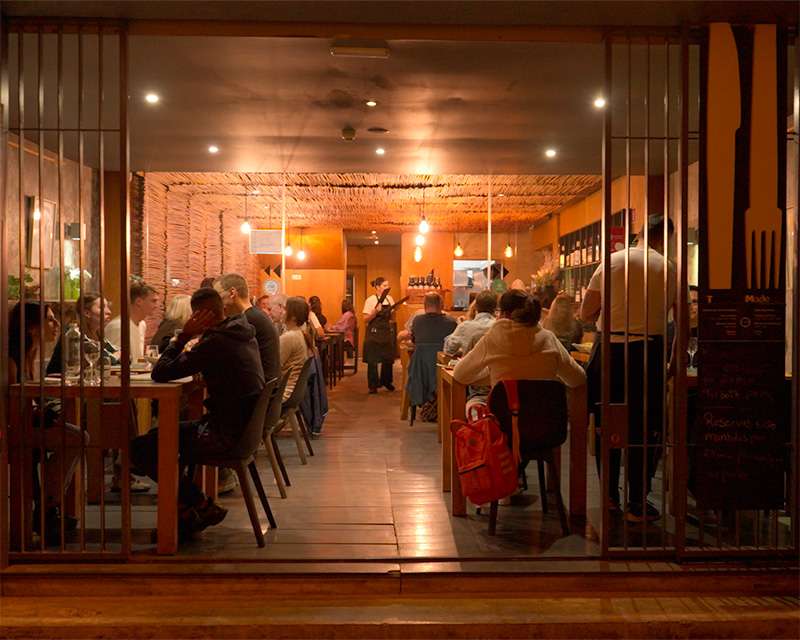
What did not work was shooting the interiors through open restaurant fronts. Warm artificial light, dark ceiling, people in motion: the white balance is recoverable, the blur at the tables is not. Either go in and ask, or leave it.
What I would do differently next time
Be up on the hill earlier. We had the right light at both viewpoints but no margin — at one of them it was enough for two positions, not four. Arriving half an hour before sunset costs nothing and doubles the choice.
And on dinner: do not stop at the start of the lane. The first terraces are the fullest and the most actively worked. Prices barely change over the length of the street. The quiet does.
Sources: Visit Madeira — viewpoints in Funchal · menus and price tickets photographed on site, October 2026 · sunrise and sunset tables for Funchal, October 2026
Related: Funchal cruise port on your own: half a day in Madeira’s capital · Lisbon cruise port on your own · All cruise ports on your own · All Madeira stories · Diesen Artikel auf Deutsch lesen