
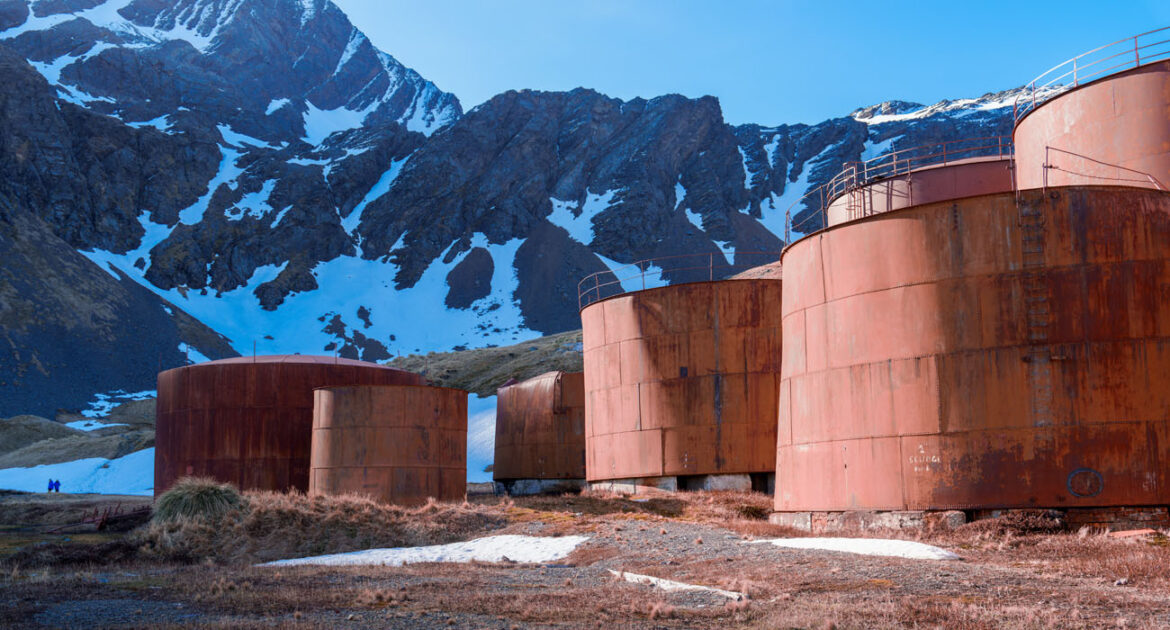
Visited: ashore at Grytviken on a South Atlantic voyage.
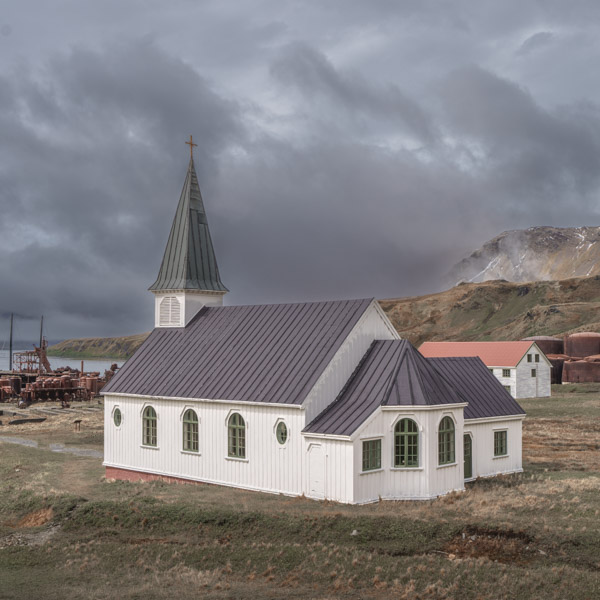
Grytviken is an abandoned whaling station on the island of South Georgia, in the South Atlantic. It stands at the head of King Edward Cove, has no permanent population, and is reached only by ship. What is left there: rusting oil tanks and boilers, a white Norwegian church from 1913, a museum in the old manager’s villa, and the cemetery where Ernest Shackleton is buried.
Where is Grytviken?
Grytviken lies on the north-east coast of South Georgia, at the head of King Edward Cove, an inlet of Cumberland East Bay. King Edward Point, the British research and government station, sits about 900 metres to the east across the water.
South Georgia itself is a long, mountainous island roughly 1,400 kilometres east-south-east of the Falkland Islands, well below the Antarctic Convergence. There is no airstrip. Everything and everyone arrives by sea.
Is Grytviken an island?
No. Grytviken is a settlement — a former industrial site — on the island of South Georgia. The confusion is common enough that it is worth stating plainly: the island is South Georgia, the place on it is Grytviken.
The name is Norwegian and means roughly “pot bay”. It was given in 1902 by a surveyor of the Swedish Antarctic Expedition, who found old English try pots on the shore — the iron cauldrons in which sealers had boiled down oil long before the whalers came.
What was Grytviken? The whaling station
The station was founded on 16 November 1904 by the Norwegian captain Carl Anton Larsen, for the Compañía Argentina de Pesca. It was the first shore-based whaling station on South Georgia and it ran for some sixty years, until the whale stocks around the island had been reduced to the point where the operation no longer paid. It closed in the mid-1960s; sources differ on the exact year.
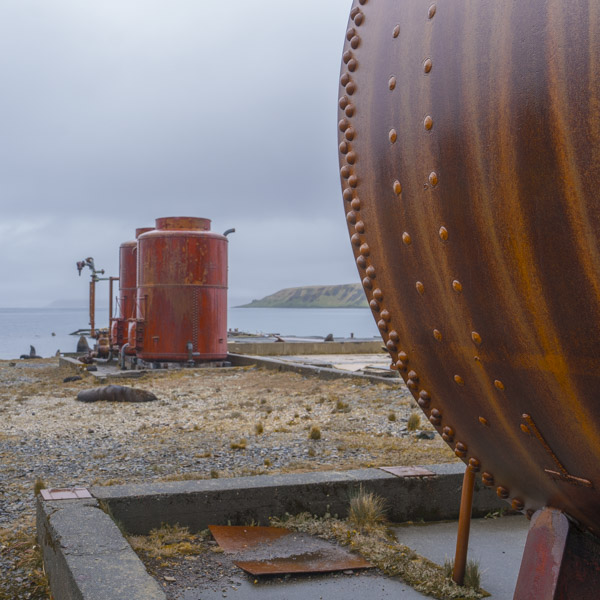
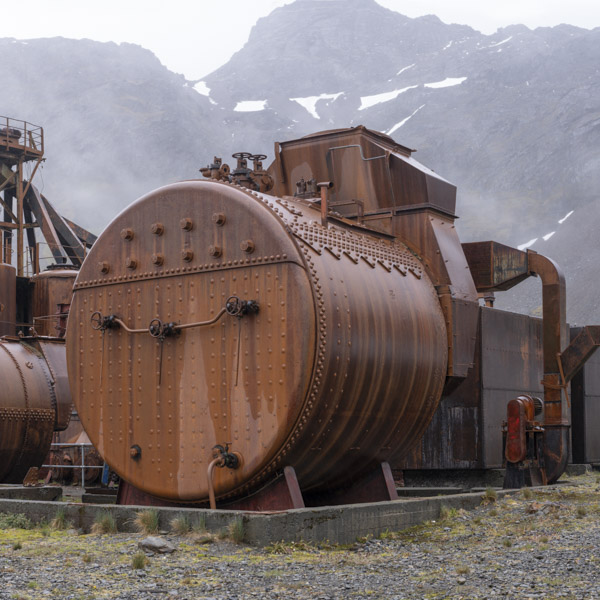
The buildings were not demolished, and that is why the place is what it is. The oil tanks, the boilers, the flensing plan where the whales were cut up, the accommodation blocks — they stand where they stood, corroding slowly in salt air. Seven shore whaling stations worked the north coast of South Georgia between 1904 and the 1960s — Grytviken, Leith Harbour, Husvik, Stromness, Prince Olav Harbour, Ocean Harbour and Godthul. Grytviken is the only one that can be visited. The other six are closed on account of asbestos and structural collapse, and can be looked at from the water and no closer. Three whale catchers lie beached in the cove: Petrel, Dias and Albatros, harpoon guns still on their bows.
Grytviken cemetery: Shackleton’s grave and Frank Wild
The whalers’ cemetery is a fenced rectangle on the flat ground west of the station, below the hills. Most of the graves in it are whalers — men who died here at work, some of them long before the station existed, the oldest dating from the sealing years.
Ernest Shackleton died of a heart attack aboard the Quest in King Edward Cove on 5 January 1922, at the start of his fourth expedition. His body was on its way to England when his widow Emily asked that he be buried on South Georgia instead, and he was brought back. His headstone is granite, and it faces south — the only stone in the cemetery that does — with a line of Browning on the reverse.
On 27 November 2011 the ashes of Frank Wild were interred to the right of it. Wild had been Shackleton’s second-in-command on the Endurance and the man who held the party together on Elephant Island; he died in South Africa in 1939 and his ashes sat in a vault, effectively lost, until a researcher tracked them down. His stone reads: Shackleton’s right-hand man.
Expedition parties traditionally drink a toast at the grave and pour a little of it on the ground. It is a short walk from the landing — twenty minutes at a slow, photographic pace — and it is the reason most people come.
The church, the museum and the post office
The Norwegian church was prefabricated and shipped out in 1913, and it is the building that carries the place. White, weatherboarded, a spire against black hills; services are still held in it occasionally, and it is one of the few structures visitors may enter.
The South Georgia Museum occupies the former station manager’s villa and opened in 1992. It covers the whaling, the sealing before it, the island’s wildlife and Shackleton — including a replica of the James Caird, the lifeboat that was sailed from Elephant Island to South Georgia. The old main store reopened in 2023 after restoration, with the harpoon grenades and flensing knives on display.
There is also a post office. A card sent from Grytviken takes months and arrives, which is a fair description of the place.
Does anyone live in Grytviken?
Not permanently. The museum is staffed through the southern summer, and the government officers and scientists are across the cove at King Edward Point. Out of season the cove is empty of people and full of fur seals, which have reclaimed the beaches the station once fouled.
Grytviken in the Falklands War, 1982
South Georgia is a long way from the Falklands and was drawn into the war anyway. Argentine forces took Grytviken in early April 1982 after a short fight with a small Royal Marine detachment. British forces retook the station about three weeks later, and the Argentine garrison surrendered without firing.
The episode is why the island appears in accounts of that war at all, and there are traces of it on the ground if you know where to look.
When to visit, and what a landing is like
South Georgia’s visitor season runs from late October to March, the Antarctic summer, when small expedition ships call on the long route between the Falklands and the Antarctic Peninsula. Landings depend entirely on the weather — a swell building in Cumberland Bay can cancel a call within minutes — so any time ashore is a gift rather than a plan.
A typical visit lasts two to three hours. All ships call here first for immigration and biosecurity. Once ashore, the ground is flat and the distances are short: the ruins, the cemetery, the church and the museum sit within a few hundred metres of each other.
Can you visit Grytviken on your own?
No, and it is worth saying plainly, because every other place in this series can be done alone. There is no pier at Grytviken and no independent version of the visit. Ships lie at anchor in King Edward Cove, everyone comes ashore by Zodiac, and the landing happens under a government permit with the expedition team running it. You go when the ship goes and you come back when it comes back.
The size of the ship decides whether you get there at all. The government notes that most visitors arrive on expedition ships carrying fewer than 400 passengers, though larger vessels of up to 800 also call. A big cruise ship is the wrong instrument for this island: numbers ashore are capped site by site, and a thousand-berth ship cannot land its passengers in the time a call allows.
The check before anyone goes ashore
Before a single person leaves the ship, the authorities come aboard and inspect. It applies to crew as much as to guests, and it is thorough rather than symbolic. Rubber boots are compulsory. Large rucksacks are not allowed ashore. Clothing, footwear and bags are checked for soil, seeds and plant material, with particular attention paid to Velcro, seams, pockets and folds, and daypacks and camera bags have to be brushed out and vacuumed first. The government guidance puts it in exactly those terms.
Then comes the rule that sounds minor and is not: you may not set anything down on the ground. No camera case on a rock, no bag on the grass while you change a lens. The reason is the same one behind everything else here — a seed or an invertebrate picked up from the soil and carried to the next landing site is how an island gets ruined.
What that means if you carry cameras
It means you take one body and one lens, and you live with the choice. Anything you cannot hang off your own shoulders has to stay on the ship, and since nothing may touch the ground, there is no moment in which you can open a bag and swap glass. I found this the hardest part of the landing, harder than the cold or the swell — standing in front of a frame that wanted a different focal length and having no honest way to get to it.
Plan the lens before you get in the boat. A single mid-range zoom is the pragmatic answer: the fur seals come close enough that a long lens is not what you need, and the station reads better tight than wide anyway.
The Zodiac landing
Ten guests to a boat, no more, and that pacing is the reason a landing takes as long as it does. The run in from the anchorage is short, and it is the best part of the day. The wildlife has no fear of people here and no reason to have any: Antarctic fur seals and southern elephant seals came right up to the boats, close enough to look into, entirely unbothered.
Whatever else the landing involves in paperwork and inspection, that approach across the cove — black water, rusted tanks against the mountains ahead, seals in the water beside you — is worth the whole procedure.
Where you may walk, and the pass above the station
Ashore you keep to the marked paths. They lead to the museum, the church and the whalers’ cemetery with Shackleton’s grave, and all three are within a few hundred metres of the landing on flat ground. Wandering off the route is not an option: parts of the site are unsafe, parts are protected, and the marking is there to be followed.
One route goes further. A path climbs from the station over the pass on the Thatcher Peninsula and down to Maiviken on the other coast. The full crossing is about 3.5 kilometres with 205 metres of ascent, rated an easy walk, two to three hours with a guide, capped at 100 guests with at least one member of staff per twenty. We only went as far as the pass and turned back — roughly an hour of climbing, and from the top you look down on the whole cove, the station, the ship at anchor and the mountains behind.
If your call is long enough and the walk is offered, take it. It is the only way to see Grytviken as anything other than a collection of buildings at sea level.
Biosecurity: what you may and may not do ashore
The rules are stricter here than almost anywhere, and they are not ceremonial. South Georgia spent a century being wrecked by whaling and by the rats and mice that came with the ships, and the recovery is recent enough to be fragile.
Before you land, boots and outer layers are inspected and disinfected — seeds in a Velcro strap are the thing they are looking for. Ashore, you may enter the church, the post office, the museum and the store, and nothing else. Climbing on the whaling structures or the beached catchers is forbidden, partly because of asbestos and partly because they are falling apart. Areas marked with orange posts hold invasive plants and are not to be walked through; you are also asked not to put bags down or sit on the ground.
That last one is the rule visitors underestimate. It is not a request to be tidy — putting a bag on the ground is how soil and seeds move between sites, and it is enforced. For anyone carrying equipment it shapes the entire landing, as described above.
Photo notes
Grytviken has almost no colour in it beyond the rust, and that is the material. The palette is iron oxide, black rock, grey water and the white of the church, and it holds together under cloud far better than under the rare clear sky.
Two frames are worth planning. The church against the hills needs you to get low enough that the spire clears the ridge line behind it. The tanks and boilers want a long lens rather than a wide one: from a distance the corrosion reads as surface and pattern, which is more interesting than another record shot of a ruin. Wildlife will be in the way, and that is not a problem — fur seals lying among the machinery are the whole story of the place in one frame.
Weather-sealed gear or covers, and spare batteries kept warm. Wind and spray are constant, and cold flattens a battery faster than you expect.
And decide the lens on the ship. Because nothing may be set down on the ground, a landing at Grytviken is a one-body, one-lens affair in practice, whatever you would normally carry. That constraint is worth planning for rather than discovering at the cemetery gate.
Sources: Grytviken · Ernest Shackleton · Frank Wild
Related: Narsaq, Greenland · Hesteyri, Iceland’s most remote village · More from South Georgia
Written by Jan Madeus — ship’s videographer at sea since 2008. I go ashore in the same ports as the passengers, with the same few hours and the same deadline. More about me.