
Visited: 10 March 2024, on a call of HANSEATIC nature at Kirkenes. The photographs are from that day. Prices and times checked November 2026 — verify against the linked sources before you sail.
Yes, Kirkenes works on your own, and it is one of the easier Arctic ports to do that way. The quay lies about 1.5 kilometres from the centre, the walk is flat and cleared, and twenty minutes puts you in the town. What you cannot reach on foot is the Snowhotel and the dog yard, ten kilometres out — that part needs a transfer, a booking or the ship’s excursion. The border with Russia is sixteen kilometres away and closed.
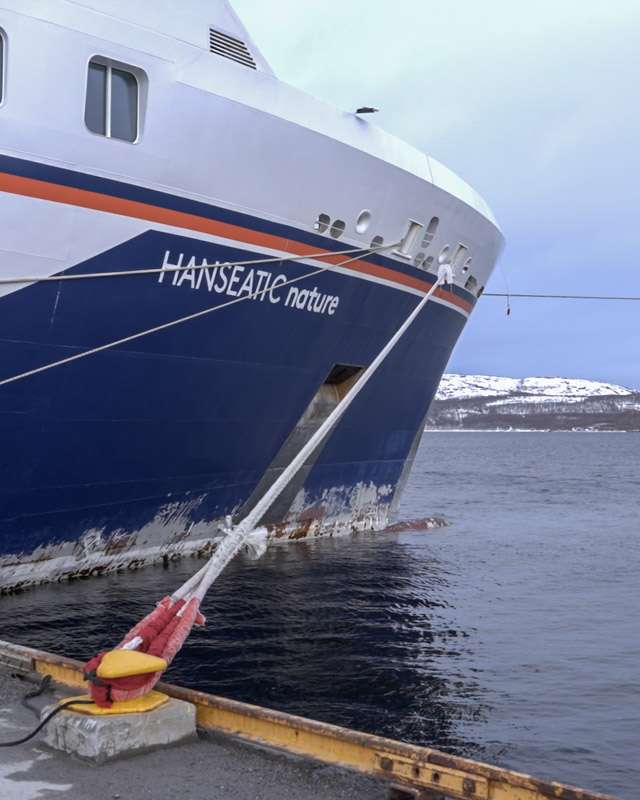
The Kirkenes winter call at a glance
| Berth | Alongside in the harbour below the town. Kirkenes is the turning point of the Hurtigruten Coastal Express, so the quay handles ships the year round |
| Tender | No |
| Distance to the centre | About 1.5 km, roughly 20 minutes on foot. Flat, cleared, no climb |
| Shuttle | None needed for the town. Snow Resort runs its own transfer from the Hurtigruten/Havila quay at 09:00, back at 11:30, for guests with a booking |
| Daylight on 10 March | Close to eleven hours. Kirkenes gains about 8.5 minutes a day through March, from 9 h 33 min on the 1st to 13 h 52 min on the 31st |
| Temperature in mid-March | Roughly −4 °C by day, −9 °C at night on the long-term average |
| Minimum time ashore | Three hours for the town on foot. A full day if you add the dog yard or the Snowhotel |
| Return buffer | 45 minutes from the centre is plenty. From the Snowhotel, count the 15–20 minute transfer and add an hour |
| Visited | 10 March 2024, HANSEATIC nature, about eight hours in port. Prices checked 2026 |
Where does the ship dock in Kirkenes, and how far is the town?
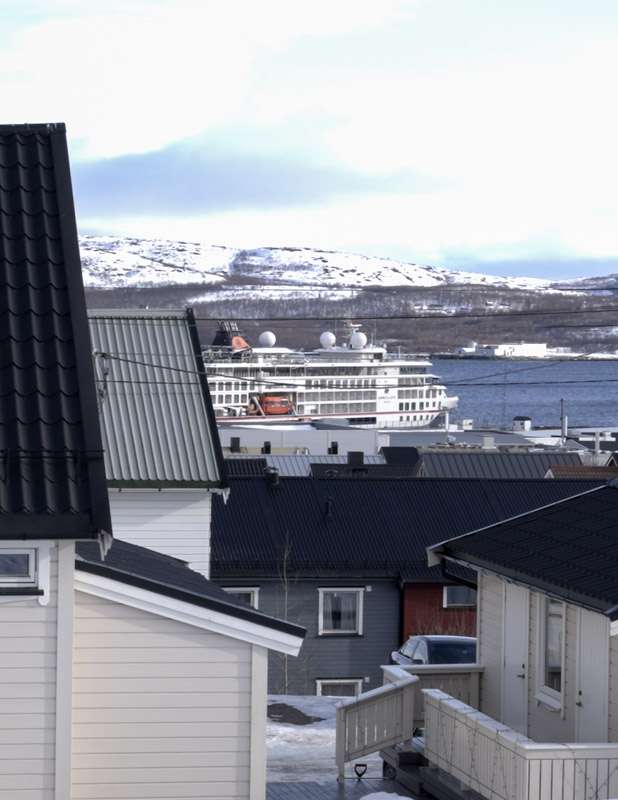
Close enough that the question answers itself. We lay alongside in the harbour below the town, and I walked in: one to two kilometres, a flat road, no decision to make. There is no tender and no need for a shuttle. Taxis exist but do not queue at the gangway, and for this distance they are hard to justify.
The useful number here is not the distance but the time. Hurtigruten’s own port page gives the Coastal Express about three and a half hours in Kirkenes, and almost every guide to this port is written for that. We had roughly eight. That changes what is possible: with three and a half hours you walk into town, look at it, and walk back. With eight you can also go out to the dog yard, or spend the afternoon on the hill above the harbour instead of hurrying.


What Kirkenes looks like when you walk in from the quay
Smaller than the map suggests, and plainer. Kirkenes had 3,404 inhabitants in 2023; the wider district comes to about eight thousand. It is a working town — iron ore from Bjørnevatn, fishing, the border trade that used to be — and it does not perform for visitors.
It also has almost no old fabric, for a reason that is the whole story of the place. During the Second World War Kirkenes took 320 air attacks and over a thousand alarms, which makes it one of the most heavily bombed towns in Europe by its size. When Soviet troops took it on 25 October 1944, thirteen buildings were left standing. What you walk through now is a town rebuilt from nothing after 1945: timber houses in plain colours, wide cleared streets, snowbanks shovelled to shoulder height.

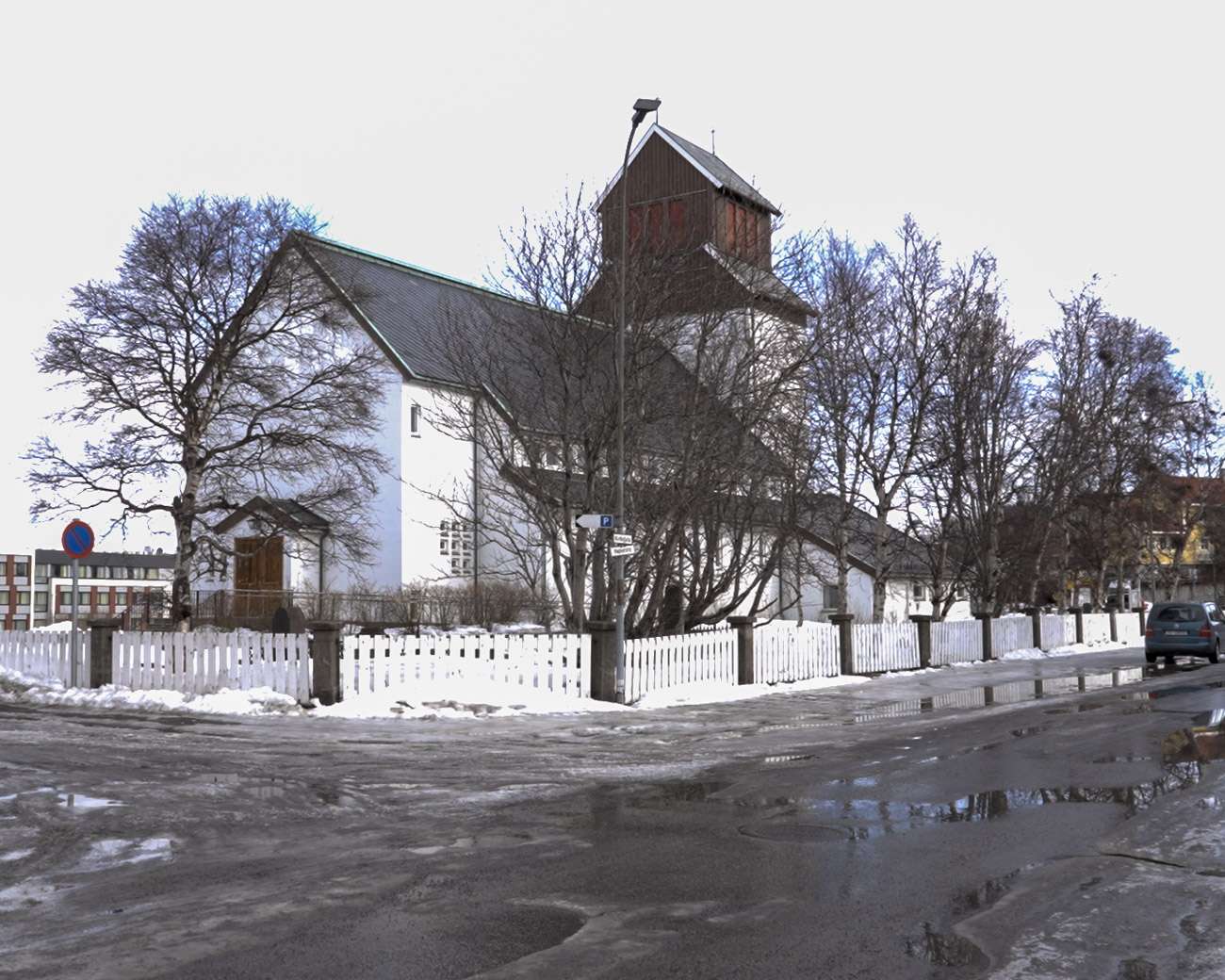
The church is the exception that proves it. The first one was finished in 1862 and gave the place its name — Kirkenes, the church headland. It burned to its foundations in the bombing of July 1944. The present building dates from 1959, by the architect Sofus Hougen, and seats about 275. One piece of the old church was recovered and built into the new one: the information board in town says it was the bell, the church’s own record says the spire. Either way, something from 1862 stands inside a building from 1959, which is as close to continuity as this town gets.
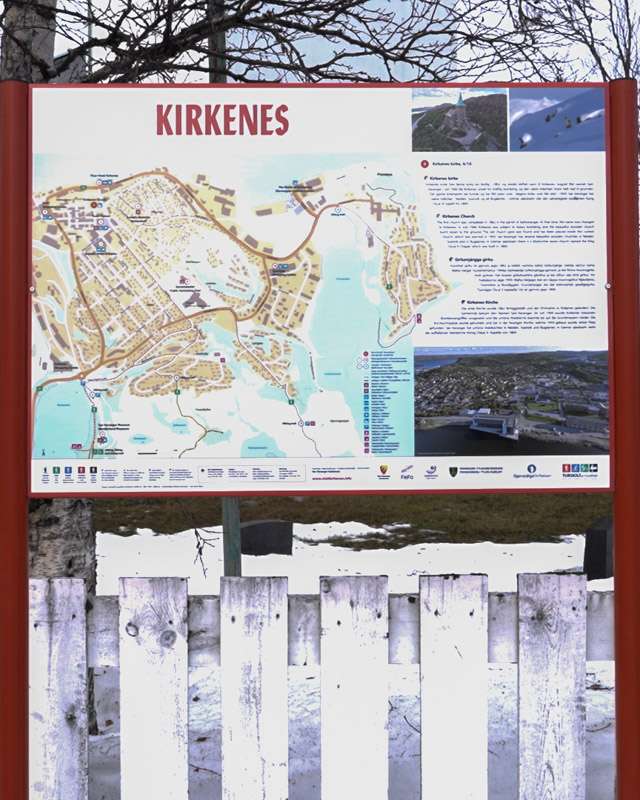
For orientation there is a town map board near the centre, which is worth two minutes: Kirkenes is compact enough that one look is enough to plan the rest of the day.
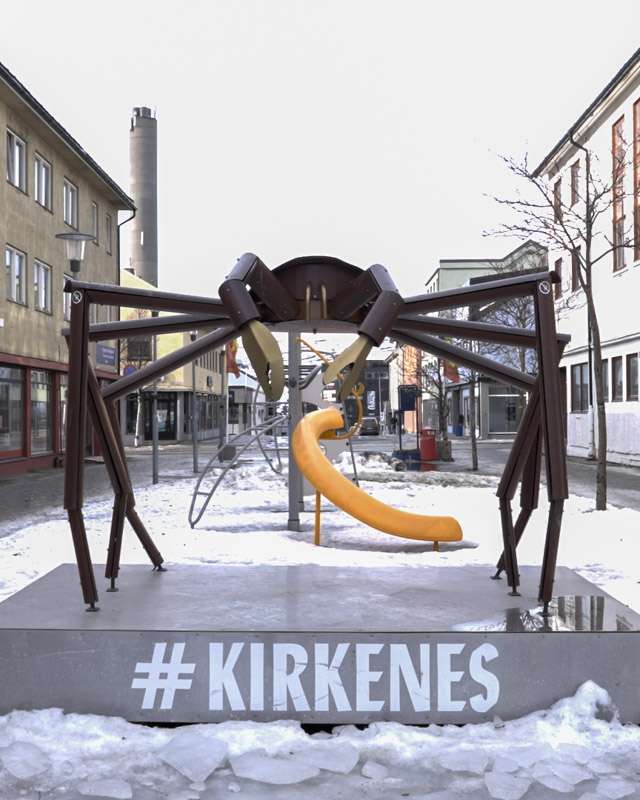
Can you go to the Russian border from Kirkenes?
You can drive to it and look at it. You cannot cross it, and neither can almost anyone else.
Storskog, sixteen kilometres east of the town, is the only legal land crossing between Norway and Russia. On 23 May 2024 the Norwegian Ministry of Justice announced that it would be closed to ordinary Russian travellers, and the restriction took effect on 29 May 2024; Russians resident on the Norwegian side and their close relatives are the exception. Until then Storskog had been the last land route from Russia into the Schengen area for shopping and holiday traffic.
That date matters for this article: on 10 March 2024 the crossing was still open under the old rules. What I saw was the last winter of the old arrangement, two and a half months before it ended. Anyone reading this before a call in 2027 is going to a quieter border than the one in my photographs.
The border itself is not a day-trip you improvise from the quay. Sixteen kilometres each way means a taxi or a booked tour, and the viewing point is a line in the snow with a sign. The town is the more interesting half of the subject.
Ukraine in a Norwegian border town
This was the thing I had not expected and the thing I photographed most. Kirkenes has lived next to Russia for a century — the Soviet army is the reason the town exists in its present form — and the war has put that into every street.
The Soviet Liberation Monument still stands in the centre: a Red Army soldier on a stone plinth, put up in gratitude for 25 October 1944, and maintained. Two streets away a van is painted blue and yellow with Stop War and Putin across the panels. In a bare tree near the square, blue and yellow hearts and ribbons hang from the branches.


Those three things stand within a few hundred metres of one another, and nobody in Kirkenes seems to find that contradictory. The monument thanks the soldiers of 1944; the paint on the van is about 2022. The town keeps both, and that is the most honest thing it has to show a visitor. If you walk in from the quay with nothing booked, this is what the day is actually about — not the fjord and not the king crab.


Andersgrotta: the shelter under the street, which I walked past
The sign in the photograph above points two hundred metres down the road. I followed it, photographed the door and turned round. That is the one thing I got wrong about this port day, so take the rest of this section as research rather than experience.
Andersgrotta is the tunnel system the Germans had driven into the rock in 1941 during the occupation. It held about 2,500 people — most of the town at the time — and it is why there were still people here when the bombs stopped. The published descriptions agree on the shape of a visit: around half an hour including a film of roughly fifteen minutes, in Norwegian, English or German; bare rock with a few reconstructed wooden rooms; around 0 to 5 °C inside whatever the season, so keep your jacket on. The entrance is on Presteveien, a few minutes from the centre, and it is not signposted the way a museum would be. In the current season tours run daily at 12:30 and are managed by Snow Resort Kirkenes; outside that, private booking.
Prices do not agree across sources: a museum database lists 200 NOK, a long-standing travel site 100 NOK. I cannot settle it, because I did not buy a ticket.
Why it is worth the half hour anyway: in a town where almost nothing above ground is older than 1945, the shelter is the only part of the war you can still walk into. I had eight hours in Kirkenes and spent none of them underground. Do better than that.
The dog yard and the Snowhotel: ship’s tour or on your own?
This is the real decision of a Kirkenes call, because it is the one thing the walk into town cannot give you. Snow Resort Kirkenes lies at Sandnesdalen 14 in Bjørnevatn, about ten kilometres from the centre — a 15 to 20 minute drive, and not a walk. Everything else in this article is free or nearly free; this part is where the money goes.
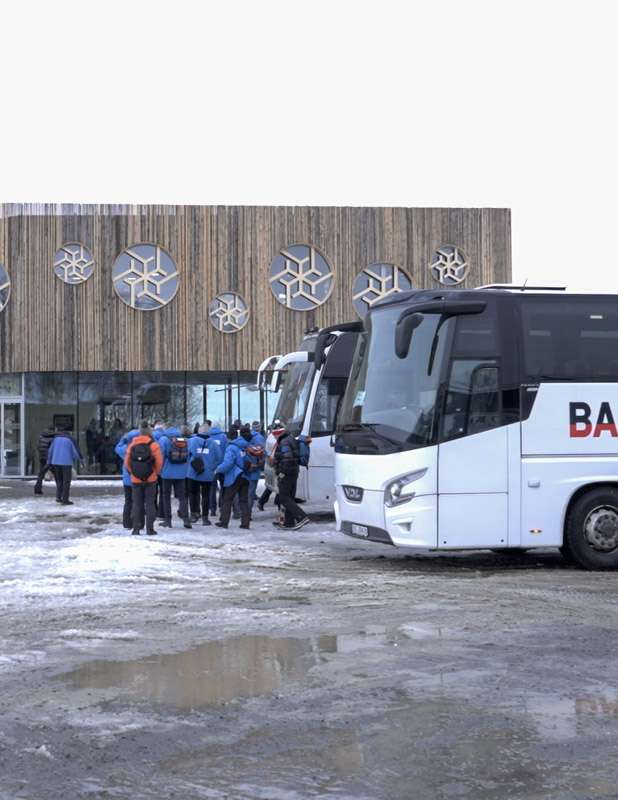
| Option | Price 2026 | Time and note |
|---|---|---|
| Walk from the quay into town | free | About 1.5 km, 20 minutes. Cleared in winter |
| Andersgrotta, WWII shelter | 100–200 NOK (€9–19) | About 30 min including the film. Daily tour at 12:30 in season; sources disagree on the price |
| Snow Resort park entry only | 300 NOK (€28) | Reindeer, dog yard and the Snowhotel 365. Park open 09:00–16:00 in winter. Transfer not included |
| Snowhotel visit with transfer | 1,185–1,250 NOK (€112–118) | 2 hours, departs 13:00 with hotel pick-up. Guide and entry included |
| Husky Safari, 10 km | 3,450 NOK adult, 1,725 NOK child 7–11 (€327 / €164) | 2 hours, departs 13:00. Transfer and Arctic clothing included. You ride as a passenger, two per sled |
| Snow Resort transfer from the Hurtigruten quay | free with a booking | Out at 09:00, back at 11:30, 1 Dec–30 Apr. 15–20 minutes each way |
| Ship’s excursion, dog yard and Snowhotel | roughly €80–120 in 2024 | What I paid, from memory rather than a receipt. Transfer, guide and both sites in one |
Read the table and the answer is unusually clear, which is not how these comparisons normally go. On this one the ship’s excursion was the cheaper option — somewhere around a hundred euros for the dog yard and the Snowhotel together, against 3,450 NOK for the husky safari alone if you book it locally today. Transfers are the reason: ten kilometres out of town turns every independent plan into a taxi fare or a booked shuttle, and the resort’s own prices already have that built in.
The honest middle way, if you want the place but not the price: book the park entry at 300 NOK and get yourself there. That buys the reindeer, the dog yard and a walk through the Snowhotel, and it is a tenth of the safari. It does not buy a sled ride.
Driving the sled yourself — and what has changed since 2024
I drove. Standing on the runners behind my own team, on a track through thin birch forest, with the guide’s sled ahead. That is the detail I would check before booking today, because the current Husky Safari at Snow Resort is explicitly a passenger product: ten kilometres, two hours, two guests per sled, an experienced musher steering, departures at 13:00 from December to April.

Those are two different afternoons. Riding is a sleigh ride with scenery; driving is work — brake, weight, reading the dogs — and the photographs are different too, because a driver has both hands busy and shoots almost nothing. If driving matters to you, ask the operator directly whether a self-drive option still exists before you pay.
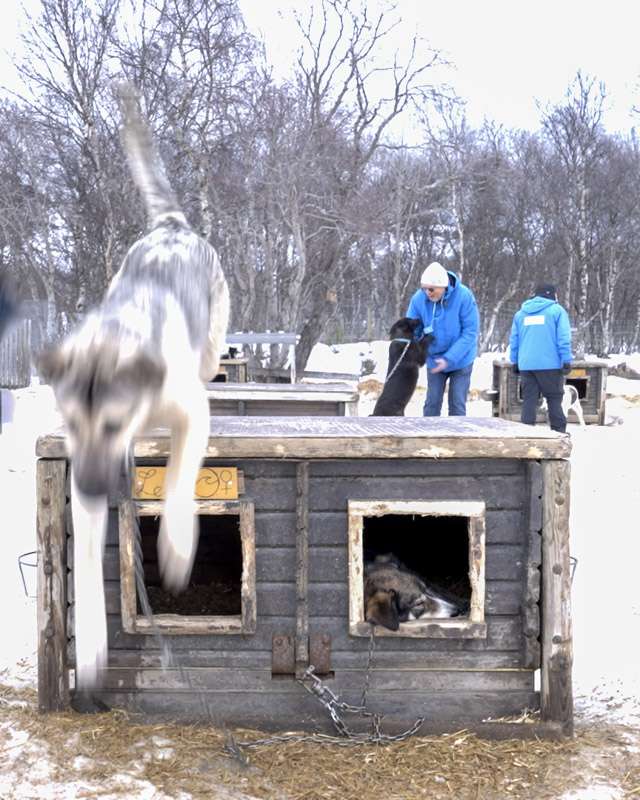
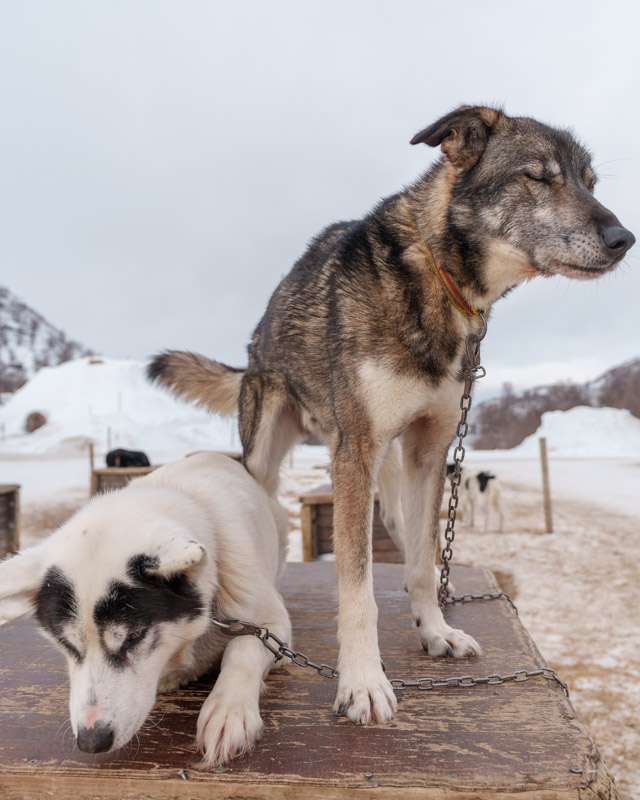
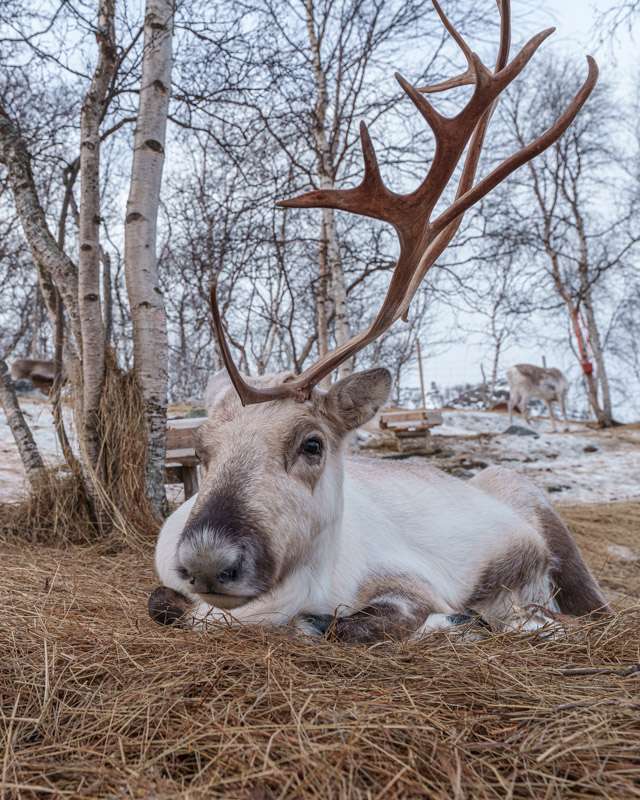
The yard itself is worth the time before the ride ever starts. The dogs here live outside year-round in wooden kennels, and what strikes you first is how little resemblance any of it bears to the brochure version: half of them asleep in their doorways, a few standing on their own roofs for the view, all of them loud the moment harnesses appear. There are reindeer in an adjoining enclosure, lying on straw under bare birches, entirely uninterested in visitors.
What the Snowhotel actually is
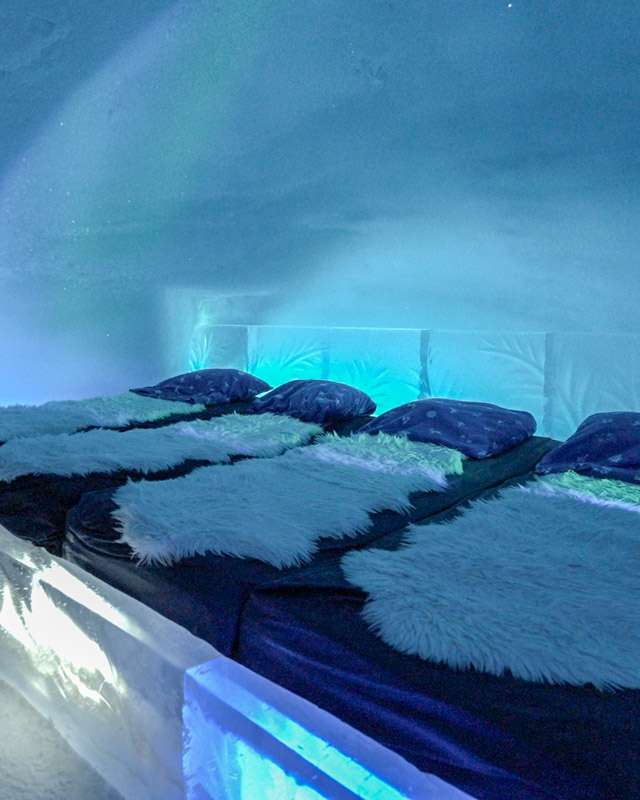
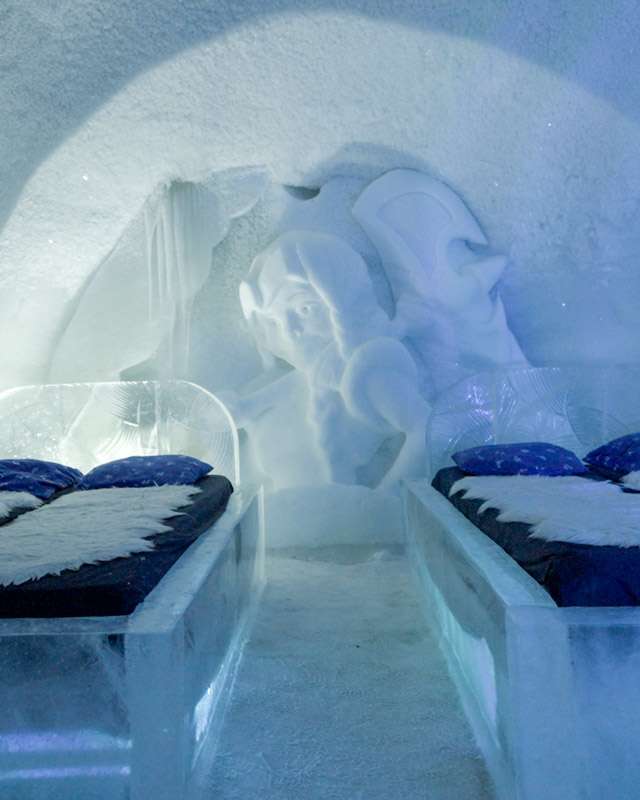
A building made of snow and ice that is rebuilt every year and now stays open the whole year — the operators call it Snowhotel 365, and the inside sits at about −4 °C regardless of what the Barents Sea is doing outside. You walk a corridor of packed snow between rooms; the beds are blocks of snow with hides and insulated sleeping bags on them; each room has a carved ice sculpture lit from behind in blue.
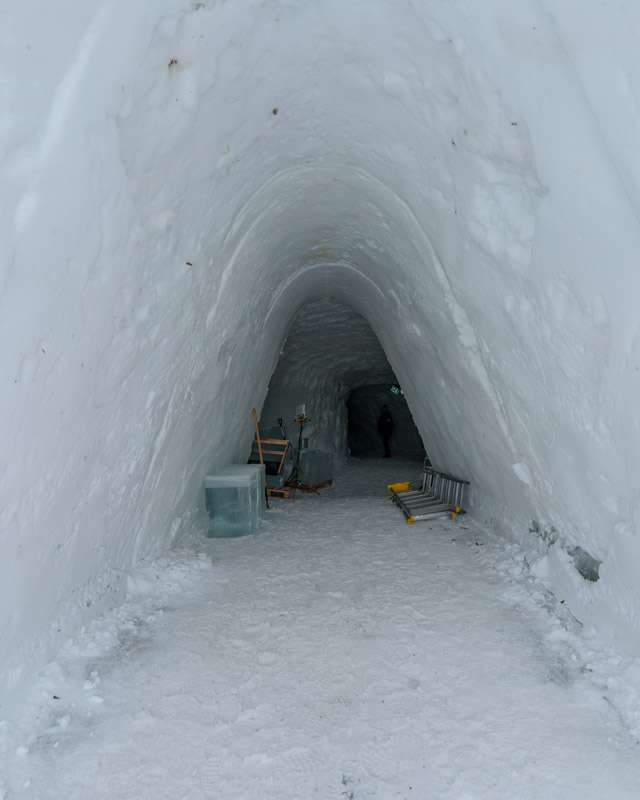
Twenty minutes is enough to see it, and that is not a criticism. It is a single idea executed very well, and the useful thing to know on a port day is that a walk-through is a short item, not an afternoon. If your call is a Hurtigruten three and a half hours, choose this or the town, not both.
How much daylight do you get in March?
Enough for a full day, and it changes fast. Kirkenes gains roughly eight and a half minutes of daylight every day through March: 9 hours 33 minutes on the 1st, 13 hours 52 minutes on the 31st. On 10 March that works out at close to eleven hours, with sunrise in the early morning and useful light until well after four.
The long-term averages for mid-March are around −4 °C by day and −9 °C at night, and the ground is packed snow everywhere outside the cleared pavements. Boots with a sole, not trainers. Spikes are not essential in town but will not be wasted on the track out at the dog yard.
Photo notes: Kirkenes in March light
The sun never gets high here in March, which means the golden hour is not an hour. The light comes in sideways for most of the day, and the problem is not that there is too little of it but that there is nothing to aim it at — the town is low, plain and mostly white. Three things worked for me.
Colour against snow. The same answer as Tromsø, for the same reason. The blue and yellow van, the hearts in the tree, the heap of fishing floats by the harbour: in a grey-white town these are the pictures. The float pile is the one I would go back for — a few hundred kilos of orange, blue and green plastic stacked against sheet metal, and nobody arranged it.
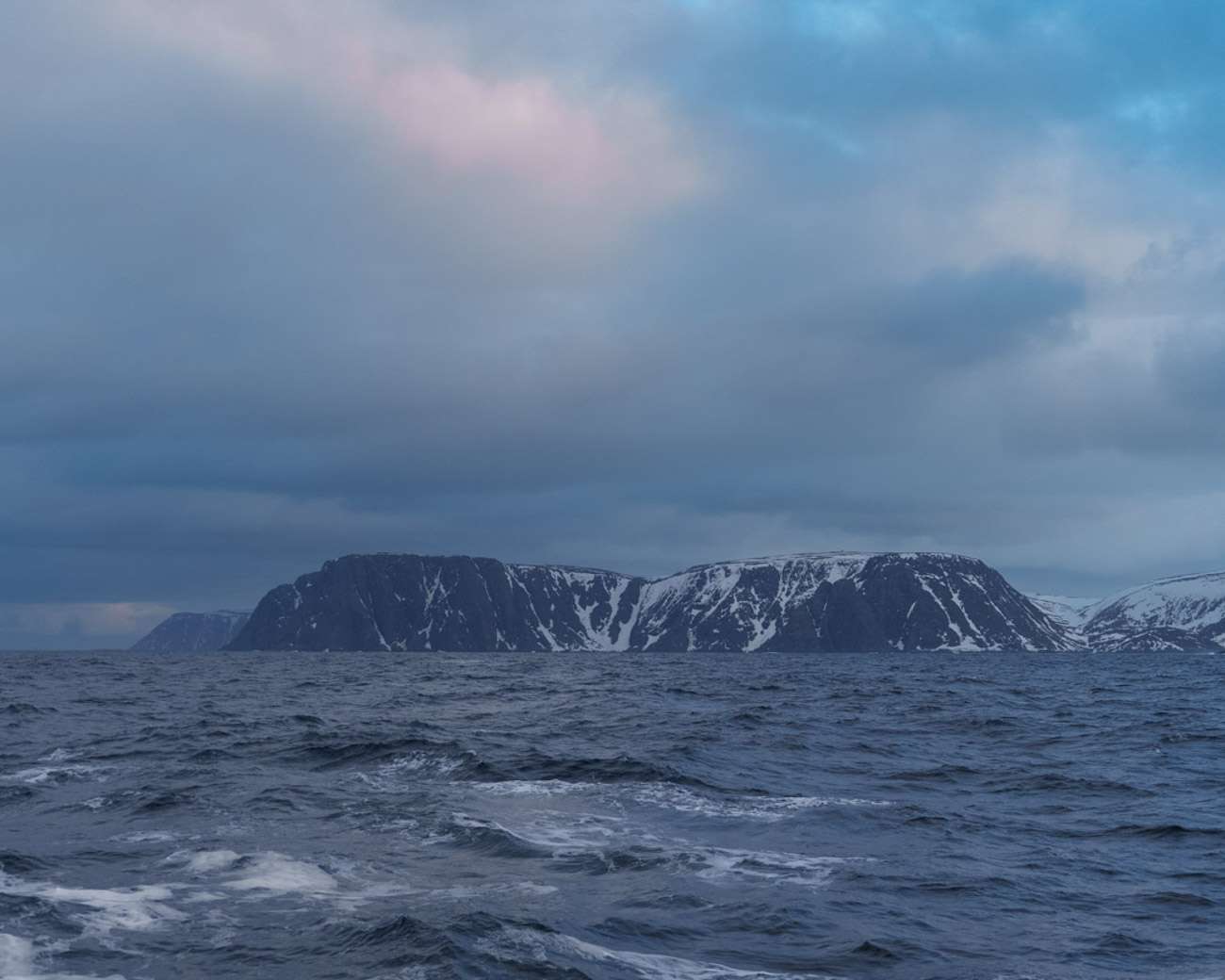
The approach. We came in before the light was properly up, and the coast on the way to Kirkenes gave more than the town did: dark water, snow-streaked cliffs and a band of cloud that held colour for twenty minutes. If your ship arrives early, be outside for it.


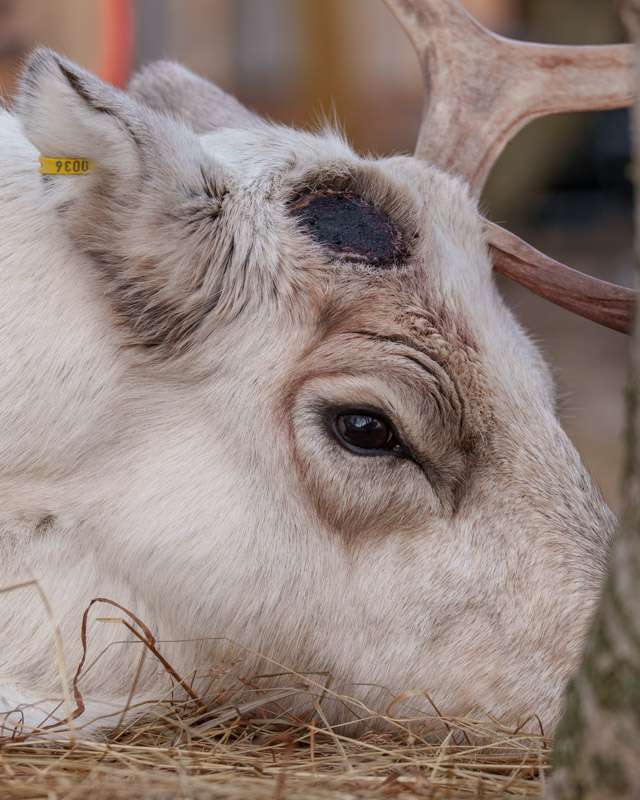
Close, not wide. At the dog yard the wide shot is a row of kennels in snow and says nothing. The picture is the dog asleep in its doorway, or a reindeer’s eye and antler at a metre. Same at the Snowhotel: the corridor reads as a tunnel, the ice sculpture reads as an object, and the wide room shot reads as a lit white blur.

What I would do differently next time
Walk in first and book the excursion for the afternoon. We did the yard and the Snowhotel as an organised block, and the town got what was left — which in March, with the light going at four, is not enough for a place whose whole subject is on the walls and in the streets.
And I would go underground. Andersgrotta was two hundred metres away and open, and I photographed the door instead of buying a ticket — the only part of the war in this town you can still stand inside. After that the Borderland Museum, 1.4 kilometres from the centre, which I also skipped: if the Soviet monument and the painted van are the question, that is where the answer is kept. I cannot tell you what is in either, because I went into neither.
Sources for the figures in this article: population, air raids and the liberation of 25 October 1944 from Wikipedia; thirteen buildings standing, the 3.5-hour call and the walk from the quay from Hurtigruten; the 1.5 km from quay to town from WhatsInPort; church dates from Kirkenes Church and the town’s own information board; Andersgrotta from The Hidden North, Dark Tourism and WhichMuseum; park entry, opening hours and the 10 km distance from the Visit Kirkenes winter guide 2025/26; Snowhotel visit and Husky Safari prices from Booking Kirkenes and Snow Resort Kirkenes; transfer times from Snowhotel Kirkenes; Storskog and the 16 km from Wikipedia, the closure dates from The Barents Observer; daylight and temperatures from Weather Spark. Converted at 10.55 NOK to the euro, 15 November 2026. Checked November 2026.
Frequently asked questions about Kirkenes on your own
How far is Kirkenes town from the cruise quay?
About 1.5 kilometres, roughly twenty minutes on foot. The road is flat and cleared in winter, there is no tender, and no shuttle is needed for the town.
Can you visit the Russian border from Kirkenes?
You can look at it. Storskog lies 16 km east and is the only legal land crossing between Norway and Russia, but it has been closed to ordinary Russian travellers since 29 May 2024. Getting there means a taxi or a booked tour, not a walk.
How far is the Snowhotel from Kirkenes?
About 10 km, at Sandnesdalen 14 in Bjørnevatn — a 15 to 20 minute drive. Not walkable from the ship. Snow Resort runs a transfer from the Hurtigruten quay at 09:00, back at 11:30, free with a booking.
What does the Snowhotel cost without a ship’s excursion?
Park entry alone is 300 NOK (about €28) and covers the reindeer, the dog yard and a walk through the Snowhotel, with no transfer. A guided visit with hotel pick-up is 1,185–1,250 NOK (€112–118) for two hours.
How much does dog sledding cost in Kirkenes?
The Husky Safari at Snow Resort is 3,450 NOK per adult and 1,725 NOK for children aged 7 to 11 — about €327 and €164. Two hours, ten kilometres, transfer and Arctic clothing included. You ride as a passenger; an experienced musher drives.
Is the ship’s excursion worth it in Kirkenes?
For the dog yard and the Snowhotel, usually yes — which is rare. Both lie ten kilometres out, and local prices for the same two items are higher than the combined ship’s tour. For the town itself the excursion adds nothing: walk.
Is Andersgrotta open to visitors?
Yes, with a daily tour at 12:30 in season, managed by Snow Resort Kirkenes. About half an hour including a fifteen-minute film in Norwegian, English or German, at around 0 to 5 °C inside. I photographed the door and did not go in, so this answer is from the sources listed above, not from the day.
How much daylight does Kirkenes have in March?
Close to eleven hours on 10 March. The town gains about eight and a half minutes a day, from 9 h 33 min on 1 March to 13 h 52 min on 31 March.
Written by Jan Madeus — ship’s videographer at sea since 2008. I go ashore in the same ports as the passengers, with the same few hours and the same deadline. More about me.
Related: Tromsø Cruise Port in Winter — the same voyage, two days later · Honningsvåg and the North Cape · Oulu on your own in winter · Cruise Ports on Your Own — all port guides · Auf Deutsch lesen: Kirkenes auf eigene Faust
Ports on this route — the Norwegian coast: Stavanger and the Lysefjord · Flåm and the Stegastein viewpoint · Tromsø on your own · Tromsø in winter · Honningsvåg and the North Cape · Longyearbyen on your own · Svolvær on your own · All cruise ports on your own