
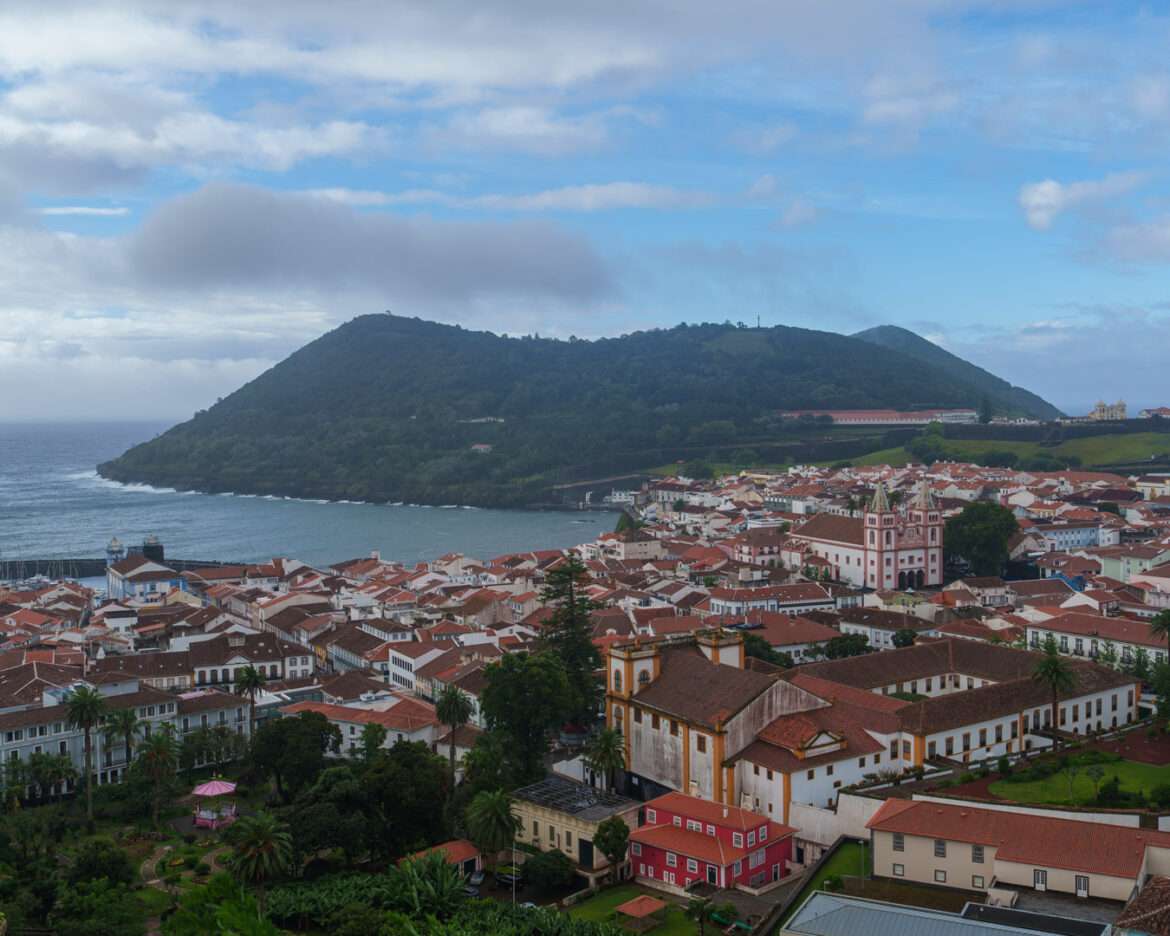
Visited: September 2026, on a call of MS Amadea. The photographs are my own, taken that morning in the rain.
Cruise ships tie up at the commercial port of Praia da Vitória — about 3 km from that town and roughly 20 km from Angra do Heroísmo, the UNESCO old town almost everyone has come for. Angra is not within walking distance. It is the island bus (about 45 minutes), a taxi (20 to 25 minutes) or the ship’s coach. Two unhurried hours are enough to walk the old town.
Where does the ship dock in Praia da Vitória?
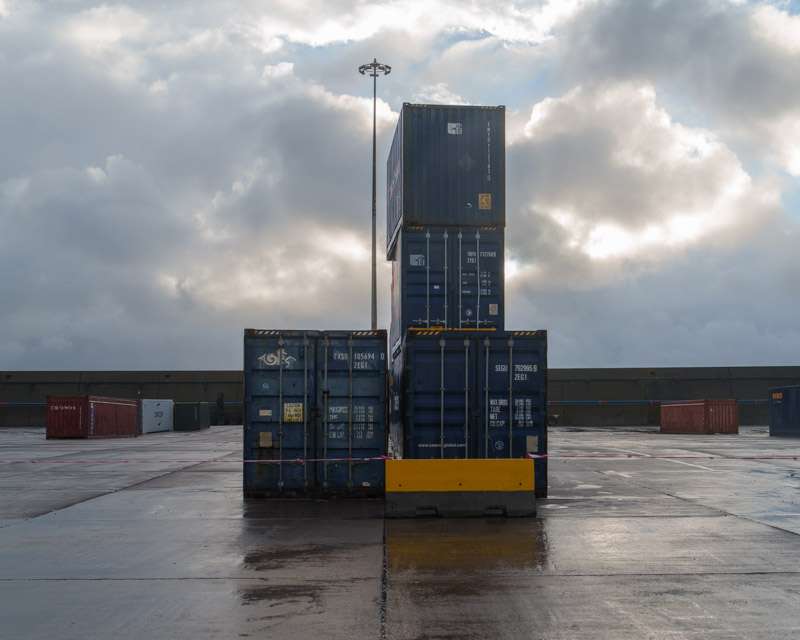
At the Porto Comercial da Praia da Vitória, at the southern end of the bay. The berthing line takes ships of up to about 300 metres alongside in 10 to 12 metres of water; anything longer anchors off and tenders passengers in. On the quay there are containers, a coach park, taxis, a tourist office and toilets — nothing to look at, and nothing to do while you wait.
The town of Praia da Vitória is 3 km away, roughly half an hour on foot along a busy road with little to see. Most lines run a shuttle into the centre for a fee that is announced on board. The town has a long sandy beach, a marina and a handsome parish church, and it is worth an hour if your call is long. It is not the reason the ship came here.
How do you get from Praia da Vitória to Angra do Heroísmo?
Island bus. Line CA2 runs to Angra in about 45 minutes, roughly hourly on weekdays and thinner at weekends. The catch is the first kilometre: the nearest stop is about 1.3 km from the port gate, so add 15 to 20 minutes on foot at each end. The fare is a few euros, paid on the bus.
Taxi. Twenty to twenty-five minutes for the 20 km. Drivers quote in the region of 30 to 40 euros one way. Agree the fare — and the pick-up time, if you want collecting — before you get in. Split between three or four people, this is the sensible choice on a short call.
Ship’s coach. What I was on. Per head it costs more than a taxi, and it buys one thing that has value on this island: somebody else watching the clock.
Whatever you take, plan to be back at the pier 45 to 60 minutes before all-aboard. The road between the two towns is ordinary two-lane road, and a tractor in front of you is a real delay.
What to see in Angra do Heroísmo in two hours
The old town is small and steep. The round below is about an hour of walking and another hour of standing still, all of it on cobbles — wear shoes you can grip in.
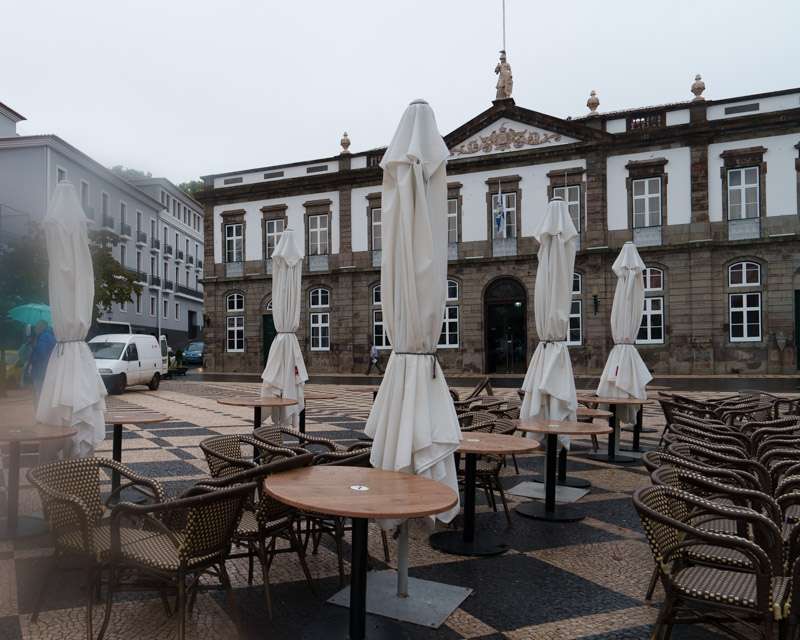
Praça Velha. The main square, with the town hall across the head of it and the black-and-white pavement that Portugal lays everywhere. Cafés on two sides. This is the natural start and the natural place to lose twenty minutes at the end.
Palácio Bettencourt. A nobleman’s house from the end of the seventeenth and the beginning of the eighteenth century — basalt framing the windows and the portal, the family arms over the door. It now holds the public library and the district archive, and you can walk in.
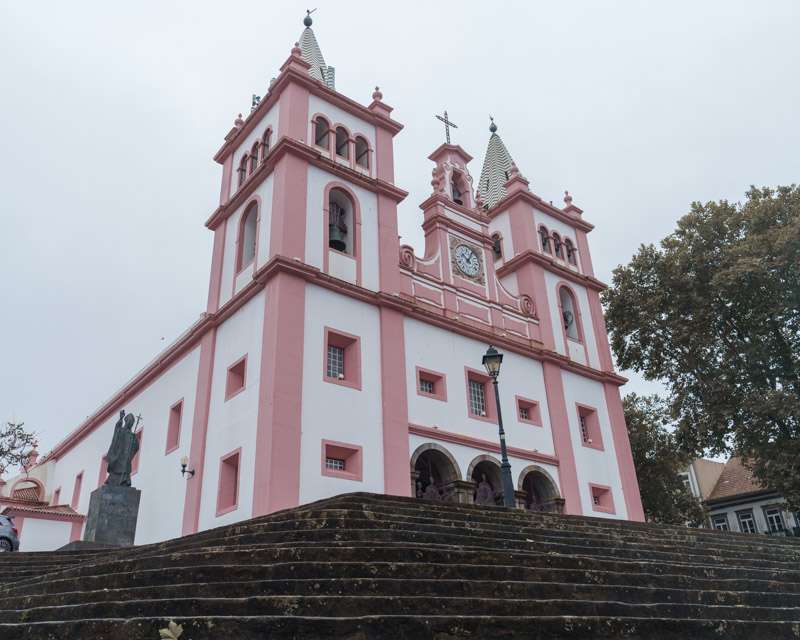
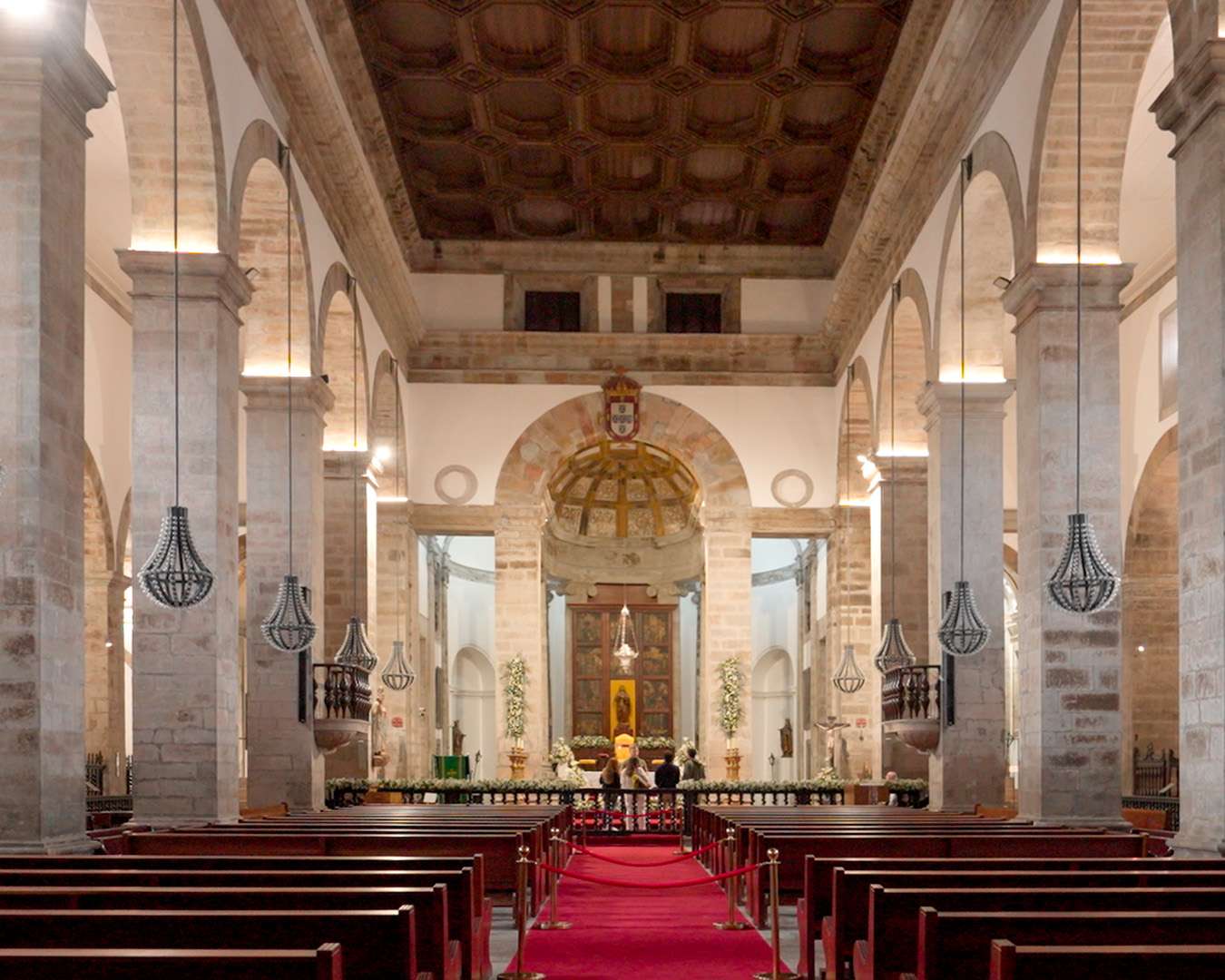
The cathedral. Sé do Santíssimo Salvador, begun in January 1568, foundation stone laid two years later, the outside finished around 1618. Two bell towers, thirty-two bells. The interior is pale stone under a coffered ceiling and startlingly bare. There is a reason for that, and it is the next section.
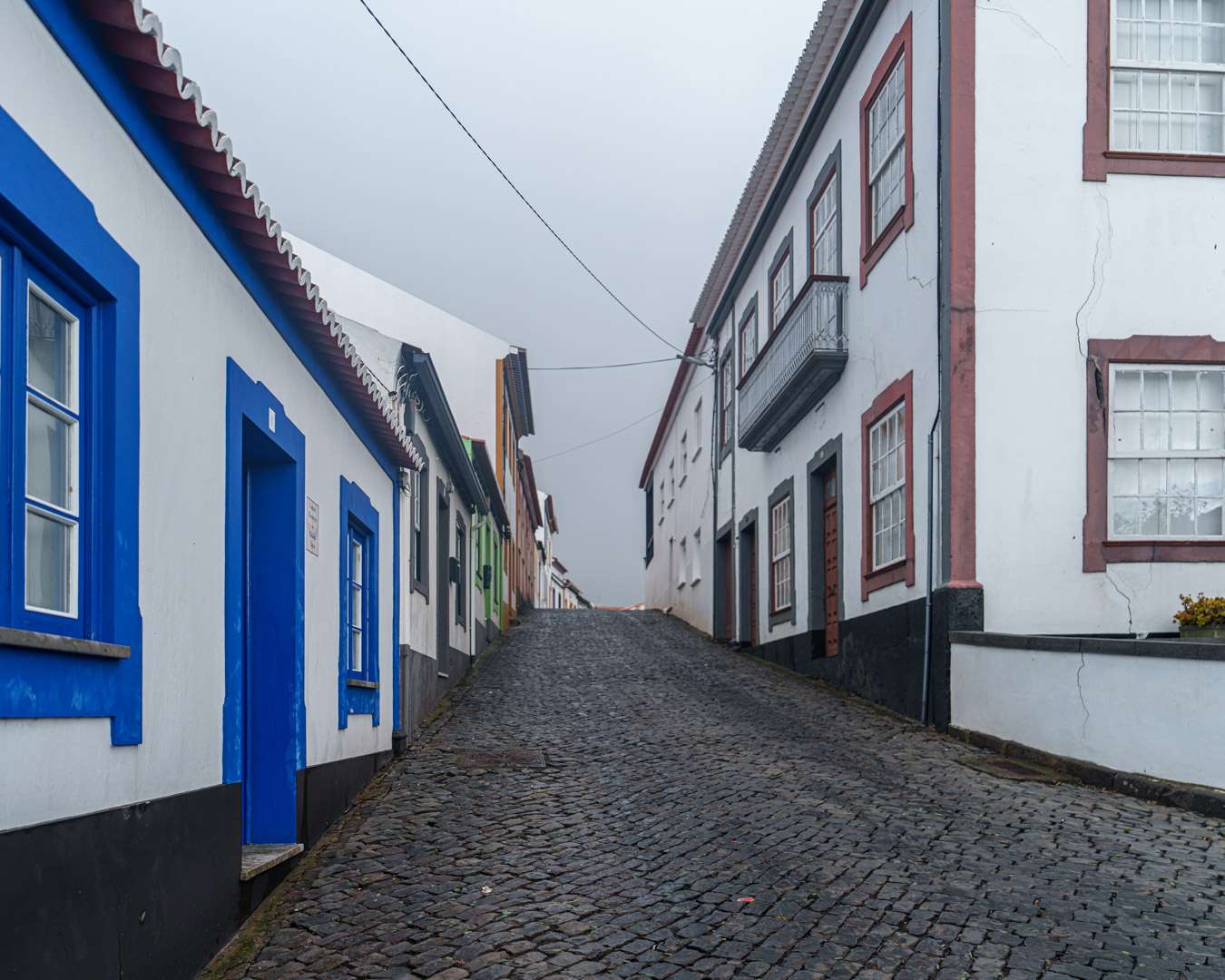
The lanes above the cathedral. Two streets up from the main axis the town goes quiet: single-storey houses, blue and red window frames on whitewash, a cobbled lane running uphill to nothing in particular. This is the part of Angra that most tour groups walk past.
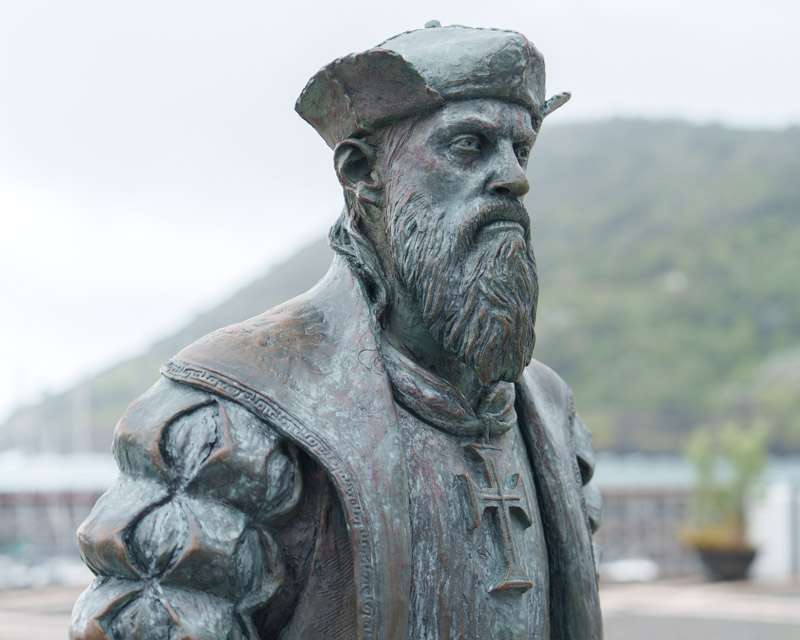
The waterfront. Down at the marina a bronze Vasco da Gama looks out at the bay. He put in here on the way home from India in 1499 and buried his brother Paulo in the town. Behind him, Monte Brasil closes the bay.
Why the oldest city in the Azores looks newly built
On 1 January 1980, at 15:42, the ground moved. Magnitude 6.9, the epicentre in the sea about 50 km west of the city. More than sixty people died and over fifteen thousand houses were damaged or destroyed.
Three years later UNESCO put the central zone of Angra on the World Heritage list. Not in spite of the rebuilding, but because of the way it was done: the same stone, the same techniques, the same plan.
The cathedral was unlucky twice more. In September 1983 one of the bell towers came down during the restoration. In November 1985 a fire took the gilded altarwork, the organs and the painted ceiling. Most of what you see in Angra has not survived; it has been built again, out of the same basalt, in the same shape. Knowing that changes how the town reads.
The bay that made the city
Angra means bay. It is deep, and the hill to the west keeps most winds off it. That was enough. Ships sailing home to Europe from India or the West Indies in the sixteenth century had to pass this way, and they stopped here for water, repairs and shelter. In 1534 Angra became the first city of the archipelago.
The hill that shelters the bay is itself a volcano — Monte Brasil, a tuff cone 205 metres high that came up out of the sea. On top of it stands the fortress of São João Baptista, begun in 1593 under Philip II of Spain to a design by the Sienese engineer Tibúrcio Spannocchi. It is still a military site, and the grounds and footpaths on Monte Brasil are open by day.
Inland, the island is the floor of a caldera: Cinco Picos, 7 by 9 kilometres, the largest in the Azores. Seen from the rim at Serra do Cume — 545 metres, the classic viewpoint, and not on our route this time — the pastures look stitched together. The pattern is not a design. It is what is left when people carry stones out of a field for generations and stack them at the edge.
And the title. On 11 August 1829 a Miguelite fleet tried to land troops in the bay at Praia, on the other side of the island, and was driven off. That day renamed the town: Praia da Vitória. Angra’s own honorific, do Heroísmo, came out of the same war. The grand title belongs to the city behind the hill. The day that earned it belongs to the bay where your ship is tied up.
What a day ashore costs
| Item | September 2026 | Note |
|---|---|---|
| Ship’s shuttle, pier to Praia da Vitória | chargeable, price given on board | 3 km; walkable in 30 min along a busy road |
| Island bus to Angra (CA2) | a few euros, paid on the bus | about 45 min; nearest stop ~1.3 km from the port gate |
| Taxi to Angra | around €30–40 one way | 20–25 min; agree the fare before departure |
| Sé do Santíssimo Salvador | no admission charge | closed during services |
| Monte Brasil and the fortress grounds | free | military site; daylight hours |
Prices I could not confirm from two sources are left out rather than guessed.
Ship’s tour or on your own?
On a full-day call with two or more of you, a taxi to Angra and back is cheaper than the excursion and leaves you free to stand still in front of a building for as long as you want. The bus is cheaper again, but the 1.3 km walk to the stop and an hourly timetable make it a poor fit for a short call — miss one and you have lost an hour you did not have.
The ship’s coach is worth its price in one case: a call of six hours or less, in weather like ours, when the value of the day is not saving money but not missing the town altogether.
Photographs: where to stand, and what the light does
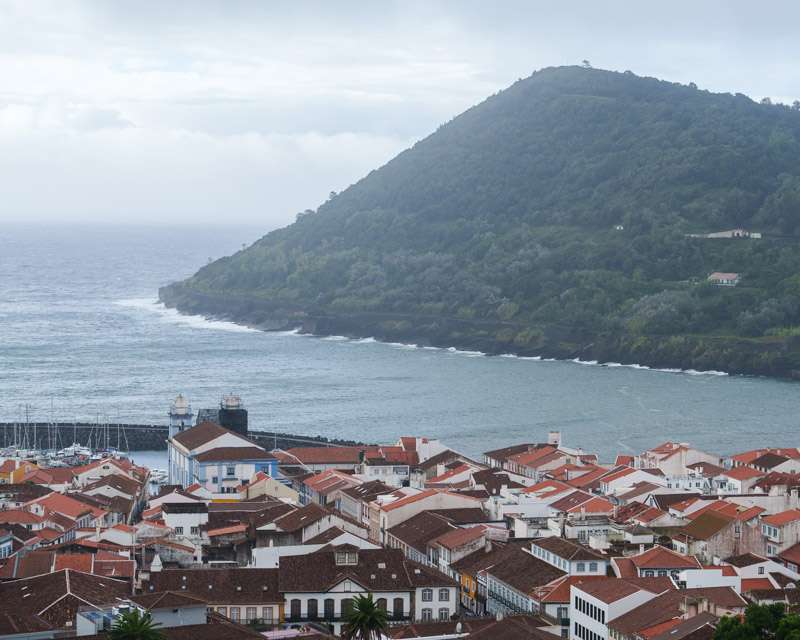
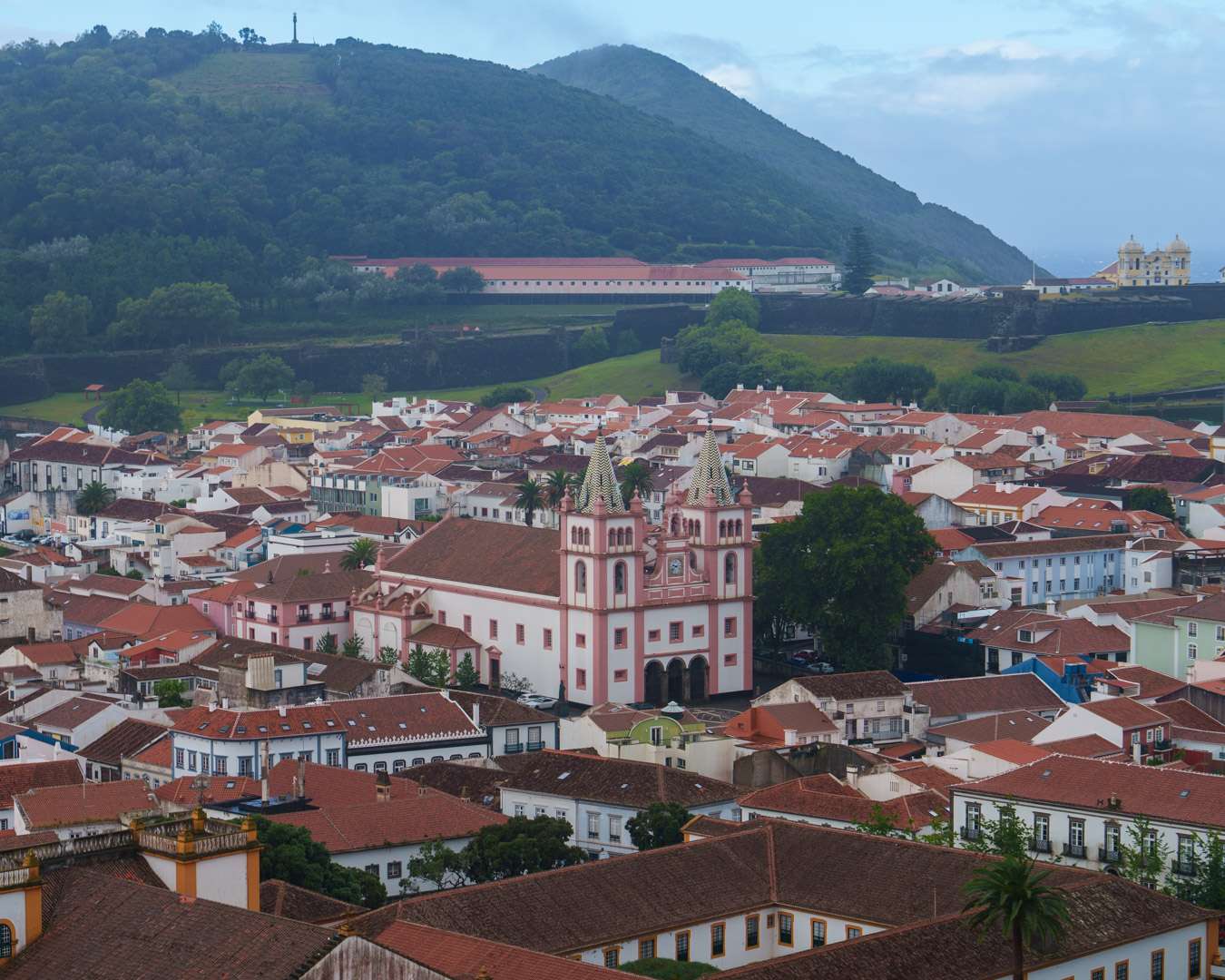
The picture this town owes you is the one from above: red roofs falling away to the water, the breakwater, and Monte Brasil closing the bay. Any of the high streets on the eastern side of the old town gives you a version of it. Go up first, while your legs are fresh, and come back down through the lanes.
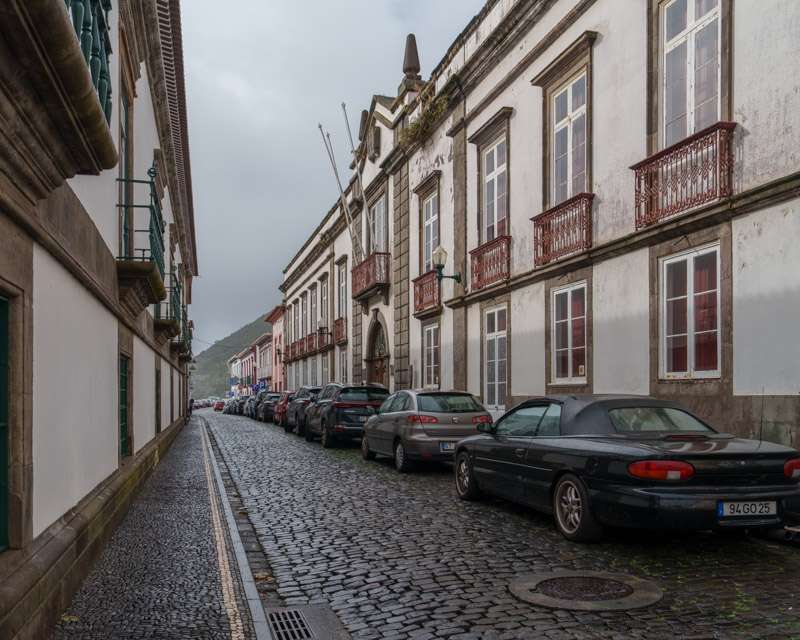
The second picture is the lanes themselves, and rain helps: wet basalt goes almost black and the blue and red frames lift off the whitewash. Angra in the wet is a better subject than Angra in the sun.
The third is inside the cathedral. Bare stone, a coffered ceiling, very little gold — after 1985 there is not much left to distract, and the room holds together.
What did not work was the light outside. Flat and hazy all morning, no direction, a white sky in every frame with a roofline in it. The panoramas are the weakest pictures of the day for exactly that reason, and no amount of processing invents contrast that was not there.
What I would do differently
Two hours in Angra is the minimum, not the plan. Next time I would take a taxi straight from the pier, start at the top of the town instead of the square, and keep the last half hour for Monte Brasil, which we never reached. And if the forecast is grey again, I would spend more of the time in the lanes and less on the viewpoints — this town rewards the close look more than the wide one.
Related: Terceira: Angra, Biscoitos and Serra do Cume · São Miguel from Ponta Delgada · All cruise ports on your own · All Azores stories